Is Your Septic Tank Trying to Tell You Something?
The signs you are overdue for septic pumping are often hiding in plain sight — slow drains, strange gurgling sounds, wet patches in your yard, or a smell you can't quite place. About 1 in 5 American homes, roughly 21 million households, rely on a private septic system to manage wastewater. Yet most homeowners don't think about what's happening underground until something goes wrong.
Here's a quick look at the most common warning signs:
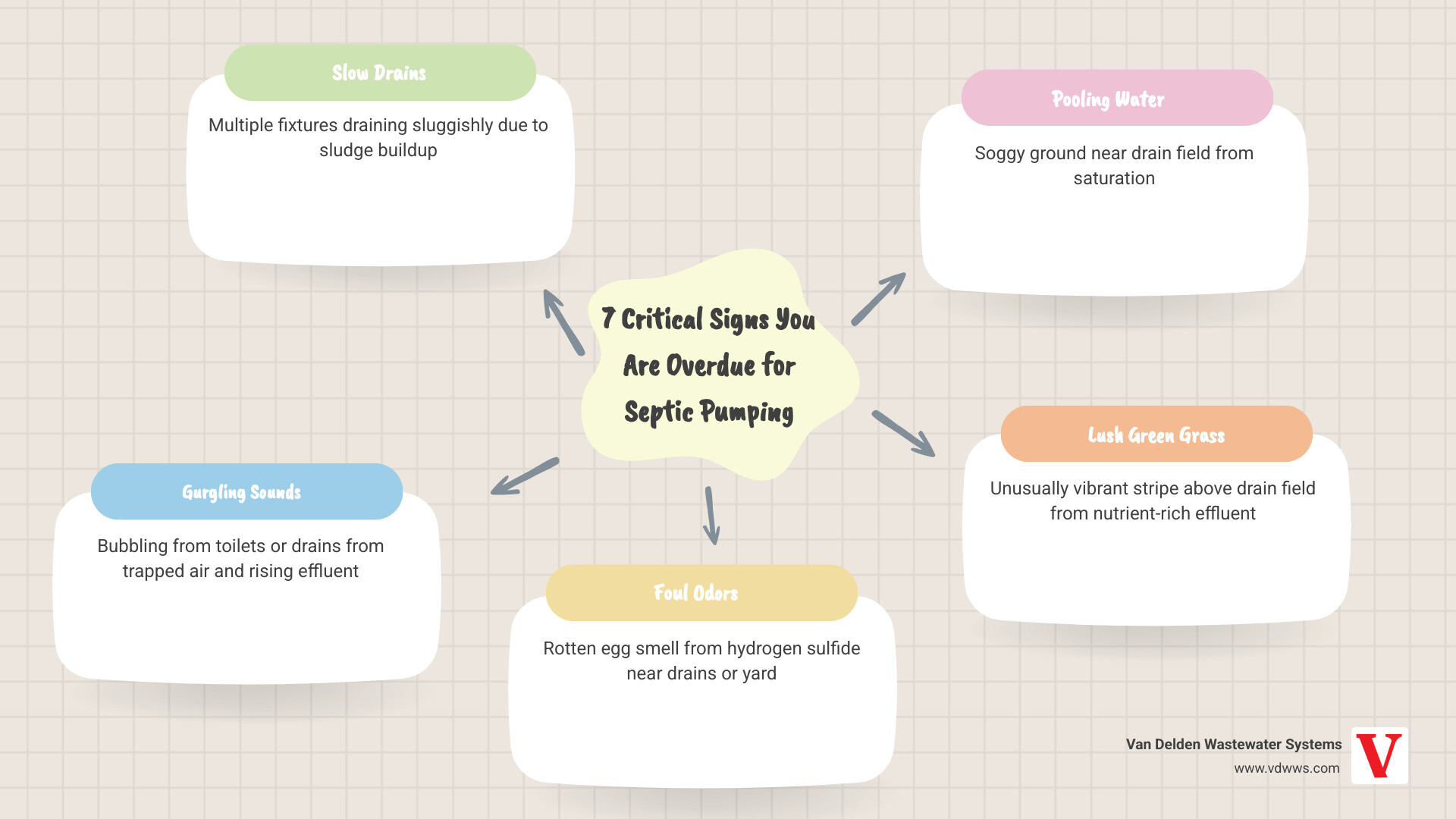
- Slow drains throughout the house — not just one sink or tub, but multiple fixtures draining sluggishly
- Gurgling or bubbling sounds from toilets or drains after flushing
- Foul odors — a rotten egg or sewage smell near drains, in the yard, or around the tank area
- Pooling water or soggy ground near the drain field, even when it hasn't rained
- Unusually lush, green grass growing in a stripe above the drain field
- Sewage backing up into toilets, bathtubs, or floor drains
- It's been 3–5 years since your last pump-out (or you simply don't remember)
A septic tank works by separating wastewater into three layers: solid sludge settles at the bottom, a layer of liquid effluent sits in the middle, and a lighter scum layer floats on top. Over time, the sludge and scum layers build up. When they take up too much space, the system can't do its job — and the warning signs above start to appear.
The good news is that catching these signs early means the fix is usually straightforward. Ignoring them is where things get expensive.
7 Critical Signs You Are Overdue for Septic Pumping
Living in areas like Boerne, Spring Branch, or San Antonio means enjoying a bit more space, but it also means taking responsibility for your own wastewater. When your system is healthy, it’s invisible. When it’s full, it becomes very loud — sometimes literally.
Understanding the One Sign It's Time to Pump Your Septic System is helpful, but usually, your home will give you several hints at once. As the sludge layer at the bottom of your tank grows, the "settling zone" for liquid wastewater shrinks. This causes effluent levels to rise higher than they should, eventually pushing solids out into your drain field or backing them up into your home’s pipes.
If you haven't seen a technician in a few years, keep a sharp eye out for these Septic Tank Warning Signs.

Sewage Backups and Slow Drains
There is perhaps no clearer (or more unpleasant) message from your septic system than a sewage backup. When the tank is at capacity, wastewater has nowhere to go but back from whence it came. This typically starts at the lowest point in your home — think basement floor drains or first-floor bathtubs.
However, before a total backup occurs, you’ll likely notice systemic slow drains. If just your kitchen sink is slow, you probably have a localized clog. But if the kitchen, the guest bath, and the master shower are all taking their sweet time to empty, that’s a sign of a full tank. Your pipes are essentially "holding their breath" because the tank is too full to accept more volume. This is one of the Top 3 Signs You Should Clean Your Septic Tank Right Now to avoid a messy cleanup in your living room.
Lush Grass and Pooling Water: Signs You Are Overdue for Septic Pumping
We all want a beautiful lawn, but if one specific patch of grass over your drain field looks like a tropical rainforest while the rest of your Shavano Park yard looks like typical Texas scrub, you have a problem.
When a septic tank is overdue for pumping, the excess liquid (effluent) can’t be processed quickly enough. It starts to rise toward the surface. This liquid is nutrient-rich, full of nitrogen and phosphorus from your household waste. It acts as a powerful fertilizer, creating those suspiciously lush, green stripes.
If the situation worsens, you’ll see pooling water or "spongy" soil. If it hasn't rained in a week but you’re stepping into a puddle near your tank, the system is failing to disperse water into the soil. These are undeniable Signs Your Septic Tank Should Be Pumped before the drain field becomes permanently damaged.
Foul Odors and Gurgling Pipes: Signs You Are Overdue for Septic Pumping
Your septic system is designed to keep gases trapped and vented safely. However, as the tank fills with sludge, those gases — specifically methane and hydrogen sulfide (which smells like rotten eggs) — can get pushed back through the plumbing. You might smell this in your yard or, more alarmingly, inside your house near the drains.
Then there is "the gurgle." If you flush the toilet and hear a glug-glug-glug sound coming from the shower drain, or if the toilet itself bubbles after you run the washing machine, it’s a sign of trapped air. This air is being displaced because the tank is too full of solids to allow for smooth water flow. If you’re asking yourself, "How Can I Tell if My Septic Tank is Full," the gurgle is your answer. It’s often the final warning before a complete backup occurs, typically giving you a 4-to-8-week window to act.
Understanding Your Septic Pumping Schedule
Waiting for signs to appear is a risky game. In a perfect world, you should pump your tank on a schedule that prevents those signs from ever showing up. The EPA generally recommends a 3-to-5-year interval, but that is a broad average.
The "right" time depends on your specific household. For example, a 1,000-gallon tank serving a family of four in Timberwood Park will likely need service every 2.5 to 3 years. A single person living in a house with the same size tank might make it five years easily.
| Tank Size (Gallons) | 1 Person | 2 People | 4 People | 6 People |
|---|
| 750 | 9 years | 4 years | 2 years | 1 year |
| 1,000 | 12 years | 6 years | 3 years | 1.5 years |
| 1,250 | 15 years | 7.5 years | 3.5 years | 2 years |
| 1,500 | 19 years | 9 years | 4 years | 2.5 years |
Note: These are estimates. Heavy water usage or garbage disposals can significantly shorten these windows.
If you are unsure of your last service date, it is always better to err on the side of caution. You can find more details on How Often Should My Septic Tank Be Cleaned to help plan your maintenance. We often hear this FAQ Answered: When Should I Pump My Septic Tank, and the answer is usually: "Before you smell it!"
Factors That Accelerate Your Pumping Needs
Not all households produce waste at the same rate. Several factors can put your system on the "fast track" for a pump-out:
- Garbage Disposals: These are septic system enemies. They introduce undigested food solids that don't break down as easily as biological waste, which can increase the sludge layer by up to 50%.
- High Water Usage: Doing 10 loads of laundry in a single Saturday (what we call "Laundry Day Stress") can flush the tank too quickly, not giving solids time to settle.
- Household Size: More people means more showers, more flushes, and more dishwashing.
- Chemicals and Antibacterial Soaps: These can kill the "good" bacteria in your tank that help break down solids, leading to faster sludge accumulation.
Finding the Right Time to Pump Your Septic Tank means looking at your lifestyle and adjusting accordingly.
The Risks of Neglecting Routine Maintenance
It can be tempting to ignore a gurgling pipe if the toilet is still flushing, but the "wait and see" approach is the most expensive strategy a homeowner can take. When a tank is overdue for pumping, the solids eventually have nowhere to go but out of the tank and into the drain field.
This leads to a phenomenon called "biomat thickening." The drain field relies on a thin layer of bacteria (biomat) to treat wastewater. But when raw solids enter the field, the biomat grows too thick, essentially "waterproofing" the soil. Once the soil can no longer absorb liquid, your drain field is effectively dead.
Replacing a drain field can cost tens of thousands of dollars, whereas a routine pump-out is a fraction of that. If you’re wondering What Happens if I Don't Pump My Septic Tank, the answer is a combination of property damage, health hazards from raw sewage, and a massive hit to your home’s value. Furthermore, a failing system can lead to groundwater contamination, which is a major concern for our neighbors in the Texas Hill Country who rely on well water. This is a primary reason Why Should I Pump My Septic Tank regularly — it protects your family and your environment.
Differentiating Between Clogs and Septic Failure
How do you know if you need a plunger or a pumper?
- The Plunger Fix: If only one toilet is backing up and the rest of the house is fine, you likely have a local clog (too much toilet paper, a child's toy, etc.).
- The Pumper Fix: If multiple fixtures are slow, or if using the washing machine causes the shower to back up, the issue is systemic.
It’s also important to understand Septic Tank Pumping vs Cleaning: What's the Difference. Pumping removes the liquid and the floating solids, but "cleaning" involves removing the heavy sludge at the bottom and scrubbing the tank walls. Both are essential for long-term health, but a simple pump-out is often the first step in diagnosing a larger issue.
Frequently Asked Questions About Septic Pumping
As we approach April 2026, we’re seeing more homeowners in areas like Hollywood Park and Fair Oaks Ranch take a proactive interest in their home systems. Here are the most common questions we hear during our inspections.
Can I tell if my septic tank is full without opening it?
While you can't see the sludge levels through the soil, your home provides the clues. As mentioned, slow drains, gurgling sounds, and surfacing sewage are the "check engine" lights of your septic system. However, the only 100% accurate way to check is to have a professional use a "sludge judge" — a clear pipe that takes a vertical sample of the tank's layers. If you’re seeing the physical signs, it’s already past time. Knowing When is It Time for Septic Tank Pumping usually involves a mix of tracking the calendar and listening to your pipes.
Is a gurgling toilet always a septic issue?
Not always, but it usually points to a venting problem. If air can't escape through the roof vents, it will burp back through the toilet. However, in a septic-connected home, that "venting" issue is frequently caused by a high water level in the tank blocking the inlet pipe. If the gurgling persists for more than a day, call a professional.
How do I protect my drain field from failure?
The drain field is the most delicate part of your system. To protect it:
- Practice water efficiency: Spread out laundry loads and fix leaky faucets.
- Keep it clear: Never park cars, build sheds, or plant trees over the drain field. Heavy weight compacts the soil, and roots can crush pipes.
- Routine pumping: This is the #1 way to keep solids out of the field.
Conclusion
Your septic system is one of the most important components of your home, and it deserves a little TLC every few years. Recognizing the signs you are overdue for septic pumping — like that telltale gurgle or the unusually green grass in your yard — can save you from the headache of an emergency backup and the massive expense of a drain field replacement.
At Van Delden Wastewater Systems, we’ve been helping our neighbors in San Antonio, Boerne, Bulverde, and the surrounding areas since 1937. We are a family-owned business that believes in honesty and education. Our technicians are non-commissioned, meaning they aren't there to sell you things you don't need; they are there to ensure your system is working perfectly. We provide detailed service forms and photo documentation so you know exactly what’s happening underground.
Don't wait for a disaster to strike. Schedule your professional septic tank service today and enjoy the peace of mind that comes with a healthy, well-maintained system.