When a Drip Irrigation System Is Better Than a Drainfield: A Homeowner's Guide
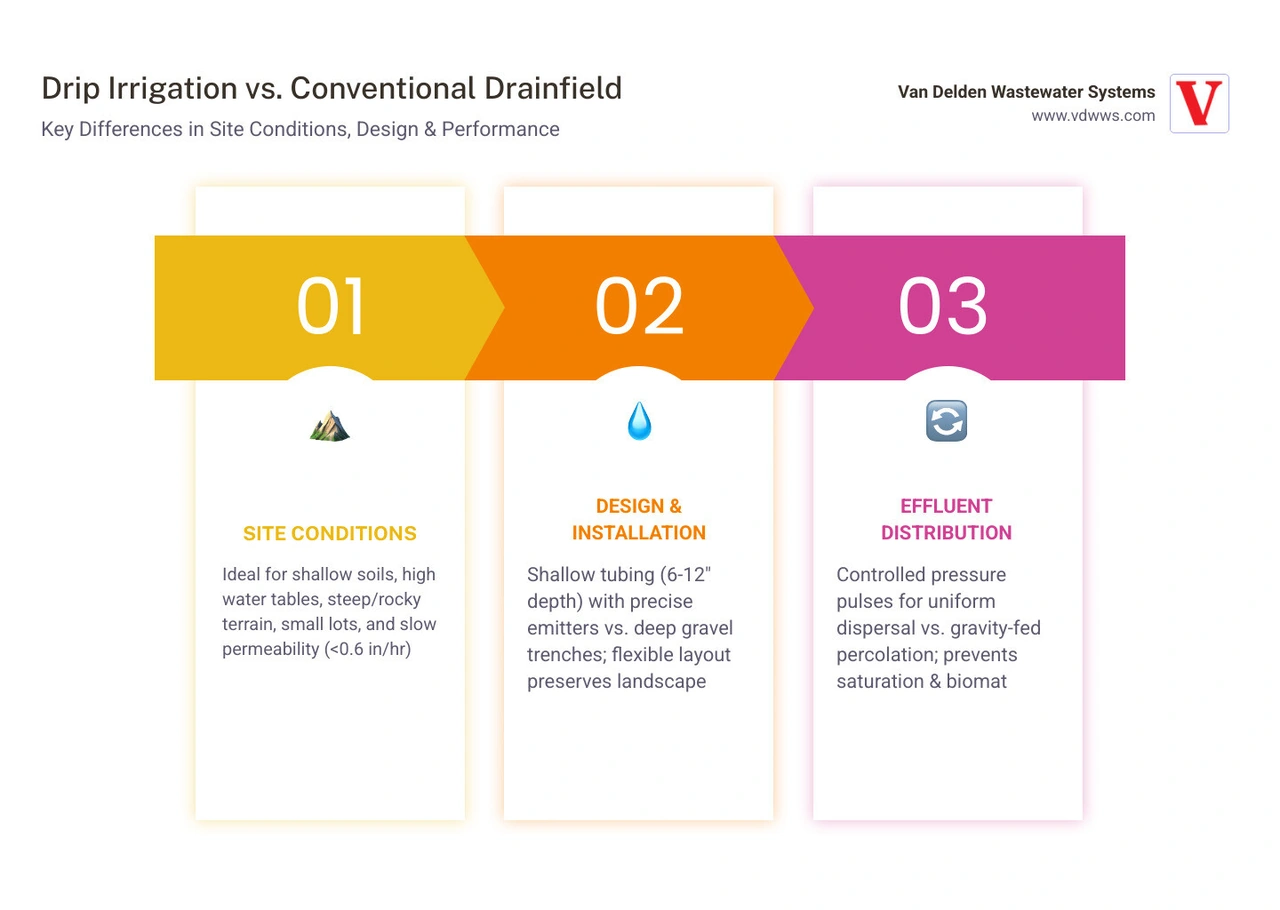
When a drip irrigation system is better than a drainfield is a question that comes up the moment a conventional system simply won't work on your property — and the answer matters more than most homeowners realize. If your lot is small, your soil is clay-heavy, your water table sits high, or your bedrock is close to the surface, a traditional drainfield may not be an option at all. A drip irrigation septic system distributes treated effluent through shallow subsurface tubing — just 6 to 12 inches below the surface — instead of relying on deep trenches and large absorption fields. That difference opens the door for properties that would otherwise have no viable path to on-site wastewater treatment.
A drip system is typically the better choice when:
- Your soil's limiting zone (the point where soil becomes restrictive) sits within 20 to 26 inches of the surface
- Your lot lacks the space required for conventional drainfield setbacks
- Your property has a seasonal or perched high water table within 12 to 24 inches of the surface
- Your terrain is steep, rocky, or irregular
- Your soil has slow permeability (less than 0.6 inches per hour) that prevents adequate drainage
- You are in an environmentally sensitive area requiring higher effluent quality standards
- Your original drainfield has failed and no replacement area remains on your property
Not every property needs a drip system — and not every property can use a conventional drainfield. The right answer depends on your specific site conditions, local regulations, and long-term maintenance expectations. This guide walks through exactly when one method outperforms the other, so you can make a confident, informed decision.
Understanding the Mechanics: Drip Irrigation vs. Traditional Drainfields
To understand why one might be superior to the other, we first have to look at how they move water. A traditional drainfield is a gravity-fed or low-pressure system that uses perforated pipes laid in deep trenches filled with gravel or stone. The wastewater (effluent) leaves the septic tank and flows into these trenches, where it eventually seeps into the soil. It relies heavily on the soil’s ability to "percolate" or soak up large amounts of water at once.
In contrast, a drip irrigation system is a much more precise piece of engineering. Instead of large pipes and deep trenches, it uses small-diameter, flexible subsurface tubing. This tubing is equipped with "emitters" spaced every two feet that release effluent in tiny, controlled pulses.
| Feature | Conventional Drainfield | Drip Irrigation System |
|---|
| Distribution Method | Gravity or low-pressure dosing | Constant high-pressure dosing |
| Installation Depth | 18 to 48 inches deep | 6 to 12 inches deep |
| Soil Requirement | Highly permeable (sandy/loamy) | Versatile (works in clay and rocky soil) |
| Effluent Quality | Primary treated (septic tank only) | Highly treated (usually via ATU) |
| Space Footprint | Large, rectangular area | Small, flexible, and irregular shapes |
| Mechanical Parts | Minimal (gravity) to moderate | High (pumps, filters, control panels) |
One of the biggest mechanical differences is the treatment level. Because drip emitters have tiny openings, the effluent must be very clean to prevent clogging. This is why we often see drip irrigation aerobic systems paired together. The Aerobic Treatment Unit (ATU) breaks down waste much more thoroughly than a standard septic tank, ensuring the water is clear enough to pass through the drip lines without causing issues.
When a drip irrigation system is better than a drainfield for your property

In the Hill Country and around San Antonio, we deal with some "challenging" dirt, to put it mildly. We have everything from heavy Blackland Prairie clay to solid limestone. These conditions are exactly when a drip irrigation system is better than a drainfield.
Conventional drainfields are "unforgiving" when it comes to soil. If the soil is too tight (high clay content), the water just sits in the trench, eventually backing up into the house or surfacing in the yard. If the soil is too shallow, the water doesn't get treated properly before hitting the groundwater.
Drip systems solve this through "hydraulic loading." Research shows that drip fields can achieve higher loading rates—often 0.10 to 0.15 gallons per square foot per day compared to the 0.05 to 0.10 gallons seen in conventional trenches. Because the water is applied so slowly and evenly, even "tight" clay soils can keep up with the absorption. This makes aerobic systems with drip irrigation a lifesaver for properties in areas like Spring Branch or Bulverde where the soil isn't ideal.
Overcoming High Water Tables and Shallow Bedrock
If you've ever tried to dig a hole in Fair Oaks Ranch or Shavano Park, you know that "shallow bedrock" isn't just a term; it’s a reality that stops a shovel in its tracks. EPA standards and local Texas regulations require a certain amount of "vertical separation"—the distance between the bottom of your septic system and a "limiting zone" like bedrock or a high water table.
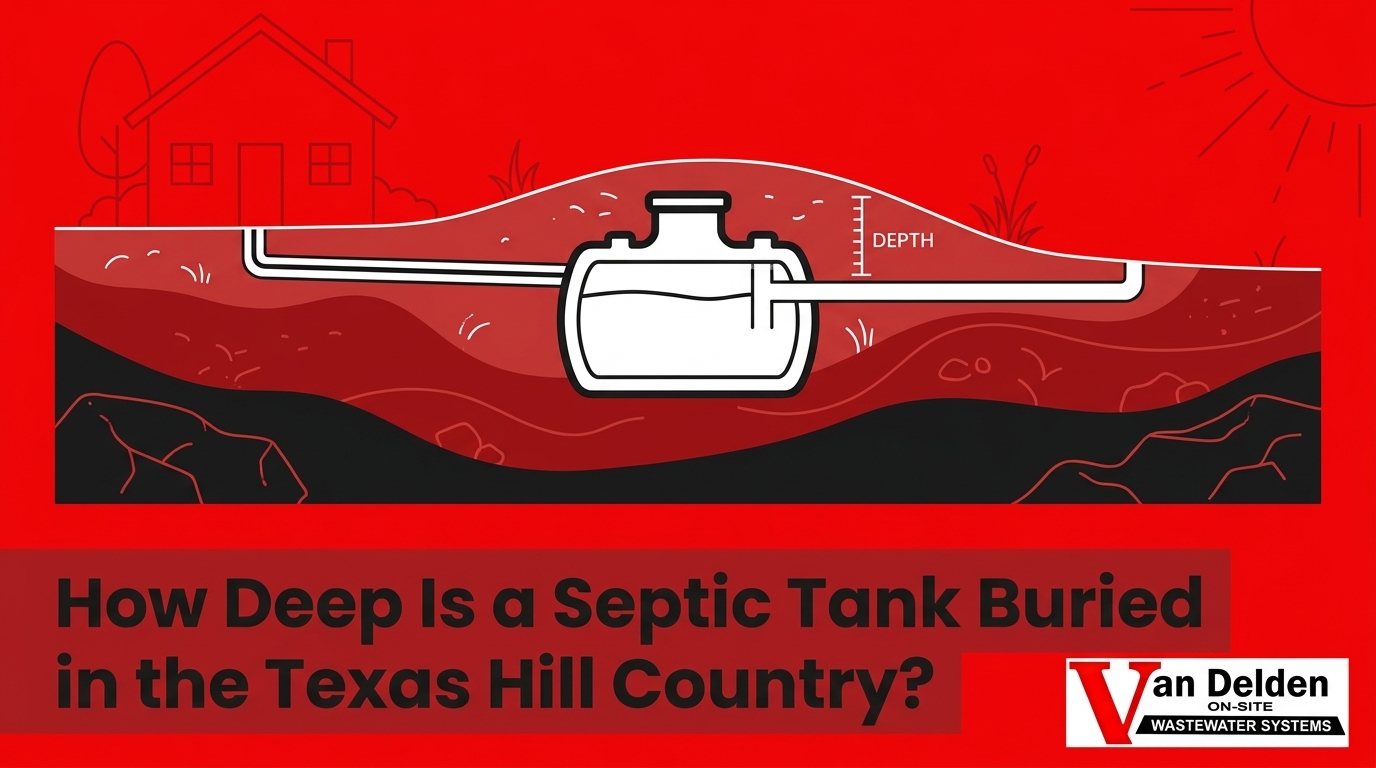
Conventional drainfields usually need several feet of good soil beneath the trench. If you only have 20 inches of soil before you hit solid rock, you can't put a conventional system there. This is a primary scenario when a drip irrigation system is better than a drainfield. Since drip lines are buried only 6 to 10 inches deep, they can maintain the required separation from the bedrock or groundwater that a 36-inch deep trench simply cannot.
Navigating Small Lots and Irregular Terrain
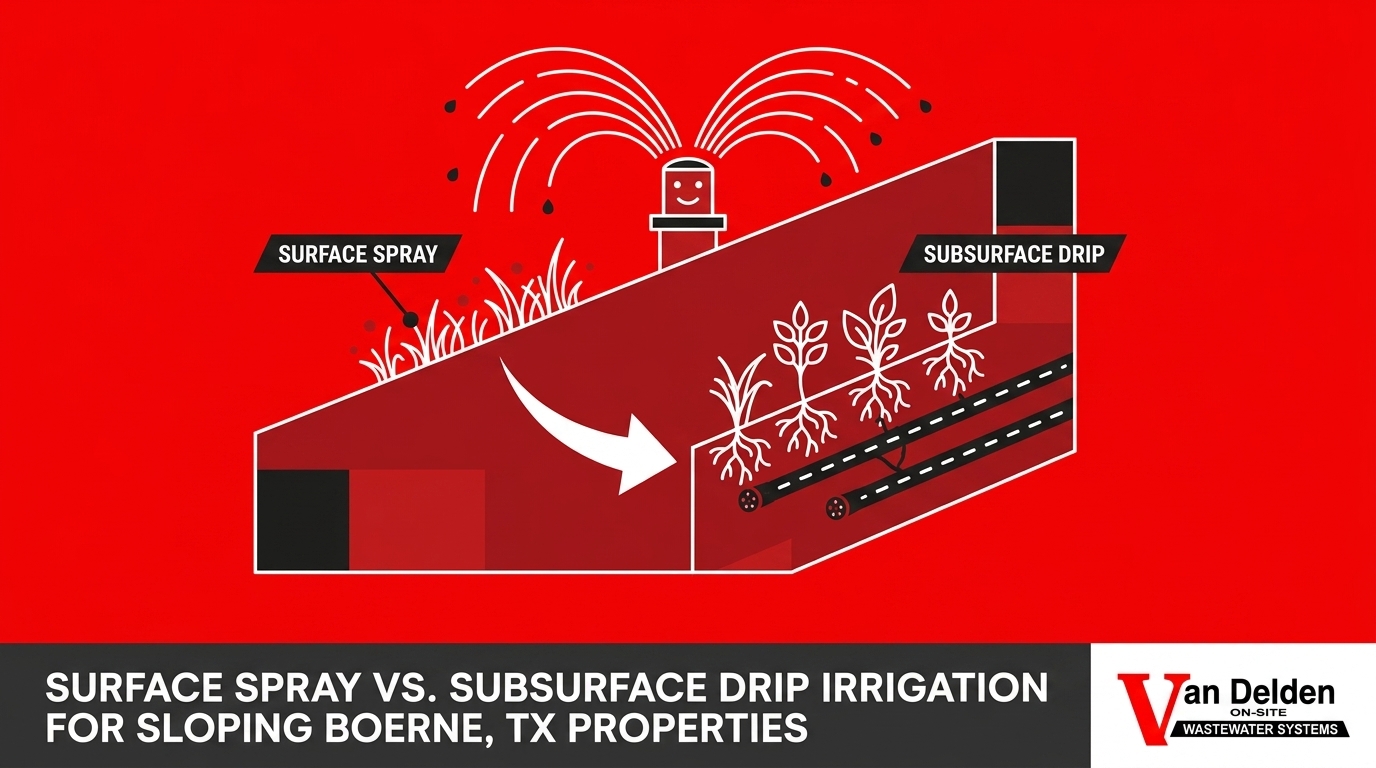
Not every backyard is a flat, empty acre. Many of our customers in Timberwood Park or Hollywood Park have beautiful landscapes, mature trees, or steeply sloping yards. A conventional drainfield requires a large, flat, rectangular area that is cleared of trees.
Drip irrigation is much more flexible. The tubing is flexible and can be snaked around prize oak trees, installed on steep hillsides where gravity systems would fail, or tucked into narrow side yards. If you have a low pressure dosing system, you already understand the benefit of using a pump to move water, but drip takes that precision to the next level. It allows us to preserve your landscaping while still providing a robust waste solution.
In the year 2026, environmental stewardship is more than a buzzword—it’s a necessity for property value and public health. When we look at the data, drip systems are remarkably efficient. Properly designed and maintained drip septic systems can achieve up to 95 percent removal of contaminants from wastewater.
This high performance is largely due to the "timed dosing" used in these systems. Instead of the soil being hit with 300 gallons of water all at once when everyone takes a shower in the morning, a control panel tells the pump to send small doses out every hour or two. This prevents the soil from becoming saturated and "drowning" the beneficial bacteria that do the actual cleaning. You can learn more about how these pressurized systems compare by looking at a common low pressure dosing system.
When a drip irrigation system is better than a drainfield for nutrient removal
One of the coolest things about drip irrigation is that it places the wastewater exactly where plants can use it: the "root zone." In a conventional drainfield, the water is often buried too deep for grass or plants to reach. It just drains away.
With a drip system, the nitrogen and phosphorus in the effluent act as fertilizer for your lawn. This is known as "nutrient uptake." Because the lines are shallow (6-12 inches), the plants can pull those nutrients out of the water through their roots. This not only gives you a greener lawn but also prevents those nutrients from leaching into our local groundwater and causing algae blooms in nearby creeks or rivers.
When a drip irrigation system is better than a drainfield for long-term soil health
A major cause of septic failure is something called a "biomat." This is a slimy layer of bacteria that grows on the bottom of a drainfield trench. Over 25 to 30 years, this biomat can become so thick that water can no longer pass through it.
Drip systems help prevent this "death by biomat" because they provide better soil aeration. By applying water in small pulses and keeping the lines shallow where oxygen can reach the soil, the system encourages aerobic (oxygen-breathing) bacteria. These bacteria are much more efficient at breaking down waste and don't create the thick, waterproof slime that anaerobic bacteria do in deep, soggy trenches.
Maintenance and Longevity: What Homeowners Should Expect
We always tell our customers in Boerne and San Antonio: a drip system is like a high-performance sports car. It performs better and goes places other systems can't, but you can't just "set it and forget it."
A drip system has several components that a standard gravity system doesn't:
- A Pump Tank: To move the water under pressure.
- A Filtration Unit: Usually a disc or screen filter that must be cleaned to keep the emitters from clogging.
- A Control Panel: The "brain" of the system that manages the timed doses and monitors for leaks.
- Flushing Valves: These periodically "flush" the lines at high speed to clear out any biofilm buildup.
Because of these moving parts, aerobic systems with drip irrigation require regular inspections. In many of our service areas like Garden Ridge or Helotes, local regulations actually require a maintenance contract with a licensed provider to ensure the system is working correctly.
Frequently Asked Questions about Drip Septic Systems
Can a drip system be installed in existing landscapes?Absolutely. One of the best things about drip is that the tubing is often "plowed" into the ground using a thin blade. It’s much less destructive than the backhoes and massive trenches required for a conventional drainfield. Your grass usually recovers in just a few weeks.
How long do drip emitters typically last?With proper filtration and annual flushing, drip emitters can last 20 years or more. However, they are "unforgiving" of neglect. If you don't clean the filters or maintain the ATU, they can clog, which is a difficult and expensive fix.
Is a drip system required for aerobic units?Not always, but they are very common partners. An ATU provides the high-quality effluent that a drip system needs to stay clog-free, and the drip system provides the precise dispersal that makes the most of that treated water.
Conclusion
Choosing between a drip system and a drainfield isn't just about preference; it's about what your land allows. At Van Delden Wastewater Systems, we’ve been helping families in the San Antonio and Hill Country area since 1937. We’ve seen how a properly installed drip system can turn a "unbuildable" lot into a beautiful home site.
While a conventional drainfield is a solid, low-maintenance choice for a large lot with great soil, the reality is that those lots are becoming harder to find. Whether you are in Boerne, Bulverde, or downtown San Antonio, we are here to provide an honest, professional site evaluation. Our non-commissioned technicians are focused on educating you, not upselling you, ensuring you get the system that fits your property’s unique "fingerprint."
If you’re ready to see if a drip system is the right fit for your next project or replacement, learn more about Drip Irrigation Aerobic Systems and let us help you protect your home and the environment for years to come.