Why Every Texas Homeowner Needs a Septic Pumping Schedule
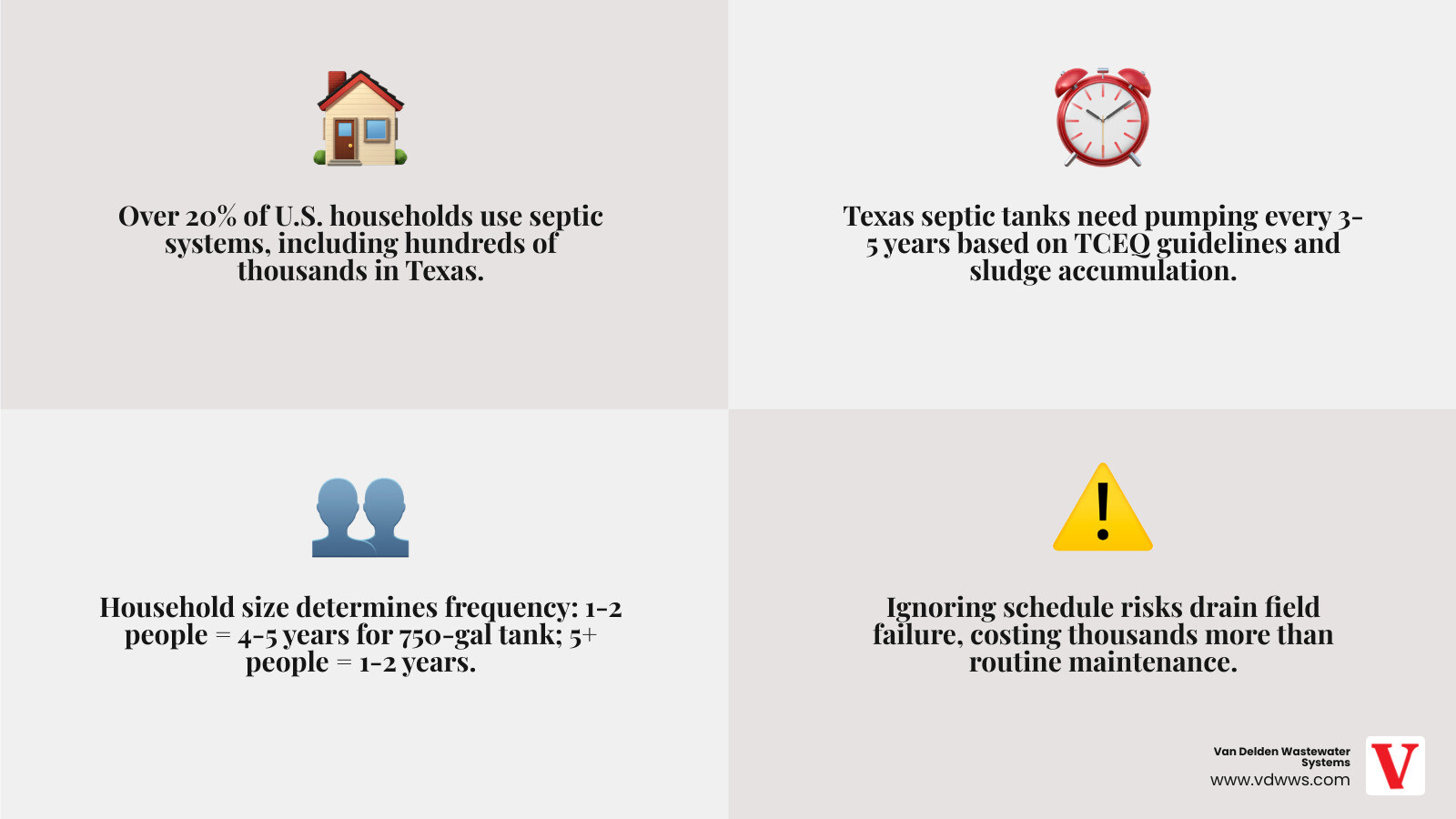
A pumping schedule guide for texas homeowners comes down to one simple rule: most conventional septic tanks need to be pumped every 3 to 5 years. But your exact schedule depends on how many people live in your home and the size of your tank.
Quick Reference: Texas Septic Pumping Schedule by Household Size
| Household Size | 750-gal Tank | 1,000-gal Tank | 1,500-gal Tank |
|---|
| 1-2 people | 4-5 years | 5-6 years | 7-9 years |
| 3-4 people | 2-3 years | 3-4 years | 4-6 years |
| 5+ people | 1-2 years | 2-3 years | 3-4 years |
Based on TCEQ guidelines and standard sludge accumulation rates.
More than one in five U.S. households rely on a septic system — and Texas is no exception. Across the state, from the clay-heavy Blackland Prairie to the sandy soils of South Texas, hundreds of thousands of homeowners are responsible for managing their own wastewater treatment on their property.
The problem? Most people never think about their septic tank until something goes wrong. And by then, a simple pump-out has turned into a drain field failure — the kind of repair that can cost many times more than years of routine maintenance combined.
The good news is that staying on schedule is not complicated. It is basic math based on your tank size and how many people use it daily. This guide walks you through exactly how to build your personal maintenance plan, what Texas-specific factors change the math, and what warning signs mean you cannot wait.
The Essential Pumping Schedule Guide for Texas Homeowners
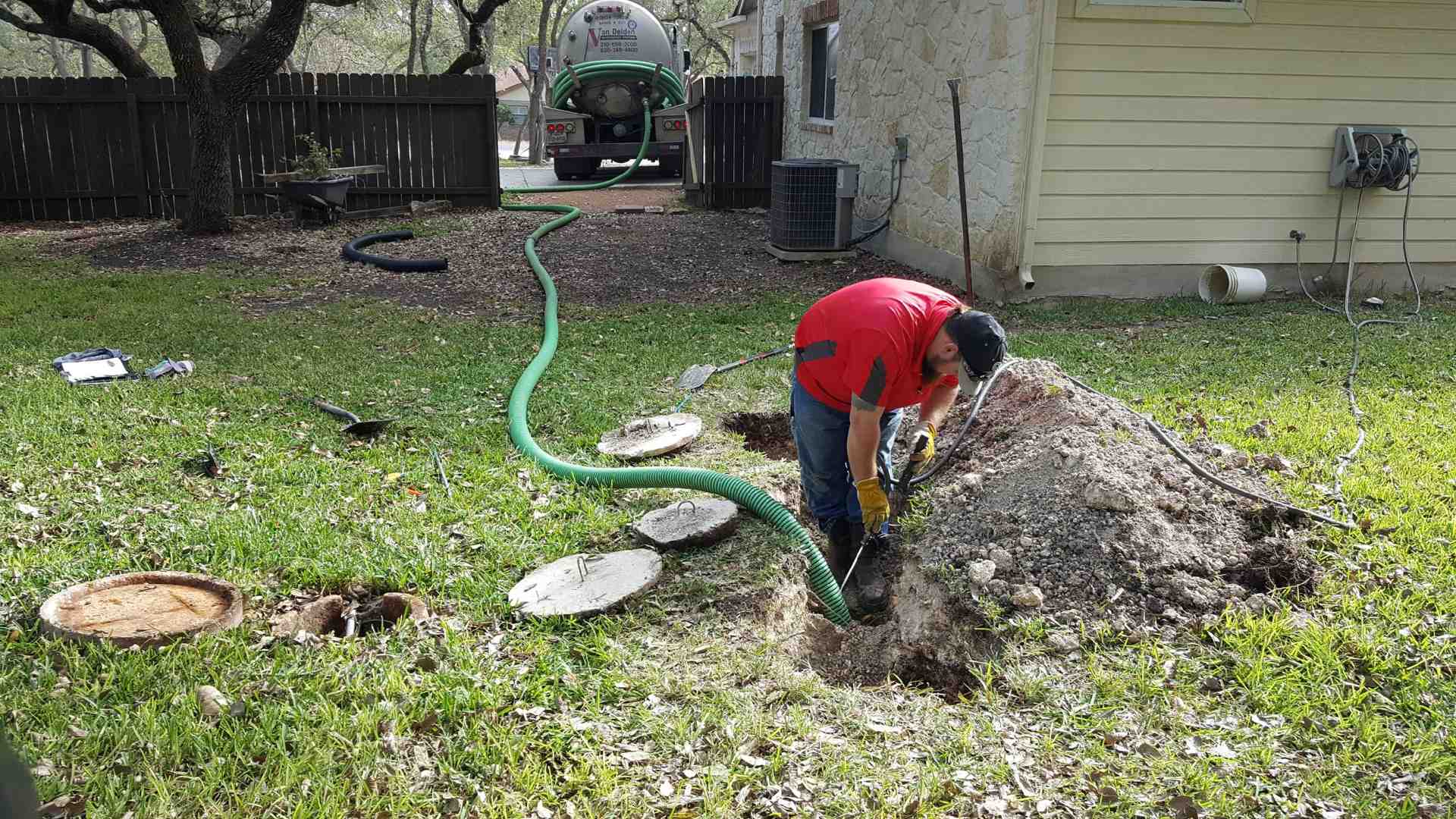
When we talk about maintenance, many homeowners ask us, "If it's working fine, why should I mess with it?" The answer lies in how a septic tank functions. Inside that tank, waste separates into three layers: heavy solids (sludge) at the bottom, oils and grease (scum) at the top, and relatively clear water (effluent) in the middle.
Over time, that sludge layer grows. If it gets too high, the solids begin to flow out of the tank and into your drain field, which is the most expensive part of your system to replace. Understanding When To Schedule Septic Tank Pumping is the difference between a system that lasts 40 years and one that fails in ten.
For most of our neighbors in San Antonio, Boerne, and Bulverde, the standard 1,000-gallon tank is the baseline. However, even with the same tank size, a family of five produces significantly more waste than a retired couple. This is Why Should I Pump My Septic Tank regularly; it's the only way to clear out those accumulated solids before they cause a catastrophe.
Calculating Your Personalized Pumping Schedule Guide for Texas Homeowners
To get a precise idea of your needs, we often point homeowners toward the simple formula recommended by Texas A&M AgriLife Extension. It isn't just guesswork; it's about the ratio of your tank's capacity to the daily load you put on it.
A helpful rule of thumb is to divide your tank capacity by your household size. If that number is under 250, you should pump every 2–3 years. If it’s between 250 and 500, you can likely wait 3–5 years. For numbers over 500, a 5–6 year interval may be safe.
| Residents | 1,000 Gallon Tank | 1,250 Gallon Tank | 1,500 Gallon Tank |
|---|
| 1 Person | 10+ Years | 10+ Years | 10+ Years |
| 2 People | 5.9 Years | 7.5 Years | 9.1 Years |
| 3 People | 3.7 Years | 4.8 Years | 5.9 Years |
| 4 People | 2.6 Years | 3.4 Years | 4.2 Years |
| 5 People | 2.0 Years | 2.6 Years | 3.3 Years |
Knowing How Often Should My Septic Tank Be Cleaned helps you avoid the "out of sight, out of mind" trap. Each person in your home generates roughly 70 gallons of wastewater every single day!
Factors That Shorten Your Maintenance Interval
While the table above provides a great starting point, certain lifestyle choices can "fast-forward" your schedule.
- Garbage Disposals: These are often the biggest culprit. A disposal adds a massive amount of organic solids to your tank that haven't been "pre-digested" by your body. If you use one frequently, you may need to pump up to 50% more often.
- Water Softeners: In areas like Shavano Park or Hollywood Park where the water is hard, softeners are common. However, the backwash from these systems adds extra water volume and salt, which can occasionally disrupt the bacterial balance.
- High Water Usage: If your household does four loads of laundry on a Saturday, you are "slugging" the system with hundreds of gallons at once. This can stir up sludge and push it toward the drain field.
Following a Septic Tank Pump Out Guide means adjusting for these variables. If you notice things are moving a bit slower than usual, that is often One Sign Its Time To Pump Your Septic System.
How Texas Soil and Climate Impact Your System
Texas geography plays a huge role in how your septic system performs. In Central Texas locations like Fair Oaks Ranch or Spring Branch, we often deal with heavy clay or rocky limestone. Clay is notorious for poor drainage; it holds onto water like a sponge, which means your drain field can become saturated much faster than it would in sandy loam.
On the bright side, the Texas heat is actually a friend to your septic tank's biology. Warm temperatures promote faster bacterial breakdown of organic matter. However, this doesn't mean you can skip pumping. It just means the "digestion" process is more active during our long summers.
Climate events, such as heavy rain or the occasional hurricane-related deluge, can also impact your schedule. When the ground is soaked, the wastewater has nowhere to go. During these wet periods, it is vital to reduce water usage to prevent a backup. Knowing the Best Times For Septic Tank Pumping — usually before the rainy season or before a large houseguest event — can save you a major headache. Choosing the Right Time To Pump Your Septic Tank is part of being a proactive homeowner.
Extending the Life of Your Drain Field
The drain field is the most expensive component of your system, with replacement costs often reaching five figures. To protect it, we recommend:
- Installing water-conserving fixtures: Low-flow toilets and showerheads drastically reduce the daily load.
- Spreading out laundry: Instead of "Laundry Day," try doing one load a day to avoid overwhelming the tank.
- Diverting runoff: Ensure your gutters and driveway runoff are pointed away from the drain field area.
If the soil stays constantly saturated, the aerobic bacteria in the soil can't breathe, and the system fails. Monitoring When Is It Time For Septic Tank Pumping ensures that only clear water, and not sludge, ever reaches that precious soil.
Maintenance Requirements for Aerobic vs. Conventional Systems
In many parts of Texas, especially where the soil is too thin or too dense for a traditional drain field, aerobic systems are the standard. Unlike conventional systems that rely on gravity and anaerobic bacteria, aerobic systems use a pump to inject oxygen into the waste, creating a much cleaner effluent that is often sprayed onto the lawn via sprinklers.
Because these systems have mechanical parts (pumps, timers, alarms), the Texas Commission on Environmental Quality (TCEQ) has strict rules. Under Chapter 285, most aerobic systems require a maintenance contract and inspections every four months. While the treatment is more efficient, you still need to pump the "trash tank" every 3 to 5 years to remove the non-digestible solids.
Homeowners often have 3 Frequently Asked Septic Pumping Questions regarding these systems, usually centering on why they need a contract if the system "looks fine." The reason is simple: if the air pump fails, the system stops treating waste immediately. Our Faq Answered When Should I Pump My Septic Tank section further clarifies that aerobic systems are high-performance machines that require high-performance care.
Warning Signs Included in Your Pumping Schedule Guide for Texas Homeowners
Even if you are not "due" for a pump-out based on the calendar, your system might be screaming for help. Watch for these Top 3 Signs You Should Clean Your Septic Tank Right Now:
- The "Septic Stink": If you smell rotten eggs (hydrogen sulfide) near the tank or your drains, the gases are likely backing up because the tank is full.
- The Gurgle: If your toilet or sink makes a "glug-glug" sound when you flush or drain water, it’s a sign that air is being trapped by rising waste levels.
- Lush, Green Patches: If one part of your yard looks like a tropical rainforest while the rest is typical Texas brown, your drain field may be overflowing with "fertilizer" it can't handle.
Learning How To Tell Its Time To Clean Your Septic Tank before the sewage ends up in your bathtub is the hallmark of a savvy homeowner.
Frequently Asked Questions about Texas Septic Maintenance
Maintaining a septic system can feel like a mystery, but it’s really about record-keeping and visibility. One of the best things you can do is install a riser — an extension that brings the tank lid to ground level — so you don't have to dig up your yard every time you need an inspection. Keeping an eye out for Signs Your Septic Tank Should Be Pumped is much easier when the access port is visible.
Can I pump my own septic tank legally in Texas?
Technically, Texas law does not strictly forbid a homeowner from pumping their own tank, but it is highly discouraged and practically very difficult. You would need a vacuum truck capable of holding 1,000+ gallons and, most importantly, a legal place to dispose of the waste. Licensed sludge haulers must follow strict TCEQ disposal regulations. Furthermore, the gases inside a septic tank, like methane and hydrogen sulfide, can be fatal in seconds. This is a job where professional equipment and training are non-negotiable.
How do I find my septic tank size if I don't have records?
If you just moved into a home in Garden Ridge or Timberwood Park and have no records, don't worry. Your first stop should be the local county health department or the TCEQ's On-Site Sewage Facility (OSSF) permit database. Most systems installed after the late 1980s will have detailed permits on file showing the tank size and location. If that fails, we can use professional probing tools or electronic locators to find the tank and measure its dimensions.
Is it harmful to pump a septic tank too frequently?
It isn't "harmful" to the tank itself, but it is a waste of your hard-earned money. Some people think pumping every year will make the system last forever, but your tank actually needs a certain amount of bacteria to function correctly. As long as you stick to your personalized pumping schedule guide for texas homeowners, you are maintaining the perfect balance between waste removal and bacterial health.
Conclusion
At Van Delden Wastewater Systems, we believe a well-informed homeowner is our best customer. Since 1937, our family has been serving the San Antonio and Boerne areas with a focus on education and honesty. Our technicians are background-checked and non-commissioned, meaning they aren't there to sell you things you don't need — they are there to ensure your system works exactly as it should.
We provide detailed service forms and photo documentation with every visit, so you have a clear record of your tank's health. If you are unsure when your last service was, or if you've noticed any of the warning signs mentioned in this guide, don't wait for a backup to happen.
For more information on what goes into a professional service, check out our Septic Tank Pumping Cost Guide. Ready to get your system on the right track? Schedule your professional Texas septic service today and let us handle the "dirty work" so you can enjoy your home with peace of mind.