What Every Homeowner Should Know About How a Septic System Works
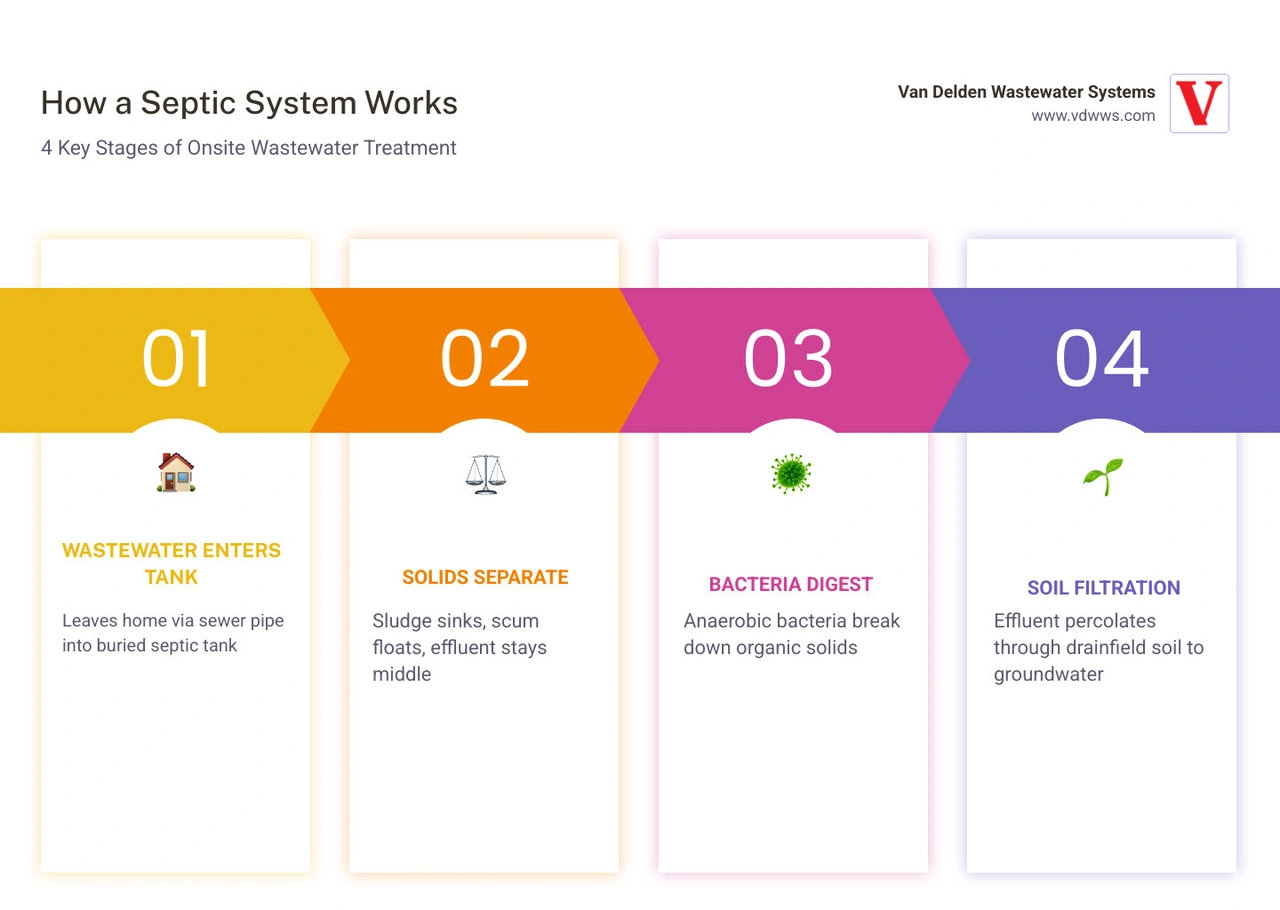
How a septic system works for homeowners comes down to four key stages that quietly treat all the wastewater your household produces — every day, underground, without you ever having to think about it:
- Wastewater leaves your home through a main sewer pipe and flows into a buried septic tank.
- Solids settle and separate inside the tank — heavy waste sinks to the bottom as sludge, oils and grease float to the top as scum, and partially clarified liquid (effluent) remains in the middle.
- Bacteria break down the solids — naturally occurring anaerobic bacteria digest organic matter in the sludge, reducing its volume over time.
- Effluent flows to the drainfield — also called a leach field — where it slowly percolates through soil, which filters out harmful bacteria, viruses, and nutrients before the water reaches the groundwater table.
That's the whole system. A buried tank, a stretch of soil, and biology doing the heavy lifting.
Most homes without access to a municipal sewer line rely on exactly this kind of private, onsite wastewater treatment. In fact, approximately 21 million American homes use septic systems, and in states like Pennsylvania, around 26% of all households depend on one. If you're on well water, live in a rural or semi-rural area, or notice no sewer charge on your water bill, there's a good chance your home has one too.
The problem is most homeowners don't learn how their system works until something goes wrong — slow drains, sewage odors in the yard, or a very expensive repair bill. Understanding the basics is the single best way to prevent all three.
I’m looking for a reliable explanation of how a septic system works for homeowners in San Antonio—where do I start?
If you live in San Antonio, Boerne, or Bulverde, you likely know that our local geography plays a huge role in how we manage water. Starting your journey into How Septic Systems Work means viewing your backyard not just as a lawn, but as a decentralized wastewater treatment plant.
Unlike city sewer systems that carry waste miles away to a massive facility, your septic system provides onsite treatment. This is actually a major environmental win. By treating water right where it’s used, septic systems help with groundwater recharge, putting purified water back into our local aquifers rather than piping it into distant rivers. To get the full picture, our How Septic Works Ultimate Guide breaks down this journey from the moment you flush to the moment the water returns to the earth.
The Initial Collection: How a Septic System Works for Homeowners
Every drop of water that goes down your drains—from the kitchen sink, the shower, and the laundry—collects into a single main sewer pipe. This pipe leads directly to the septic tank, which is the heart of the collection phase.
Typically, a Standard Septic System features a tank made of concrete, fiberglass, or polyethylene. For a standard three-bedroom home, the minimum tank size is usually 1,000 gallons. In modern designs, we often see two-compartment tanks. These are designed for a 2-day retention time, meaning the wastewater stays in the tank long enough for gravity to do its job.

In a two-compartment tank, the first chamber usually holds about 2/3 of the total volume. This is where the heaviest "action" happens—solids settle and oils float. The second chamber (the remaining 1/3) provides a final settling area, ensuring that the liquid leaving the tank is as clear as possible.
The Final Filtration: How a Septic System Works for Homeowners
Once the liquid (effluent) leaves the tank, it moves toward the drainfield. In many systems, it first passes through a distribution box (D-box). Think of the D-box as a traffic cop; its job is to evenly distribute the effluent among the various perforated pipes in your leach field.
This even distribution is critical. If one area of the drainfield gets too much water, the soil becomes saturated and can no longer filter the waste. In Common Septic Systems Standard Septic Systems, the soil is actually the most important part of the treatment process. Microbes living in the unsaturated soil act as a natural biological filter, consuming pathogens and neutralizing nutrients like nitrogen and phosphorus before they can reach the groundwater.
The Core Components: From the Septic Tank to the Drainfield
Inside that buried tank, a fascinating biological process is occurring. As wastewater enters, it naturally separates into three distinct layers:
- The Scum Layer (Top): This consists of anything lighter than water, such as grease, oils, and fats.
- The Effluent Layer (Middle): This is the relatively clear liquid that is destined for the drainfield.
- The Sludge Layer (Bottom): This is made of heavy organic and inorganic solids.
While it might look like a simple box, the A Short History of the Septic System shows how these designs have evolved to maximize "anaerobic digestion." Anaerobic bacteria (bacteria that live without oxygen) thrive in the tank and can break down up to 80% of the solids into gases and liquids.
To keep the system running smoothly, we use tank baffles. These are T-shaped pipes at the inlet and outlet. The inlet baffle directs incoming waste downward to prevent it from disturbing the scum layer, while the outlet baffle ensures that only the clear effluent from the middle layer escapes to the drainfield. Many modern systems also include outlet filters—basically a screen that catches any stray solids before they can clog your expensive drainfield pipes.
Conventional vs. Advanced Treatment Systems
Not every backyard in the San Antonio area is suited for a standard gravity-fed system. Some properties have thin soil, high water tables, or are located near sensitive water sources. In these cases, we look at Common Septic System Types to find the right fit.
| System Type | Best For | Complexity | Treatment Method |
|---|
| Standard/Conventional | Deep, well-draining soil | Low | Gravity & Soil Microbes |
| Aerobic Treatment Unit (ATU) | Small lots or poor soil | High | Oxygen-fed bacteria (Aerobic) |
| Low Pressure Dosing (LPD) | Sloped lots or thin soil | Medium | Pressure-pumped distribution |
| Mound System | High water tables/Bedrock | High | Above-ground sand/soil mound |
If you have a Common Septic Systems Aerobic System, your tank works a bit like a mini-municipal plant. It uses an air pump to bubble oxygen into the wastewater. This encourages aerobic bacteria, which are much faster and more efficient at breaking down waste than their anaerobic cousins. You can learn more about this in our guide on How Aerobic Septic Systems Work.
For homes where the soil is too shallow (a common issue in parts of the Texas Hill Country), a Common Septic Systems Low Pressure Dosing System or a sand filter may be required to provide that extra layer of purification before the water hits the bedrock.
Essential Maintenance: Pumping and Inspection Schedules
We often tell homeowners that a septic system is a "living" ecosystem. Just like any ecosystem, it can be thrown out of balance. The most common cause of failure is simply waiting too long to pump the tank.
Most households should have their tank inspected and pumped every 3 to 5 years. If you have a larger family or use a garbage disposal, you might need to do this every 2 to 3 years. During a professional inspection, we measure the sludge and scum layers. If the sludge occupies more than one-third of the tank's total volume, it’s time for a pump-out.
Understanding the difference between system types is also vital; for instance, Septic System Jargon Defined Standard vs Aerobic Systems explains why aerobic systems often require more frequent check-ups due to their mechanical components like aerators and pumps.
To keep your system healthy between visits, follow these "Never Flush" rules:
- No "Flushable" Wipes: They don't break down and are the #1 cause of clogs.
- No Grease or Cooking Oil: It hardens and creates "fatbergs" in your pipes.
- No Harsh Chemicals: Large amounts of bleach or drain cleaners kill the "good" bacteria that eat your waste.
- No Feminine Products or Diapers: These will never decompose in a tank.
Warning Signs of a Malfunctioning System
Your septic system will usually try to tell you when it’s struggling. Being proactive can save you from a total system failure, which can be a massive headache.
Common Red Flags:
- The "Septic Stink": Foul odors (like rotten eggs) near the tank or drainfield.
- Gurgling Pipes: If your drains make a "glug-glug" sound when you flush or run the shower.
- Slow Drains: If all the sinks in the house are draining slowly, it’s likely a system-wide backup, not a simple clog.
- Lush, Green Grass: If one patch of grass over your drainfield is significantly greener and faster-growing than the rest, it’s often because it’s being over-fertilized by surfacing sewage.
- Pooling Water: Standing water or mushy soil in the yard when it hasn't rained.
A malfunctioning system isn't just a nuisance; it's a health risk. Untreated sewage can contain pathogens like E. coli and viruses that can contaminate your well water or local streams. If you see these signs, it is important to stop using water immediately and call a professional.
Frequently Asked Questions about Septic Systems
Can I flush toilet paper with a septic system?
Yes, you can! Standard toilet paper is designed to break down quickly in water. However, you should avoid "ultra-plush" varieties that are very thick, as they take longer to decompose. The biggest rule: never flush wipes, even if the box says they are "septic safe." They are not.
How often should I pump my septic tank?
For the average home in the San Antonio area (3 bedrooms, 1,000-gallon tank), we recommend pumping every 3 to 5 years. However, if you have five or more people living in the house, or if you use your garbage disposal frequently, you should lean toward the 3-year mark. Regular pumping prevents solids from flowing into the drainfield, which is the most expensive part of the system to replace.
Do septic tank additives actually work?
Generally, no. Most experts, including the EPA and the Georgia Department of Public Health, discourage the use of additives. Your waste naturally contains all the bacteria needed to start the decomposition process. Some chemical additives can actually harm the system by breaking solids into tiny particles that then float out and clog your drainfield. Save your money for the 3-year pump-out instead!
Conclusion
Your septic system is one of the most important—and most expensive—components of your home. By understanding how a septic system works for homeowners, you can take simple steps to ensure it lasts for 30, 40, or even 50 years. It all comes down to being mindful of what goes down the drain, conserving water to avoid overwhelming the soil, and sticking to a professional maintenance schedule.
At Van Delden Wastewater Systems, we’ve been helping families in Boerne, San Antonio, and the surrounding Texas Hill Country since 1937. We believe in educating our customers so you can feel confident in your home’s "hidden ecosystem." Whether you need a routine inspection, a pump-out, or an upgrade to an advanced system, our background-checked, non-commissioned technicians are here to provide honest, quality service.
Ready to schedule your maintenance or have more questions about your Septic Systems? Give us a call today—we’re here to help keep your home running smoothly.