Why Spring Septic Care for Texas Hill Country Homes Matters More Than You Think
Spring septic care for texas hill country homes is one of the most important maintenance tasks you can do as a Hill Country homeowner — and one of the most overlooked. Every spring, heavy rainfall, surging tree root growth, and shifting limestone soils put real stress on septic systems across Comal, Guadalupe, and Medina Counties. For homes built over shallow bedrock — where soil depth can be as little as 6 to 18 inches — that stress hits harder and faster than it would almost anywhere else in Texas.
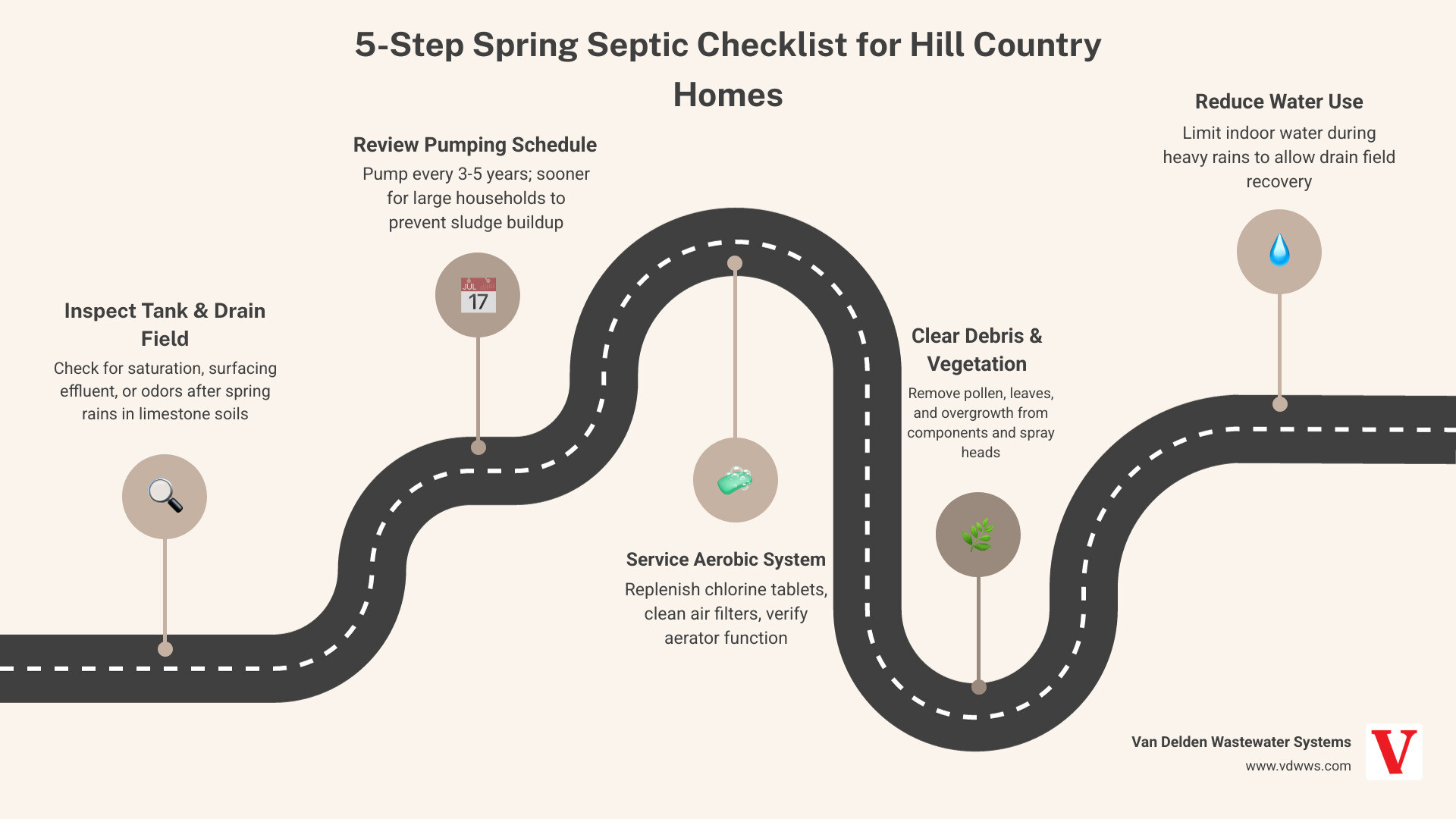
Here's a quick overview of what spring septic care involves for Hill Country homes:
- Inspect your tank and drain field for signs of saturation, surfacing effluent, or unusual odors after spring rains
- Check pumping schedule — most Hill Country tanks need pumping every 3 to 5 years (sooner for larger households)
- Service your aerobic system — replenish chlorine tablets, clean air filters, and confirm the aerator is running
- Clear pollen, debris, and vegetation from around system components and spray heads
- Reduce indoor water use during and after heavy rain events to give your drain field time to recover
- Watch for warning signs — slow drains, gurgling pipes, soggy patches, or unusually green grass over the leach field
- Contact a TCEQ-licensed professional if anything looks or smells off
Systems over 20 years old are especially vulnerable, since they were often designed for lower water usage than today's households demand. And in a place like Spring Branch or the broader Guadalupe River corridor, a failing system isn't just a household problem — runoff from a compromised drain field can reach a waterway within hours during a storm event.
The good news? Most spring septic failures are preventable with the right maintenance habits and a trusted local professional who knows Hill Country geology.
Essential Spring Septic Care for Texas Hill Country Homes
When we talk about the Texas Hill Country, we aren't just talking about beautiful views; we're talking about a unique geological landscape that dictates how your home handles wastewater. The region is characterized by limestone bedrock and karst features—essentially porous rock that allows water to move quickly through underground channels. This makes Septic System Checks Before Spring Begins a vital part of protecting our local groundwater and the Edwards Aquifer.
In our service areas, including Spring Branch, Bulverde, and Fair Oaks Ranch, the Texas Commission on Environmental Quality (TCEQ) Region 13 oversees regulations. Local authorities, like the Comal County Engineer's Office or the Guadalupe County Environmental Health Department, act as authorized agents. They enforce strict permitting requirements because our thin soils don't provide the same natural filtration as the deep sands of East Texas. A spring soil evaluation is often the first step in understanding why your system might be struggling after a wet winter.
Why Spring Septic Care for Texas Hill Country Homes Prevents Summer Failures
As we move into April 2026, the transition from spring to summer is a critical window. Spring in the Hill Country often brings "monsoon" style rain events that cause hydraulic overload—a fancy term for when your system is simply overwhelmed by too much water. If your drain field is already saturated from spring storms, it can't breathe.
By focusing on Prepare Septic System For Spring In Fair Oaks Ranch, you are essentially "pre-gaming" for the summer heat. When the Texas sun begins to bake the ground in July and August, the soil shrinks and cracks. If your system hasn't been properly maintained in the spring, these soil shifts can lead to broken pipes or compromised tank integrity. Water conservation during the spring helps keep the "biomat"—the layer of beneficial bacteria in your drain field—healthy and ready for the increased usage that often comes with summer guests and school vacations.
Professional Spring Septic Care for Texas Hill Country Homes and Aerobic Maintenance
Many homes in our area, especially those on rocky lots in Timberwood Park or Shavano Park, utilize aerobic treatment units (ATUs). Unlike conventional gravity systems, these are mechanical "mini-plants" that require oxygen to break down waste. Spring is the perfect time to review your aerobic maintenance contract. TCEQ regulations generally require these systems to be inspected every four months.
During a professional spring visit, we focus on:
- Chlorine Tablet Replenishment: Ensuring your system is properly disinfecting effluent before it is sprayed onto your lawn.
- Air Filter Cleaning: The aerator is the heart of your system. Pollen in the spring can clog these filters, causing the motor to overheat.
- Alarm Testing: Making sure your high-water and compressor alarms are functioning before a storm hits.
For more on why these steps are non-negotiable, check out our guide on Spring Cleaning Dont Forget About Your Septic Tank.
Managing Heavy Rainfall and Hydraulic Overload in Rocky Soils

The Hill Country is famous for flash floods. Because our limestone bedrock is so close to the surface, the ground has very little "sponge" capacity. When a heavy spring storm rolls through, that water has nowhere to go but sideways, often flooding septic drain fields.
When a drain field is underwater, the effluent from your house has no place to exit. This is a primary cause of Common Septic Drainfield Problems. Surface water diversion is key; we often recommend homeowners check that their gutters and landscaping aren't funnelling rainwater directly onto the septic area.
| System Type | Rainfall Recovery Time | Key Vulnerability |
|---|
| Conventional | 48–72 Hours | Soil saturation stops gravity flow; can lead to backups. |
| Aerobic (Spray) | 12–24 Hours | High water table can trigger alarms; spray heads may clog with mud. |
| Aerobic (Drip) | 24–48 Hours | Saturated soil prevents emitters from "pushing" water out. |
Maintenance Steps for Aerobic and Conventional Systems
One of the most frequent questions we hear is: "How often should I pump?" While the general rule is every 3 to 5 years, the Hill Country's thin soils make this even more critical. If you allow solids to escape the tank and enter a leach field located on limestone, you risk a permanent clog that is incredibly expensive to fix.
During your spring maintenance, we check sludge levels to see if you're due for a pump-out. For older systems or those struggling with slow drainage, we might recommend professional drain field jetting to clear out debris. In some cases, we utilize Terralift technology—a process that uses a long probe to inject air into the soil, fracturing the compaction around the drain field without the need for massive excavation. This is a lifesaver for yards with beautiful, established landscaping.
Don't forget the "small" things: spring pollen and falling debris from Live Oaks can settle into your tank lids or clog aerobic spray heads. A quick check of the Dos And Donts Of Septic System Maintenance can save you a major headache later in the year.
Protecting Your Drain Field from Tree Roots and Soil Changes
We all love our Hill Country Live Oaks and Mountain Cedars, but their roots love your septic system even more. In the spring, trees experience a massive growth spurt, and they are looking for the nutrient-rich water found in your drain field.
Root intrusion is a leading cause of pipe blockages and tank cracks. Furthermore, the rocky soil of our region can shift as it absorbs spring moisture, potentially causing "bellies" or low spots in your pipes where waste can collect and clog. If you live in Bulverde or Spring Branch, Drainfield Maintenance Bulverde Tx should always include a check for encroaching vegetation. Keeping a "buffer zone" of at least 10 to 15 feet between large trees and your septic components is a best practice for system longevity.
Frequently Asked Questions about Hill Country Septic Systems
What are the most common signs of septic system problems in spring?
The most obvious signs include slow-flushing toilets or gurgling sounds in your pipes—often the first warning that the tank is full or the drain field is saturated. You might also notice foul odors (which a healthy system should never have) or soggy patches in the yard even when it hasn't rained recently. Interestingly, if you see a patch of grass that is much greener and taller than the rest of the yard, it usually means your leach field is over-performing because it's struggling to process waste deeper in the soil. For a full list of red flags, see our Septic System Care Guide 2025.
How does heavy spring rainfall affect my leach field?
In the Hill Country, heavy rain leads to soil saturation. When the soil is "full" of rainwater, it cannot absorb the effluent (wastewater) coming from your septic tank. This creates hydraulic overload. In severe cases, you may see effluent surfacing on top of the ground. Because of our limestone bedrock, this untreated water can travel quickly into nearby creeks or even the Guadalupe River, creating an environmental hazard. Understanding How To Care For Your Septic System And Why helps you realize that reducing water usage during these wet weeks is the best way to protect your property.
Why is professional pumping recommended every 3 to 5 years?
As you live in your home, solid waste settles at the bottom of your tank (sludge) and fats/oils float to the top (scum). Over time, the space for liquid treatment shrinks. If you don't pump the tank, these solids eventually get pushed out into your drain field, where they clog the soil pores. Modern water usage—think high-efficiency washers and multiple showers—puts more "hydraulic load" on systems than they were designed for 20 years ago. Regular pumping is the cheapest insurance policy you can buy for your home. It ensures you won't have to deal with backups during the Summer Heat.
Conclusion
At Van Delden Wastewater Systems, we’ve been navigating the rocky "limestone life" of the Texas Hill Country since 1937. As a family-owned business, we pride ourselves on providing more than just a service—we provide education. Our technicians are non-commissioned, meaning they aren't there to sell you parts you don't need; they are there to ensure your system runs safely and efficiently.
Whether you are in Boerne, Bulverde, or need emergency assistance in Spring Branch, we are here to help. Don't wait for a spring storm to turn into a summer disaster. Schedule your spring septic service in Spring Branch today and rest easy knowing your home is protected by the most experienced team in the Hill Country.