Why the Texas Hill Country Climate Is Harder on Septic Systems Than You Think
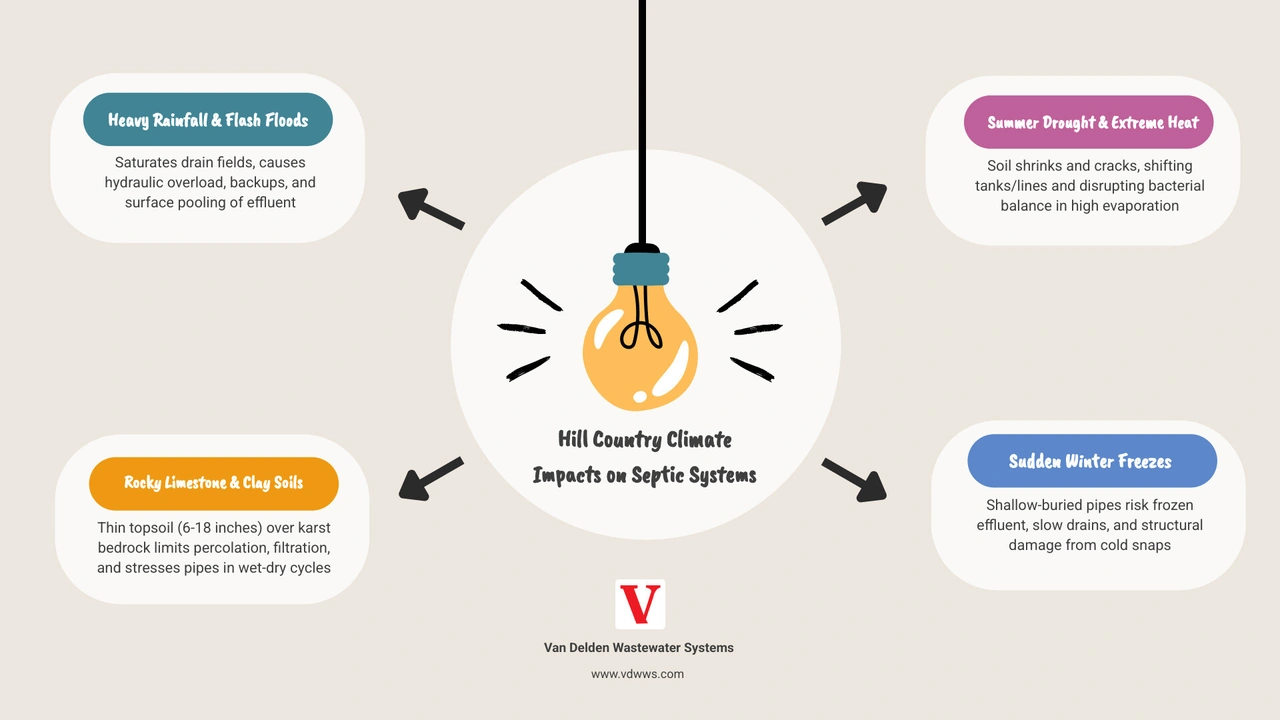
How Texas hill country climate affects your septic system comes down to four key forces working against your wastewater setup year-round:
- Heavy rainfall and flash flooding saturate drain fields, preventing soil from absorbing effluent and causing backups or surface pooling
- Rocky limestone and clay soils limit percolation depth, reduce natural filtration, and physically stress pipes during wet-dry cycles
- Summer drought and extreme heat cause soil to shrink and crack, shifting tanks and lines while straining bacterial balance
- Sudden winter freezes put shallow-buried pipes at risk since Hill Country systems are not designed for deep cold snaps like those in northern states
Living in the Texas Hill Country means your septic system faces some of the most unpredictable weather in the country. One week you're dealing with a flash flood rolling off limestone ridges, the next you're baking under a triple-digit sun that cracks the clay around your drain field. Unlike regions with deep, sandy soils that filter wastewater naturally, the Hill Country sits on thin topsoil — sometimes just 6 to 18 inches deep — directly over karst limestone bedrock. That geology changes everything about how your system performs and what it needs to stay healthy.
Add in the fact that Central Texas has seen explosive population growth over the past two decades, putting more pressure on the region's aquifers, creeks, and on-site wastewater systems, and it becomes clear that routine septic care here isn't optional. It's essential — for your home, your neighbors, and the Edwards Aquifer that millions of people depend on for drinking water.
How Texas Hill Country Climate Affects Your Septic System
When we talk about the climate here, we aren't just talking about the temperature. We are talking about the entire ecosystem. The Texas Hill Country is defined by its karst topography—a landscape formed from the dissolution of soluble rocks like limestone. This creates a "Swiss cheese" effect underground with caves, sinkholes, and fractures.
Understanding how weather affects septic tank performance starts with acknowledging that our soil isn't just "dirt." In areas like Boerne, Spring Branch, and Timberwood Park, the soil is often a thin layer of organic material sitting atop solid rock. In a standard septic setup, the soil is supposed to act as a biological engine, filtering out pathogens before the water reaches the groundwater. However, when the soil is only a foot deep, that "engine" doesn't have much room to work.
This unique geology means that wastewater can travel through limestone fractures incredibly fast—sometimes up to a mile per day. In sandy regions, it might take weeks for water to move that far, providing ample time for natural filtration. Here, if a system is failing or overwhelmed by weather, untreated effluent can reach the Edwards or Trinity Aquifers in a matter of hours. This is why high water tables impact on drainfields so severely in Central Texas; there is simply nowhere for the water to go but up (to the surface) or down (into our drinking water) without proper treatment.

Why is my yard soggy after a storm? How Texas Hill Country climate affects your septic system during heavy rainfall
If you’ve lived in San Antonio or Helotes for a single spring season, you know that "heavy rain" often means three inches of water in two hours. This leads to what we call hydraulic overload. Your septic tank is designed to handle a specific volume of water from your house. When a flash flood hits, the ground around your drain field becomes completely saturated.
When the soil is full of rainwater, it can no longer absorb the effluent coming out of your tank. This is one of the primary reasons for recent rains causing septic system failure across the region. The water has to go somewhere, so it either backs up into your house or "surfaces" in your yard, creating those tell-tale soggy, smelly patches of grass.
For homeowners, spring septic care for Texas Hill Country homes must focus on diversion. If your gutters or the natural slope of your land are funneling rainwater directly onto your drain field, you are essentially asking your system to process the neighborhood’s runoff in addition to your household waste. That is a recipe for a disaster.
Managing rocky soil and clay expansion in Central Texas
While much of the Hill Country is limestone, many of our neighbors in areas like Garden Ridge or toward the Blackland Prairie deal with heavy clay. Clay is the opposite of limestone but equally challenging. While limestone lets water move too fast, clay holds onto it like a sponge.
Clay soil expands when it’s wet and shrinks when it’s dry. This "heaving" can actually put physical stress on your septic pipes, sometimes causing them to shift or even snap. During a drought, the soil pulls away from the tank and lines, creating gaps. When the rains finally return, water rushes into these gaps, carrying silt and debris that can clog your system.
| Feature | Limestone Karst (e.g., Boerne) | Blackland Clay (e.g., East San Antonio) |
|---|
| Percolation Rate | Extremely High (via fractures) | Extremely Low |
| Filtration Quality | Low (water moves too fast) | High (but easily saturated) |
| Climate Risk | Groundwater contamination | Surface pooling and backups |
| Structural Risk | Pipe damage from rocky edges | Pipe damage from soil expansion |
Spring Rains and Flash Flooding Challenges
Spring in Central Texas is beautiful, but it’s the busiest time for our service teams. The combination of rising temperatures and heavy downpours can trigger alarms on Aerobic Treatment Units (ATUs). If you have an aerobic system, you likely have a control panel with a red light and a buzzer.
Many homeowners panic when that light comes on after a storm. It’s important to know heavy rain: what to do when your aerobic system alarm activates. Often, the alarm is telling you that the "high water" float has been triggered. This happens when groundwater seeps into the tank or when the spray field is too saturated to allow the pump to discharge.
Understanding why does the rain make my aerobic system alarm activate is the first step in staying calm. In most cases, it’s a temporary issue caused by the sheer volume of water in the environment. However, if the light stays on for more than 24 hours after the rain stops, it’s time to call in the professionals.
I’m worried about my drain field overflowing. How Texas Hill Country climate affects your septic system in the spring
The best way to protect septic system during heavy rainfall is to go on a "water diet." When the sky is pouring, your drain field is already fighting for its life. This is not the time to run five loads of laundry or take a two-hour soak in the garden tub.
We recommend staggering your water usage. Instead of a "Laundry Sunday," try doing one load a day. This gives the soil time to recover and process the effluent without becoming a swamp. Taking these steps is part of a smart spring maintenance to prevent summer failures. If you stress the system in May, the damage to the soil’s "biomat" (the layer of beneficial bacteria) can lead to a total system collapse when the July heat arrives.
Managing Summer Drought and High Evaporation
By the time we hit July and August in San Antonio and Bulverde, the problem flips. Now, we are dealing with extreme evaporation and bone-dry soil. You might think drought is good for a septic system because there’s no rain to saturate the field, but that’s not quite true.
Extreme heat can actually impact the bacterial balance inside your tank. Septic systems rely on live bacteria to break down solids. When temperatures soar, the internal temperature of the tank can rise, occasionally slowing down the digestion process. Furthermore, as the soil around the tank dries out and shrinks, it can cause the tank to settle or tilt, which may disconnect the inlet or outlet pipes.
Learning how to keep your septic system running happily during the summer heat involves more than just ignoring it. In fact, summer is when many people host pool parties and family reunions, leading to massive spikes in water usage just when the system is under heat stress. Reviewing the top 7 septic tips for summer can save you from an embarrassing—and smelly—situation during your next barbecue.
Protecting your system from the 2026 summer heat
One often-overlooked summer threat in the Hill Country is pollen and dust. If you have an aerobic system, your compressor (the motor that blows air into the tank) has an air filter. During our heavy pollen seasons or dry, dusty summers, these filters can clog. A clogged filter makes the motor work harder, which can lead to it burning out in the 100-degree heat.
When protecting your septic system during summer months, make it a habit to check those filters. Also, be careful with your landscaping. While it’s tempting to over-water the grass over your drain field to keep it green, the drain field is already getting "watered" from below. Adding too much supplemental irrigation can actually saturate the soil just as much as a rainstorm would.
Winter Freezes and Sudden Cold Snaps
We don't get many freezes in San Antonio, but when we do, they tend to be "flash freezes" that catch everyone off guard. Because our soil is so rocky and thin, many septic pipes are buried quite shallow—sometimes only a few inches below the surface. In northern states, pipes are buried below the "frost line," which might be three or four feet deep. We don't have that luxury here.
Preparing your septic system for winter is all about insulation. If you have any exposed pipes—perhaps where the line enters a crawl space or near the aerobic compressor—they need to be wrapped. A frozen pipe won't just stop your toilets from flushing; it can burst, leading to a massive mess once the thaw begins. Focusing on winter care for septic system performance ensures that your system survives those rare but brutal Central Texas cold fronts.
What should I do if my pipes freeze?
If you wake up during a freeze and your drains are gurgling or won't go down, you might be wondering, "did the winter storm damage my septic system?" The answer is often found in the "slow drain."
If you suspect a frozen line, stop using water immediately. Continuing to flush or run the sink will only pile up wastewater behind the ice blockage, increasing the pressure and the likelihood of a pipe burst. Do not try to pour boiling water or harsh chemicals down the drain to melt the ice; the extreme temperature change can crack PVC pipes, and chemicals will kill your tank’s beneficial bacteria. The best course of action is to wait for the thaw and check for leaks once the water starts moving again.
Frequently Asked Questions about Hill Country Septic Care
Why does my aerobic system alarm go off during heavy rain?
Most often, this is due to "nuisance" tripping of the high-water float. Rainwater can enter the tank through unsealed lids or simply saturate the ground so much that the pump cannot discharge the effluent. If it clears within 24 hours of the rain stopping, you are likely fine. If not, the pump or float may be damaged.
How often should I pump my septic tank in San Antonio?
For a standard family of four, we generally recommend pumping a conventional system every 3 to 5 years. For aerobic systems, it’s usually every 5 to 7 years, though this varies based on how much "trash" (like wipes or grease) goes down the drain. In heavy clay soils, you might need to pump more frequently (every 2-3 years) to reduce the strain on the drain field.
Can I plant trees near my septic drain field?
We recommend keeping a 10 to 15-foot buffer zone between large trees and your septic components. In the Hill Country, tree roots are incredibly aggressive as they search for moisture in the rocky soil. Your septic lines are a perfect source of water, and roots can easily infiltrate and destroy them.
Conclusion
At Van Delden Wastewater Systems, we’ve been helping Hill Country families navigate these climate challenges since 1937. We know that how Texas hill country climate affects your septic system is a concern for every homeowner from Boerne to Shavano Park. Whether it’s the thin limestone soil or the unpredictable flash floods, your system requires a specialized touch.
Our family-owned business prides itself on providing professional, honest service. Our technicians are background-checked and non-commissioned, meaning their only goal is to educate you and ensure your system is running perfectly. We provide detailed service forms and photo documentation so you can see exactly what’s happening underground.
Don't wait for a red light or a soggy yard to tell you there's a problem. Whether you need a routine inspection, a pump-out, or advice on a new installation, we are here to help. Septic systems are our passion, and protecting the beautiful Texas Hill Country is our mission.
Give us a call today to schedule your seasonal maintenance and keep your home running smoothly, no matter what the Texas weather throws your way.