Why Resetting Your Septic Alarm Won't Fix a Failing Effluent Pump
Muting a buzzing septic alarm stops the noise, but it doesn't pause the wastewater filling your tank. Understand what this critical warning means before a total sewage backup occurs.
How Texas Hill Country soil affects your septic system is one of the most important things to understand before building, buying, or maintaining a home in this region. The short answer: the thin, rocky soil over fractured limestone bedrock makes it very hard for wastewater to be treated naturally underground — and that changes almost everything about how your septic system needs to be designed, permitted, and maintained.
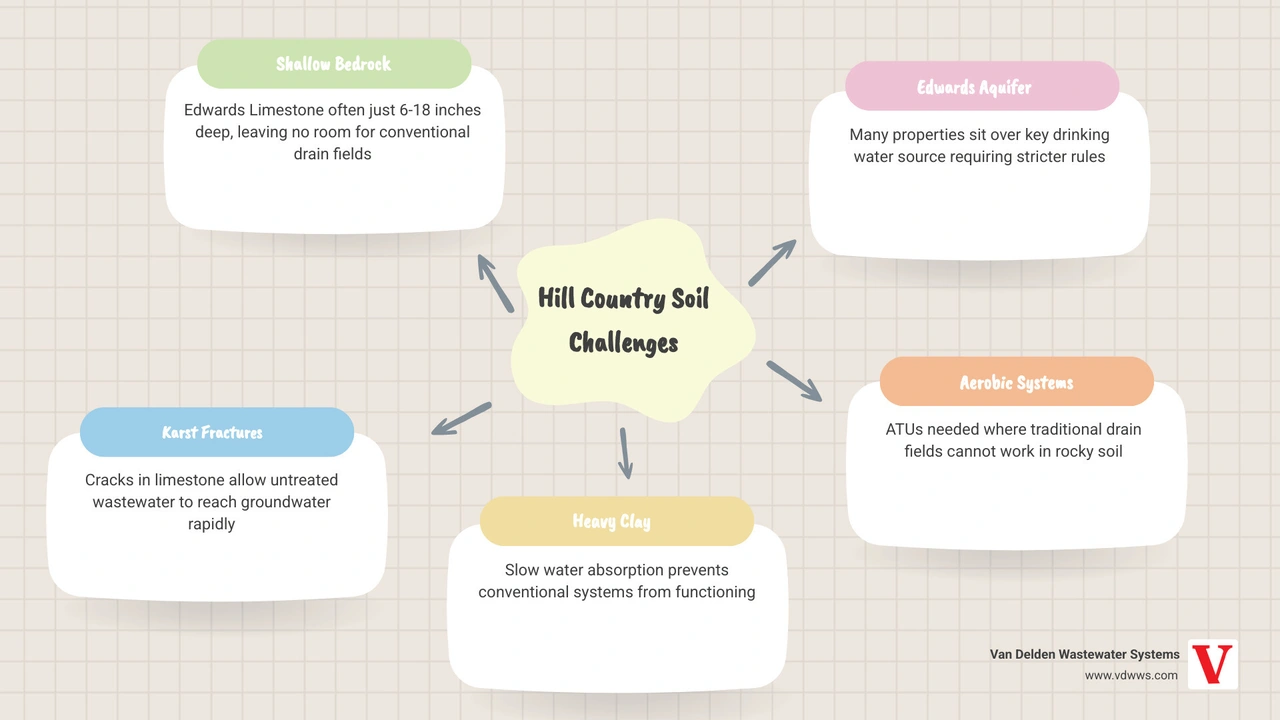
Here's a quick breakdown of the key ways Hill Country soil creates septic challenges:
• Shallow bedrock — Edwards Limestone is often just 6 to 18 inches below the surface, leaving little room for a conventional drain field
• Karst terrain — Fractured rock allows wastewater to move rapidly through underground cracks, bypassing natural soil treatment and threatening groundwater
• Clay soils — Where limestone isn't the issue, heavy clay soils absorb water too slowly for conventional systems to function properly
• Edwards Aquifer proximity — Many Hill Country properties sit directly over one of Texas's most important drinking water sources, triggering stricter permitting rules
• Aerobic systems often required — Because conventional drain fields typically can't work in these conditions, most properties need an aerobic treatment unit (ATU) instead
If you've ever tried to dig a post hole in Hays, Kendall, or Comal County and hit solid rock after a foot, you already have a sense of what septic installers are working with out here. That same geology is why a system that works fine in East Texas or the Panhandle simply won't cut it in the Hill Country.
Understanding these soil conditions isn't just helpful — it can save you from costly failures, permit violations, and serious environmental damage down the road.
To understand why the soil in our beautiful region is so challenging, we have to look at what happens beneath the surface. In a perfect world, a septic system relies on the soil to do the heavy lifting of wastewater purification.
In a conventional setup, wastewater flows from your house into a septic tank, where solids settle to the bottom. The remaining liquid effluent then moves into a drain field (or absorption field). Here, the water slowly percolates through layers of unsaturated soil. Microorganisms living in the soil naturally filter out pathogens, viruses, and harmful nutrients before the water eventually recharges the groundwater.
However, the geology of the Texas Hill Country—stretching through areas like Boerne, Spring Branch, Bulverde, and Helotes—is far from perfect for this passive process.
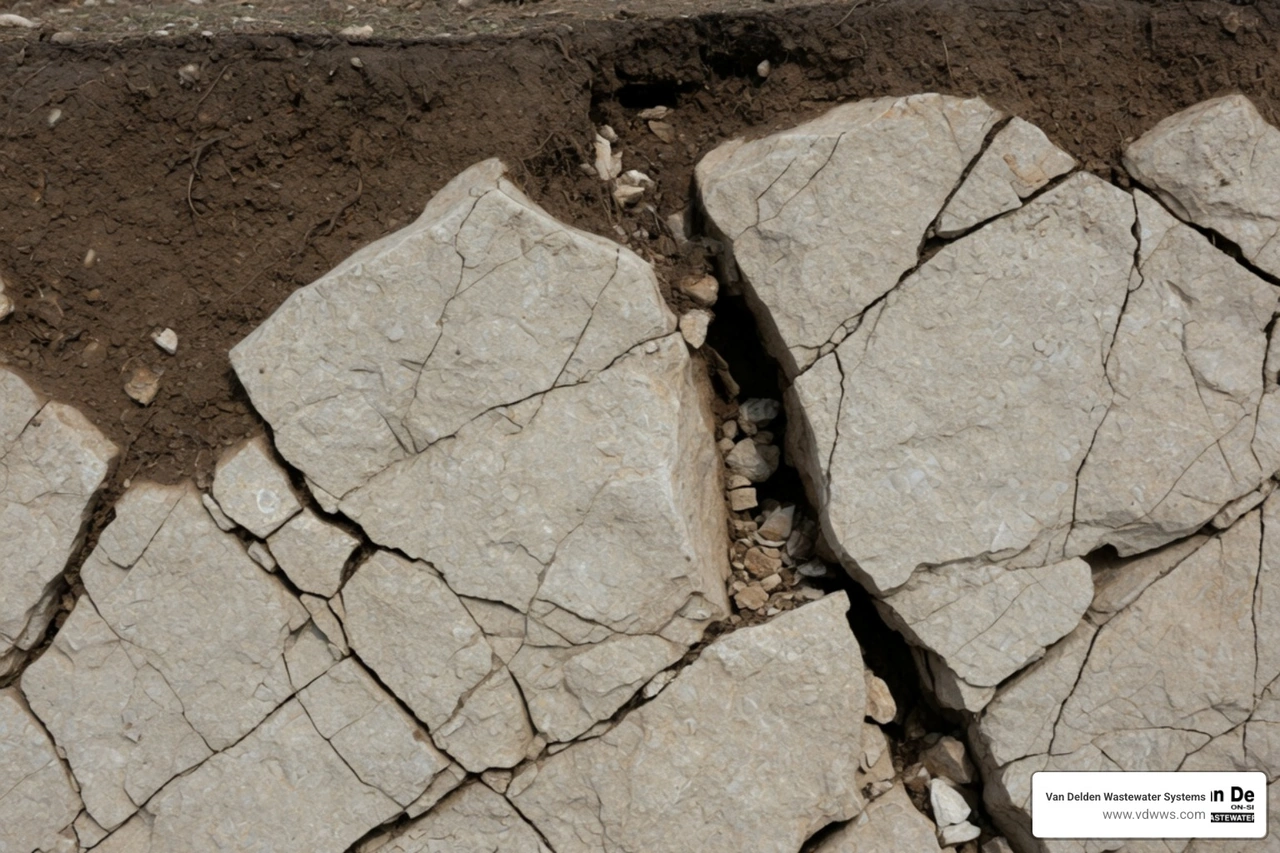
Our region is defined by karst topography. Karst is a geological landscape formed from the dissolution of soluble rocks, principally limestone. Over millions of years, water has carved pathways through our limestone, leaving behind a network of fractures, fissures, caves, and sinkholes.
If you attempt to use a conventional gravity drain field in this environment, gravity does its job too well. Instead of slowly filtering through feet of rich soil, the effluent trickles down a few inches, hits a fracture in the limestone, and rushes directly into the underground water table completely untreated.
This is a massive issue because these same limestone pathways feed directly into the Edwards Aquifer and Trinity Aquifer, which supply drinking water to millions of Texans. When untreated wastewater bypasses natural soil filtration, it risks contaminating local water wells and sensitive spring systems.
Furthermore, if the soil is too thin or compacted, wastewater cannot absorb at all. This results in pooling effluent on the surface of your yard—a smelly, hazardous situation that represents the No. 1 cause of septic system failure.
When we look closer at the soil profiles across our service areas—from Shavano Park and Hollywood Park to Timberwood Park and Fair Oaks Ranch—we find a mix of geology that keeps septic designers on their toes.
In many parts of the Hill Country, the soil is practically nonexistent. We regularly encounter the Brackett-Eckrant soil complex, which is characterized by very shallow, stony clay loam over solid limestone. In these areas, the bedrock is often a mere 6 to 18 inches below the surface.
Because a conventional drain field requires multiple feet of suitable, unsaturated soil beneath the trench bottom to treat wastewater effectively, shallow bedrock immediately rules out basic gravity-fed systems. There simply isn't enough vertical soil depth to clean the water.
If you move toward the eastern edges of the Hill Country or down into parts of San Antonio and Garden Ridge, you run into a different problem: heavy clay. Soils like Houston Black Clay are notoriously dense.
Clay has incredibly small pore spaces, which means it holds onto water tightly and drains very slowly. During a site evaluation, clay soils often yield percolation rates of less than 0.1 inches per hour. When water cannot sink into the ground, a conventional drain field quickly becomes waterlogged, leading to system backups and surface pooling.
Additionally, clay is highly "expansive." It swells up when wet and shrinks and cracks when dry, placing immense physical stress on buried pipes and tanks. If your drain field is failing due to these harsh geological constraints, it is crucial to recognize the signs early and learn how to diagnose and fix drainfield failures before the damage spreads to your home's plumbing.
Because you cannot know what lies beneath your yard just by looking at the grass, every new septic installation or major system replacement must begin with a professional site evaluation.
A site evaluation is a comprehensive assessment performed by a licensed professional to determine exactly what kind of soil and rock formations exist on your specific lot. This process typically includes:
1. Soil Borings (Profile Holes): We excavate profile holes (usually at least two, dug to a depth of several feet or until we hit solid rock) to physically inspect the soil layers, looking for changes in color, texture, and the presence of restrictive horizons like solid limestone.
2. Topography and Slope Assessment: Steep slopes can cause wastewater to run off rather than absorb, which is a common issue on Hill Country hillsides.
3. Identifying Setbacks: We map out the location of water wells, property lines, creeks, and sinkholes to ensure the system is placed a safe distance away.
While online tools like the USDA Web Soil Survey provide a helpful starting point for understanding regional soil trends, they cannot replace an on-site physical evaluation. A single property in Spring Branch can have deep soil on one side and exposed limestone on the other.
Getting a professional soil percolation test in Spring Branch, TX or your local municipality is the only way to secure an accurate, compliant septic design that matches your property's unique footprint.
Once we have completed the site evaluation and analyzed the soil profile, we can select the appropriate septic system design. In the Texas Hill Country, the geology almost always dictates the technology we must use.
• Required Soil Depth — Conventional Septic System: Minimum 2 to 4 feet of good, permeable soil — Aerobic Treatment Unit (ATU): Can be installed in thin soil (uses surface/drip dispersal)
• Limestone / Bedrock — Conventional Septic System: Unsuitable; high risk of groundwater contamination — Aerobic Treatment Unit (ATU): Excellent; treats water to a high standard before dispersal
• Treatment Method — Conventional Septic System: Passive anaerobic bacteria in tank; soil does the filtering — Aerobic Treatment Unit (ATU): Active aeration chamber; mechanical treatment inside tanks
• Dispersal Method — Conventional Septic System: Gravity drain field or gravel trenches — Aerobic Treatment Unit (ATU): Surface spray heads or subsurface drip irrigation
• Maintenance Needs — Conventional Septic System: Low (pump every 3-5 years) — Aerobic Treatment Unit (ATU): High (quarterly inspections required by Texas law)
Choosing between these options requires weighing your property's physical limitations against long-term maintenance expectations. For an in-depth breakdown of these two paths, take a look at our conventional vs aerobic septic guide 2026.
Because the soil cannot reliably treat wastewater in most of our local areas, we have to bring the treatment process inside the septic tanks themselves. This is where an Aerobic Treatment Unit (ATU) shines.
An aerobic system functions like a miniature municipal wastewater plant in your backyard. Instead of relying on anaerobic bacteria (which work slowly without oxygen), an ATU uses an electric aerator pump or blower to inject oxygen into the treatment chamber. This oxygen fuels highly active aerobic bacteria, which break down organic waste much faster and more thoroughly.
The typical process looks like this:
1. Trash Tank: Raw wastewater enters this tank, where heavy solids settle out.
2. Aeration Chamber: The water flows here, where oxygen is constantly bubbled through the liquid, allowing aerobic bacteria to rapidly clean the effluent.
3. Clarifier: A quiet chamber where any remaining fine solids settle back down.
4. Disinfection: The highly treated water passes through a chlorinator (using chlorine tablets or liquid bleach) to kill 99% of remaining bacteria.
5. Pump Tank & Spray Heads: The clean, disinfected water is pumped out through specially designed spray heads, distributing it across a designated "spray field" in your yard where it safely evaporates or waters your lawn.
For a deeper dive into the mechanics of these advanced systems, read our article Aerobic Systems Decoded.
While surface spray fields are incredibly popular, they aren't always practical. If your lot is small, heavily wooded, or has strict setback requirements from property lines and water features, you may not have enough open space for a spray field.
In these scenarios, subsurface drip irrigation is the ultimate problem solver.
Instead of spraying water into the air, a drip system pumps highly treated effluent through a network of flexible, purple tubing buried just a few inches below the grass. These drip lines feature pressure-compensating emitters that release tiny, precise amounts of water directly into the root zone of your lawn.
This design is highly advantageous for several reasons:
• It can be installed in incredibly shallow soil because it doesn't rely on deep percolation.
• There is zero drift or runoff, making it safe for tight spaces.
• It maximizes water conservation by watering your grass from underneath, preventing evaporation.
If you are dealing with a complex layout or tight lot boundaries, discovering when a drip irrigation system is better than a drainfield is an essential step in your planning process. You can also explore the specific drip irrigation benefits for challenging soil types to see how this technology tames even the rockiest Hill Country ground.
Because our local geology is so closely tied to our drinking water sources, septic systems in the Hill Country are heavily regulated. The Texas Commission on Environmental Quality (TCEQ) sets statewide standards under 30 TAC Chapter 285, but local authorities—known as Authorized Agents—often enforce even stricter county-specific rules.
If your property sits within the Edwards Aquifer Recharge Zone or Transition Zone, your design will require additional layers of review. This process ensures that no wastewater can migrate through karst fractures into the public water supply.
Before any excavation begins:
• A licensed designer must submit detailed plans to the county environmental health department (e.g., Bexar, Comal, or Kendall County).
• Permitting timelines typically take anywhere from 2 to 6 weeks.
• A final physical inspection is required before the system can be backfilled and put into service.
Skipping this process is a massive risk. Under Texas law, operating an unpermitted septic system or failing to follow proper installation guidelines can result in fines of up to $10,000 per day of violation. To make sure your project stays fully compliant, consult our guide on septic system regulations for new constructions in South Texas.
Once your system is in the ground, our highly variable Texas weather continues to interact with the soil in ways that affect your septic system's performance.
When the Hill Country experiences intense spring storms, our thin soils saturate rapidly. In clay-heavy areas, this standing water prevents any additional effluent from absorbing. If you have a conventional system, a saturated drain field can lead to slow indoor drains, gurgling pipes, and sewage backing up into your home.
Conversely, our hot, dry summers present a different set of challenges. As clay soils dry out, they shrink and crack. This shifting ground can place physical stress on buried PVC pipes, occasionally causing them to crack or disconnect.
Furthermore, during prolonged droughts, thirsty tree roots will travel incredible distances in search of moisture. They are naturally drawn to the water-rich environment of your septic lines and tanks, occasionally invading pipe joints and causing severe blockages.
To keep your system running smoothly through every season, read up on spring septic care for Texas Hill Country homes and implement smart, proactive habits. Taking small preventative steps is one of the easiest ways to extend your septic system life and protect your investment for decades to come.
Conventional systems rely on a deep layer of consistent, permeable soil to naturally filter wastewater. Because the Hill Country is dominated by shallow limestone bedrock (often only 6 to 18 inches deep) and dense clay, there is rarely enough suitable soil to meet the strict environmental safety standards required for conventional gravity drain fields.
Properties located within the Edwards Aquifer Recharge or Transition Zones are subject to stricter regulations to protect local drinking water. If your property is in these zones, your septic design must undergo a more rigorous permitting review, require larger setbacks from geologic features like sinkholes and caves, and will almost always necessitate an advanced aerobic system with disinfection.
Installing a system without a permit is highly illegal and dangerous. It can lead to severe groundwater contamination, surface pooling of raw sewage, and legal action. Property owners can face fines of up to $10,000 per day from local authorities, and you will likely be forced to remove the non-compliant system and install an approved, engineered system at a much greater expense.
At the end of the day, how Texas Hill Country soil affects your septic system comes down to geology. Our beautiful limestone hills and oak-studded properties are wonderful to look at, but they require specialized engineering beneath the surface to keep our families safe and our water clean.
Since 1937, Van Delden Wastewater Systems has been helping Hill Country homeowners navigate these exact soil challenges. As a family-owned business, we don't believe in guesswork. Our honest, background-checked, and non-commissioned technicians take the time to evaluate your property's unique soil profile, design the perfect system for your needs, and walk you through every step of the process with detailed photo documentation.
Whether you are building a new home in Boerne, Spring Branch, Bulverde, or Helotes, or need to maintain an existing system in San Antonio, we are here to help.
Don't leave your property's safety and value to chance—schedule a consultation for your septic system with our experienced team today!

Peter was personable, professional and thorough. Highly recommend Van Delden. You might be able to find a cheaper company but not better!
On time. 100% professional, knowledgeable, and courteous. Very helpful and straightforward. That is the bar all businesses should strive for.
It has been a pleasure working with your company. Not only did y’all communicate very well but your workers were always polite! Thank you!
“I thank Van Delden for such prompt service. Honest people are hard to come by these days. I will certainly recommend Van Delden to anyone! Jesse is an upstanding young man and very nice to talk to. I thank everyone at Van Delden for taking such good care of me.”
This is just a note to thank you for explaining the problem with my system. You didn’t have to be so kind and I appreciate your good business ethics and time spent. In the future you will have mine in return!