Translating a Septic Inspection Report for Kendall County Homebuyers
Don't let technical septic jargon derail your late-summer closing. We break down which inspection findings are routine maintenance items and which are true dealbreakers.
Drip irrigation benefits for challenging soil types are significant — and if you're dealing with difficult ground, here's what you need to know right away:
| Soil Type | Main Challenge | Drip Irrigation Solution |
|---|---|---|
| Heavy clay | Slow infiltration, runoff, waterlogging | Low-flow emitters, slow delivery, wide spacing |
| Sandy soil | Rapid drainage, nutrient leaching | Frequent short pulses, close emitter spacing |
| Rocky terrain | Uneven wetting, installation difficulty | Flexible tubing, adjusted flow rates, zoning |
| Mixed/variable | Inconsistent moisture across field | Zone-based design, soil-matched emitters |
Bad ground doesn't have to mean bad results. Whether your property sits on thick Texas clay, fast-draining sand, or a patchwork of rocky and mixed soils, the right irrigation approach makes a real difference. Traditional overhead or flood irrigation forces water onto the surface and hopes for the best — but challenging soils often can't keep up. Water runs off clay before it soaks in. It vanishes through sandy ground before roots can use it. Rocky patches leave some areas dry while others flood.
Drip irrigation solves this by delivering water directly to the root zone, slowly and precisely. Research consistently shows drip systems achieve application efficiency of 95% or higher — compared to just 65% for furrow irrigation. That means less waste, better moisture control, and healthier plants, even on the most unforgiving ground.
For Texas homeowners and property managers, this matters especially in areas where soil conditions vary dramatically across a single yard or field.
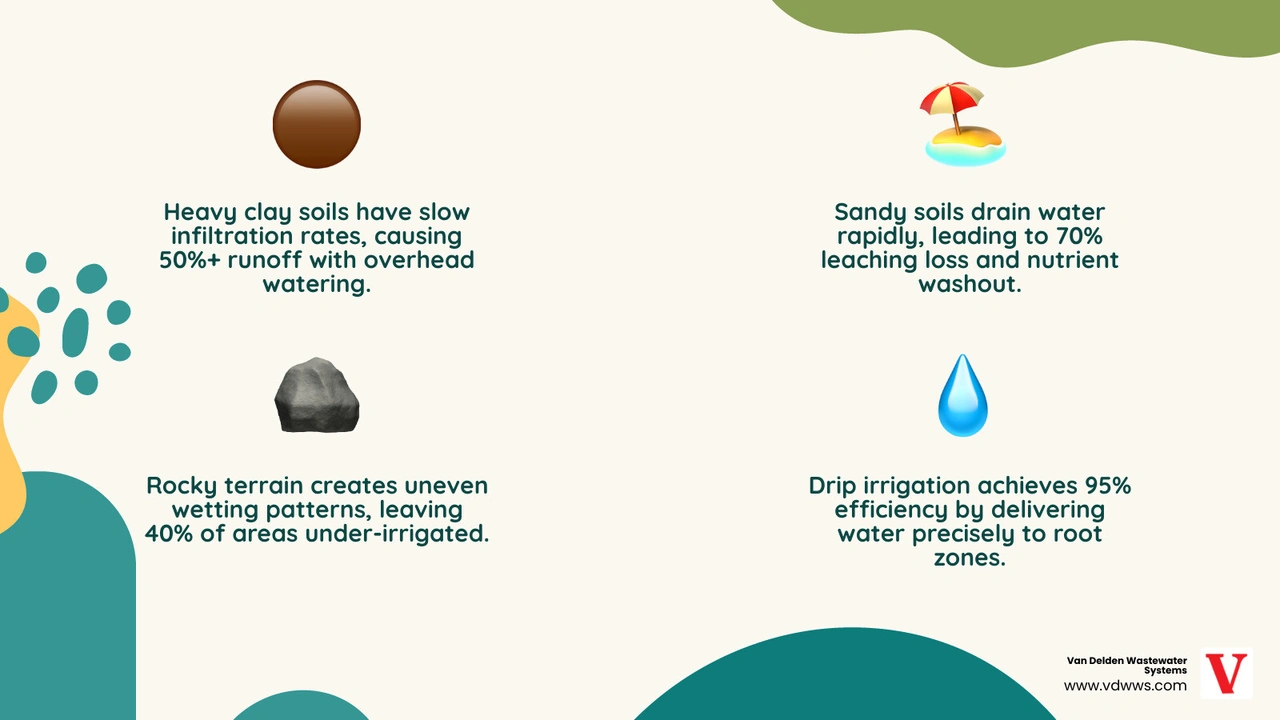
In our experience serving San Antonio, Boerne, and the surrounding Hill Country since 1937, we have seen every imaginable soil struggle. From the heavy "black gumbo" clay in Shavano Park to the limestone-heavy, rocky outcrops in Fair Oaks Ranch, the ground rarely cooperates with standard watering methods.
The primary reason homeowners are turning to drip technology in April 2026 is the sheer efficiency it offers in these environments. When we look at how water moves through soil, two forces are at play: gravity and capillary action. In challenging soils, one usually overpowers the other. In clay, capillary action (sideways and upward movement) is strong, but the soil is so dense that water can't enter quickly. In sand, gravity takes over, pulling water straight down and away from the roots.
Drip irrigation levels the playing field. By delivering water at a rate the soil can actually handle, we prevent the "pooling and runoff" cycle common in San Antonio yards. Furthermore, drip systems are the preferred method for modern wastewater management. An Aerobic system with drip irrigation allows homeowners to safely and efficiently recycle treated wastewater back into their landscapes, even in areas with poor soil drainage.
Statistics show that switching from traditional furrow irrigation to subsurface drip can save approximately 7 inches of water per acre for a standard seasonal requirement. With center pivot systems leaving nearly 22% of a square field unirrigated, drip technology ensures 100% coverage regardless of the field's shape or the soil's stubbornness.
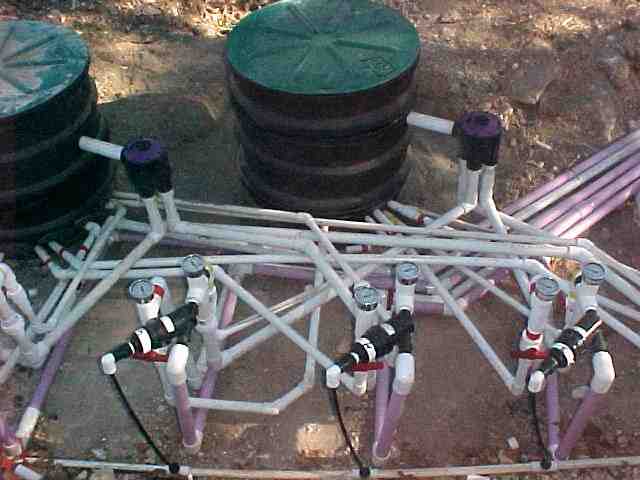
Not all drip systems are created equal. The "secret sauce" for managing difficult ground lies in the hardware—specifically the emitters and how they are spaced. To maximize the drip irrigation benefits for challenging soil types, we must customize the system to the specific geology of your property.
| Soil Type | Emitter Flow Rate | Emitter Spacing | Lateral Spacing |
|---|---|---|---|
| Heavy Clay | 0.4 – 0.6 GPH | 18 – 24 inches | 18 – 24 inches |
| Loam | 0.6 – 0.9 GPH | 12 – 18 inches | 12 – 18 inches |
| Sandy Soil | 0.9 – 1.5 GPH | 8 – 12 inches | 12 – 16 inches |
Clay is notorious for its slow infiltration rate. If you apply water too fast, it simply sits on top, creates a muddy mess, and eventually runs off into the street or a neighbor's yard. This leads to soil crusting, which further prevents aeration and chokes plant roots.
Drip irrigation provides a "slow and low" approach. By using low-flow emitters, we can match the application rate to the clay's slow absorption capacity. This allows the water to spread laterally through capillary action, creating a wide, deep wetting pattern without ever saturating the surface to the point of runoff. This consistent moisture keeps the clay from cracking during our hot Texas summers, protecting both your plants and your home's foundation.
Sandy soil is the opposite of clay; it’s a sieve. Water moves almost entirely downward, meaning if you apply a large amount of water at once (like with a sprinkler), most of it leaches past the root zone before the plant can take a sip. This also washes away expensive fertilizers.
For sandy areas in Spring Branch or Timberwood Park, drip irrigation allows for "pulse" watering. We can schedule frequent, short bursts of water that keep the root zone hydrated without wasting a drop to deep percolation. Because sandy soil has poor lateral movement, we space the emitters closer together to ensure the entire root system is reached. This precision keeps nutrients where they belong—at the roots—and can reduce net irrigation needs by up to 25%.
If you’ve ever tried to dig a hole in Garden Ridge or Helotes, you know that "soil" is often just a suggestion—rocks are the reality. Traditional rigid piping is a nightmare to install in these conditions.
Drip irrigation uses flexible polyethylene tubing that can snake around boulders and through narrow crevices where other systems would fail. In rocky terrain, we often use pressure-compensating (PC) emitters. These ensure that even if the tubing has to go up and over a rocky ledge or down a slope, the water flow remains uniform. This prevents "hot spots" where plants at the bottom of a hill get flooded while those at the top go thirsty.
Subsurface Drip Irrigation, or SDI, takes the benefits of drip technology and hides them beneath the surface—usually between 6 to 18 inches deep. For homeowners dealing with the most difficult landscapes, SDI is often the gold standard.
By burying the lines, we eliminate surface evaporation entirely. The soil surface remains dry, which is a massive advantage for weed suppression. Weeds need moisture at the surface to germinate; SDI denies them that luxury while "spoon-feeding" your desired plants from below.
In our region, SDI is frequently used for Drip irrigation aerobic systems. This setup is ideal for properties where the soil might be too thin or too heavy for a traditional septic drainfield. The treated wastewater is dispersed through the drip lines, where the soil and plant roots provide a final layer of natural filtration.
One unique phenomenon to watch for in SDI is the "chimney effect" or "surfacing." This happens if the water is applied faster than the soil can redistribute it, causing it to "pop" up to the surface directly above the emitter. Proper design by an experienced team ensures that the application rate stays below the soil's threshold, keeping the surface dry and the system efficient.
A drip system is a precision instrument, and like any high-quality tool, it requires regular care—especially when dealing with the high mineral content often found in San Antonio water.
This is where "zoning" becomes your best friend. In a single San Antonio property, you might have a rocky hillside that transitions into a clay-heavy valley. We don't treat these the same. By creating separate zones with different run times and even different emitter types, we can provide the precise amount of water each area needs. A smart controller can then manage these zones based on real-time weather data and soil moisture sensors.
Yes, and it is often the best solution for clay. Because clay has such high retention, you have to be careful not to over-saturate it with wastewater. Drip systems allow us to spread the effluent over a much larger area than a traditional leach field, applying it so slowly that the clay can absorb and treat the water effectively without becoming a swamp.
In rocky ground, the main threat to your lines isn't just internal clogs; it's external damage and soil ingestion. We install air/vacuum release valves at the high points of the system. When the system shuts off, these valves prevent a vacuum from forming, which would otherwise suck dirty water and soil particles back into the emitters. Coupled with a robust filtration station, this keeps the system running clear for 10 to 20 years or more.
Managing a property with difficult soil doesn't have to be a constant battle against the elements. By leveraging the drip irrigation benefits for challenging soil types, you can transform a stubborn landscape into a thriving, water-efficient oasis.
At Van Delden Wastewater Systems, we've spent nearly 90 years helping Texas homeowners navigate the complexities of their land. As a family-owned business, we pride ourselves on honesty and education. Our background-checked, non-commissioned technicians don't just fix problems—they help you understand your system, providing detailed documentation and photos of every service.
Whether you are looking to install a new drip irrigation aerobic system or need expert maintenance on an existing setup in San Antonio, Boerne, or Bulverde, we are here to ensure your system stands the test of time.
Ready to see what a professionally designed drip system can do for your "bad ground"? Contact Van Delden Wastewater Systems today and let's make the most of your Texas landscape.

Peter was personable, professional and thorough. Highly recommend Van Delden. You might be able to find a cheaper company but not better!
On time. 100% professional, knowledgeable, and courteous. Very helpful and straightforward. That is the bar all businesses should strive for.
It has been a pleasure working with your company. Not only did y’all communicate very well but your workers were always polite! Thank you!
“I thank Van Delden for such prompt service. Honest people are hard to come by these days. I will certainly recommend Van Delden to anyone! Jesse is an upstanding young man and very nice to talk to. I thank everyone at Van Delden for taking such good care of me.”
This is just a note to thank you for explaining the problem with my system. You didn’t have to be so kind and I appreciate your good business ethics and time spent. In the future you will have mine in return!