Unpacking the Dosing Tank's Role in Low Pressure Septic Systems
Unpacking the Dosing Tank's Role in Low Pressure Septic Systems
The Hidden Risk of Drainfield Saturation
Your yard is soggy, water is draining slowly from your sinks, and an alarm is buzzing from your control panel. Unpacking the dosing tank's role in low pressure septic systems is the first step to understanding why this happens. In our decades of serving the Boerne area, our team often sees homeowners risk catastrophic drainfield saturation during high-load summer months because they misunderstand how this critical component operates. Recognizing the function of timed dosing—and deciding to call a licensed professional instead of ignoring system alarms—can save your property from a costly disaster.
The unseen danger beneath your lawn: A saturated drainfield is a hidden threat that cannot process household wastewater effectively. When the soil becomes waterlogged, the natural biological treatment process stops. Untreated effluent can back up into your home or pool on the surface of your yard. This creates significant health hazards and environmental issues for your property.
Household activity pushes systems to the limit: Your septic system processes every drop of water that goes down your drains. During peak summer July conditions when household water loads often increase, our technicians frequently see systems working overtime. Extra guests, frequent showers, and multiple loads of laundry send massive volumes of water into your tanks. This sudden influx easily overwhelms a standard gravity system, which is why specialized components are necessary.
The ultimate protector: The dosing tank stands directly between normal operation and catastrophic failure. It acts as a mechanical safeguard, holding back the flood of wastewater and releasing it only when the drainfield is ready to absorb it. Setting the expectation that you must understand this component is key to avoiding costly professional interventions later. When you know how the dosing tank protects your yard, you can better manage your household water usage.
Moving Beyond Gravity: Why Low Pressure Systems Differ
The standard approach: A conventional gravity-fed septic system relies entirely on the natural slope of your land. Wastewater flows out of the house, into the septic tank, and trickles down into the drainfield. Gravity does all the work. However, this passive method requires deep, highly permeable soil to function correctly.
The mechanical alternative: Low pressure systems operate differently. When gravity is not enough to move wastewater effectively, mechanical intervention is required. These systems use electrical pumps and specialized controls to actively push effluent through the distribution pipes. This active approach ensures that wastewater spreads evenly across the entire drainfield, preventing localized flooding.
Our installation crews find that many Boerne TX area properties requiring low pressure systems rely on these mechanical components because the local rocky terrain simply does not support gravity-fed designs. Understanding common septic system types helps clarify why your property uses this specific setup.
Overcoming Natural Limitations
Poor natural percolation rates: The primary reason your property has a low pressure system is the soil. If your soil contains too much clay or sits on top of solid rock, it cannot absorb water quickly. This poor percolation rate forces the need for pressurized distribution. Instead of letting water trickle into one spot, the system sprays it evenly across a large area.
Active distribution: Your system must actively push effluent rather than passively letting it drain. This mechanical reliance means the system requires specialized components that a standard septic tank does not have. The entire operation depends on a carefully calibrated network of pumps and timers to overcome the natural limitations of your property.
• Water Movement — Conventional Gravity System: Passive, relies on land slope — Low Pressure Dosing System: Active, relies on electrical pumps
• Soil Requirement — Conventional Gravity System: Deep, highly permeable soil — Low Pressure Dosing System: Can operate in shallow or tight soils
• Distribution Method — Conventional Gravity System: Trickles continuously into trenches — Low Pressure Dosing System: Pushed in controlled, timed batches
• Component Complexity — Conventional Gravity System: Basic tank and pipes — Low Pressure Dosing System: Requires dosing tank, floats, and timers
Inside the Dosing Tank: The System's Mechanical Brain
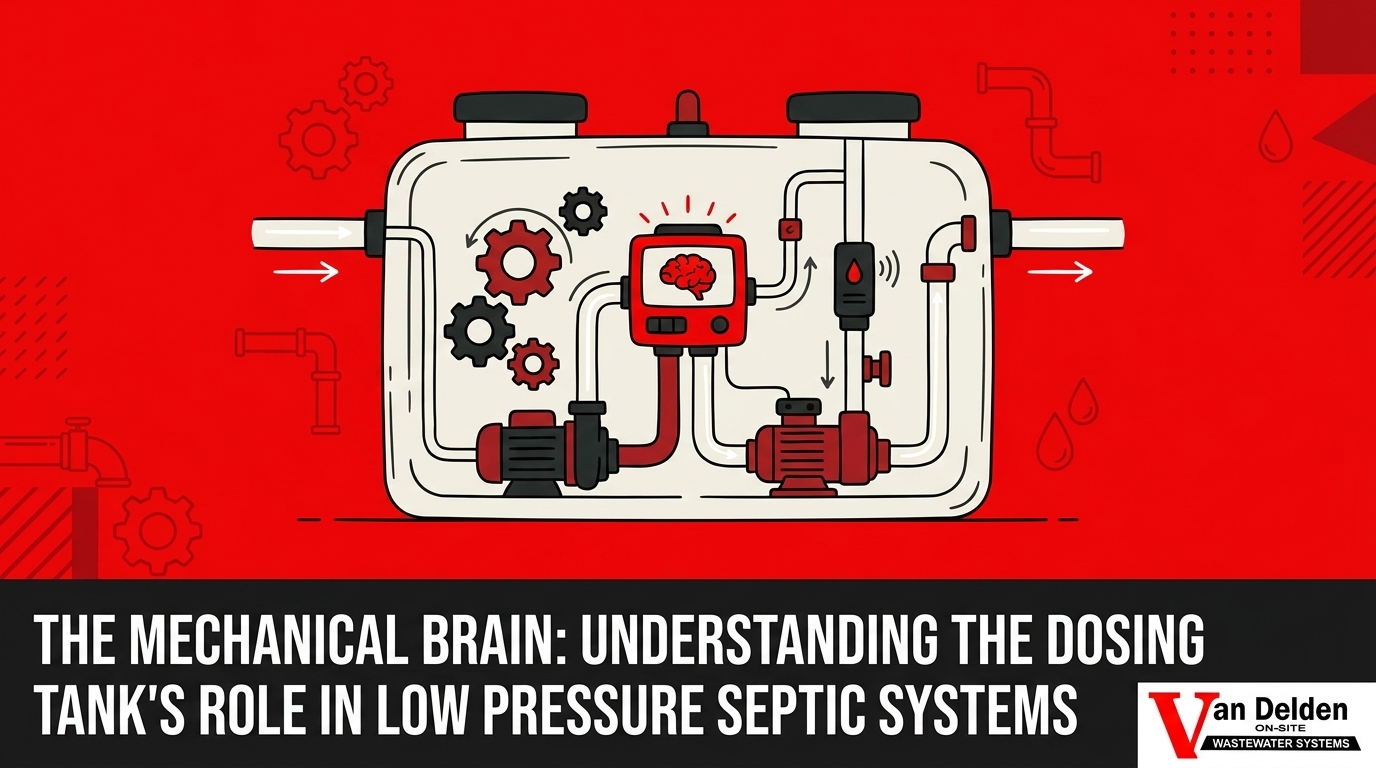
More than just a holding tank: It is easy to view the dosing tank as just another concrete box buried in your yard. However, you must define the dosing tank not just as a holding chamber, but as an active control center. It receives treated effluent from the primary treatment tanks and determines exactly when and how that water moves into the drainfield.
The pump chamber components: Inside this chamber, a submersible pump sits near the bottom. This pump is responsible for managing the wastewater flow, pushing it out to the drainfield under pressure. Alongside the pump, a series of float switches hang at different levels. These components work together in a highly synchronized process.
When our team evaluates complex septic tanks, especially for a first-time owner, a thorough inspection can answer all questions and provide a clean, straightforward understanding of how these internal parts function. This clarity is especially vital during peak summer July conditions when household water loads often increase, putting maximum demand on the pump.
The Role of Float Switches
Acting as sensors: Float switches act as the eyes and ears of the dosing tank. As water enters the chamber, these buoyant devices rise and fall with the water levels. Each float is tethered at a specific height and serves a distinct purpose in the operational sequence.
• The Off Float: Positioned near the bottom, this float drops when the tank is empty, signaling the pump to turn off so it does not run dry.
• The Timer Enable Float: As water rises, this middle float tips upward, telling the control panel that there is enough water to begin a timed dosing cycle.
• The High-Water Alarm Float: Positioned near the top, this emergency float triggers an audible and visual alarm if the water level rises dangerously high.
Professional oversight required: These electrical and mechanical parts require professional oversight to function correctly. The floats must be calibrated to exact specifications. If they become tangled or coated in debris, the entire system loses its ability to manage wastewater.
The Mechanics of Timed Dosing and Absorption
The core protection strategy: Timed dosing is the mechanism that actively protects your drainfield from being overwhelmed. Rather than allowing a continuous stream of water to flow into the yard every time you run the sink, the system holds the water back. It pumps effluent in controlled, measured batches.
For Boerne TX area properties requiring low pressure systems, this controlled delivery is non-negotiable. The soil simply cannot handle continuous saturation. By breaking the daily water usage into manageable doses, the system ensures the soil remains healthy and functional.
The step-by-step dosing cycle:
1. Accumulation: Wastewater flows from the primary treatment tank into the dosing tank throughout the day.
2. Timer Activation: The timer enable float rises, signaling the control panel that a dose is ready. The panel waits for the pre-programmed time interval.
3. Pressurized Delivery: The pump activates, pushing a specific volume of effluent through the distribution pipes and spraying it evenly into the drainfield trenches.
4. The Resting Period: The pump shuts off. The system enters a critical resting phase, allowing the soil to fully absorb the effluent and breathe before the next cycle begins.
The risk of failure: This resting period prevents the drainfield trenches from becoming waterlogged. The soil needs oxygen to support the bacteria that treat the wastewater. If this timed cycle fails and pushes too much water at once, the catastrophic result is a flooded yard, destroyed soil biology, and a ruined drainfield.
The Mechanics of Timed Dosing
Surviving Peak Season: When Timed Dosing Matters Most
The stress of high usage: Your septic system faces its greatest challenges during the summer. Increased guests, frequent laundry days, and multiple showers push maximum stress onto the system. When you host a weekend gathering, your household water usage can easily double or triple normal levels.
The buffer effect: During these high-usage events, the dosing tank acts as a buffer. It holds the excess water until the drainfield is ready. Even if you run three loads of laundry back-to-back, the dosing tank ensures that the drainfield only receives its carefully measured dose at the scheduled time.
During our routine summer maintenance calls, our technicians emphasize that a thorough evaluation of the dosing tank is exceptional service, especially before a property faces high usage. Without a properly functioning dosing tank, peak season loads would instantly flood the yard. This reiterates the importance of ensuring the system is fully operational before high-load periods begin.
Managing the Buffer Zone
Storing the surge: The tank stores incoming surges of wastewater safely underground. During peak summer July conditions when household water loads often increase, the water level inside the tank will rise significantly. This is normal operation, provided the high-water alarm float is not triggered.
Strict regulation: The timer strictly regulates the outflow regardless of how fast water enters the tank. Even if water is pouring in from a busy household, the pump will only push out the pre-set volume. This strict regulation is what prevents the drainfield trenches from drowning under peak-season pressure.
Navigating Shallow Soils and Heavy Rains
Geographical challenges: The environment around your home dictates how your septic system must perform. Boerne, TX features shallow soil over limestone and experiences periods of intense heavy rain. These specific geographical features dictate system requirements and make low pressure dosing absolutely essential.
The double-saturation risk: When intense, sudden downpours hit the Hill Country, the shallow topsoil quickly absorbs the rainwater. If your septic system was simultaneously dumping large volumes of wastewater into that same soil, the ground would instantly flood. The dosing tank prevents this double-saturation of the drainfield (from both rain and wastewater) by holding the effluent back and releasing it slowly.
Our team knows that many Boerne TX area properties requiring low pressure systems rely on this timed release to survive storm seasons. Local environmental factors make generic septic advice dangerous. A strategy that works for deep sandy soil in another state will cause immediate failure in shallow limestone environments. The dosing tank is specifically calibrated to match your exact soil depth and absorption capacity.
Alarm Responses and the Danger of DIY Bypasses
Understanding the warning: When the red light flashes and the buzzer sounds on your control panel, your system is crying for help. A dosing tank alarm actually means one of three things: the water level is dangerously high, the pump has failed, or a float has malfunctioned. It is a critical warning that the buffer zone is full.
The temptation to ignore it: You must resist the temptation to silence the alarm and ignore the underlying issue. The alarm is your final warning before wastewater backs up into your home or blows out into your yard. Ignoring it guarantees a messy, expensive disaster.
As a family-owned business serving the community since 1937, our team at Van Delden brings decades of specific expertise in Hill Country septic installations. We've seen firsthand that understanding the long-term consequences of ignoring alarms is vital. Never attempt any DIY bypasses to the timed dosing mechanism to "force" drainage. Bypassing the system directly leads to irreversible drainfield destruction, which is one of the most common causes of septic drainfield failure.
Why Professional Intervention is Required
Complex diagnostics: Diagnosing float and pump failures involves electrical and mechanical complexities. A professional must test the control panel, verify the float continuity, and check the pump's amperage draw. These are not tasks for a weekend DIY project.
Safe restoration: Licensed professionals are required to safely restore the system's timed cycle. During peak summer July conditions when household water loads often increase, a failed pump means your entire plumbing system is on borrowed time. Professional diagnostics are the only safe response to an active alarm.
Protecting Your Drainfield with Expert Maintenance
The ultimate protector: The dosing tank is the mechanical brain of your low pressure system. It serves as the ultimate protector of the drainfield, ensuring that the soil is never overwhelmed by sudden surges of household water. By controlling the exact volume and timing of every dose, it keeps your property safe and sanitary.
Proactive care: Proactive care prevents emergency saturation events. Regular inspections of the floats, pumps, and timers ensure that the system remains ready to handle heavy usage. For Boerne TX area properties requiring low pressure systems, our experience shows this maintenance is the key to longevity.
If you suspect your dosing cycle is off, or if you want to ensure your system is prepared for the upcoming season, seek professional evaluations immediately. Learn more about proactive care and professional septic system installation and replacement to keep your drainfield functioning perfectly for years to come.
Frequently Asked Questions
How does a low pressure septic system work?
A low pressure septic system works by using an electrical pump to actively push wastewater into the drainfield. Instead of relying on gravity, the system forces effluent through small holes in the distribution pipes. This pressurized delivery ensures the wastewater spreads evenly across the entire absorption area, which is critical for properties with shallow or tight soils.
What is a dosing tank for a septic system?
A dosing tank is a specialized holding chamber equipped with a pump, float switches, and a timer control panel. It receives treated wastewater from the main septic tank and holds it until a scheduled dosing time. The tank acts as a buffer, preventing the drainfield from being overwhelmed by sudden surges of household water usage.
Why is my low pressure septic alarm going off?
Your low pressure septic alarm is going off because the water level inside the dosing tank has reached the high-water emergency float. This typically indicates that the pump has failed, a float switch is malfunctioning, or the system is receiving more water than the timer is set to pump out. You should reduce your water usage immediately and contact a licensed professional for diagnostics.
How does timed dosing protect a drainfield?
Timed dosing protects a drainfield by delivering wastewater in small, controlled batches with mandatory resting periods in between. These resting periods allow the soil to fully absorb the effluent and breathe in oxygen. Without this timed control, heavy water usage would quickly waterlog the soil, destroying the biological treatment process and ruining the drainfield.
How often should a dosing tank be pumped?
A dosing tank should generally be pumped on the same schedule as your primary septic tank, typically every three to five years. Even though it primarily handles clear effluent, small amounts of sludge and scum can eventually accumulate in the pump chamber. Regular pumping prevents this debris from clogging the pump or the small holes in your drainfield pipes.
Can I bypass my dosing tank if the pump fails?
No, you cannot bypass your dosing tank if the pump fails. Bypassing the timed dosing mechanism forces raw, unregulated wastewater directly into the drainfield, which will cause immediate soil saturation and catastrophic failure. If your pump fails, you must stop using water and have a licensed professional replace the necessary components.
Peter was personable, professional and thorough. Highly recommend Van Delden. You might be able to find a cheaper company but not better!
Wendell E
On time. 100% professional, knowledgeable, and courteous. Very helpful and straightforward. That is the bar all businesses should strive for.
Andy R
It has been a pleasure working with your company. Not only did y’all communicate very well but your workers were always polite! Thank you!
Kate R.
“I thank Van Delden for such prompt service. Honest people are hard to come by these days. I will certainly recommend Van Delden to anyone! Jesse is an upstanding young man and very nice to talk to. I thank everyone at Van Delden for taking such good care of me.”
Charles H
This is just a note to thank you for explaining the problem with my system. You didn’t have to be so kind and I appreciate your good business ethics and time spent. In the future you will have mine in return!