What You Need to Know About Septic System Installation in Welfare, TX
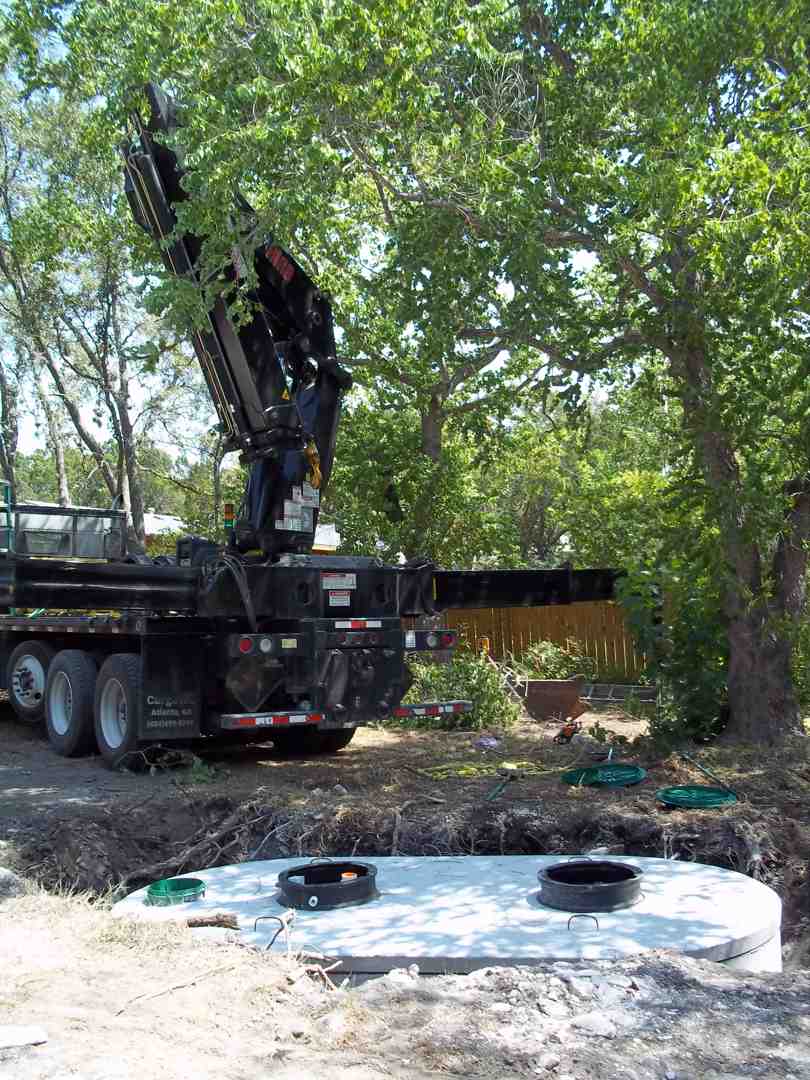
Septic system installation in Welfare TX is more complicated than in most parts of the state — and if you're planning a new build or replacing a failing system, knowing why matters before you break ground.
Welfare sits in the Texas Hill Country, where shallow limestone bedrock and dense clay soils make standard septic solutions difficult or impossible to use. The same geology that makes this area beautiful creates real engineering challenges underground. Many properties here simply don't have the four feet of permeable soil that conventional systems require to treat wastewater safely.
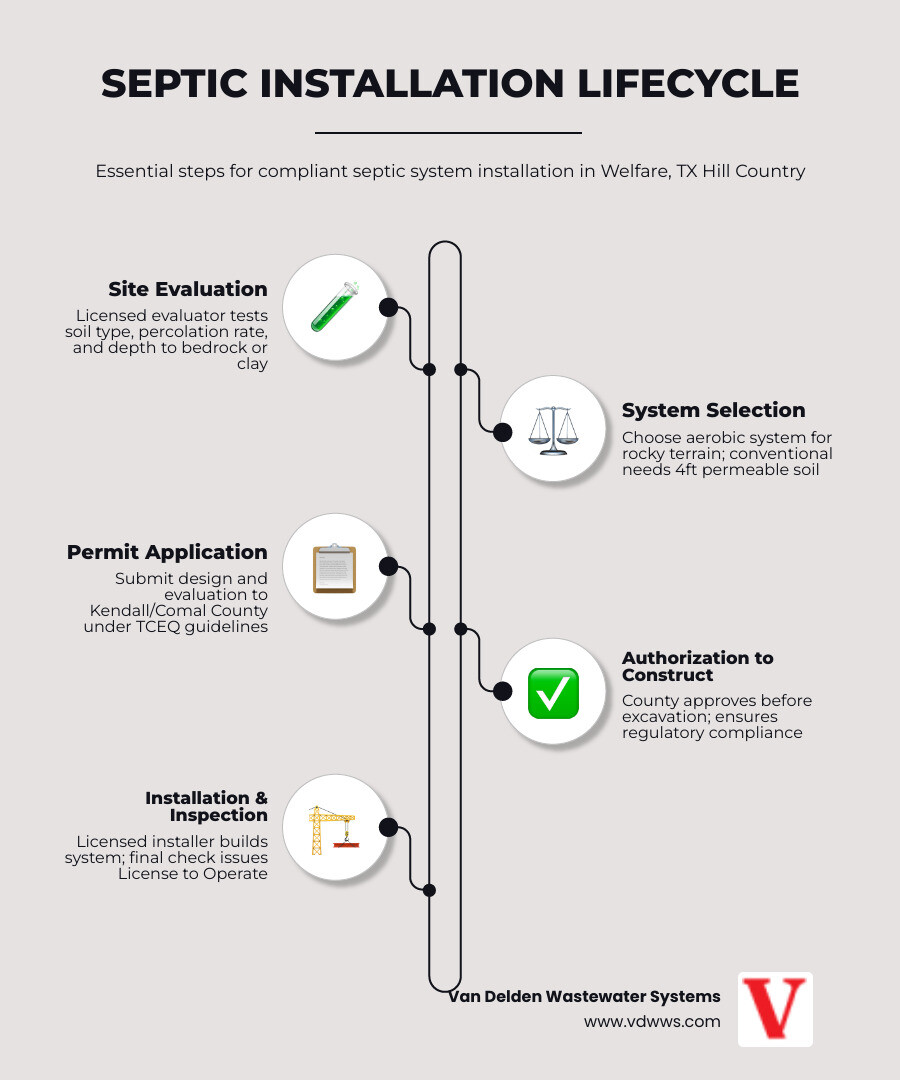
Here's a quick overview of what the installation process involves:
- Site evaluation - A licensed evaluator tests your soil type, percolation rate, and depth to rock or restrictive clay layers
- System selection - Based on soil results, you'll likely need an aerobic system rather than a conventional drain field
- Permit application - Submit your design and site evaluation to Kendall or Comal County Environmental Health under TCEQ guidelines
- Authorization to Construct (ATC) - County issues approval before any excavation begins
- Installation - A licensed installer places the tank, lines, and dispersal components per the approved plan
- Final inspection - A county inspector verifies the system matches approved plans before issuing a License to Operate
Whether you're dealing with a backup right now or planning ahead, understanding these steps helps you avoid costly mistakes and stay compliant with Texas regulations.
Essential septic system installation in welfare tx terms:
Why Hill Country Geology Impacts Septic System Installation in Welfare, TX
When we talk about septic system installation in welfare tx, we aren't just talking about digging a hole and dropping in a tank. The geology of the Texas Hill Country is the primary "antagonist" in the story of wastewater management. Unlike flatter parts of Texas with deep, sandy loam, Welfare is defined by its rugged beauty—which translates to hard limestone and dense Class IV clays just inches below the surface.
These geological features are known as "restrictive horizons." In On-Site Sewage Facilities (OSSF), a restrictive horizon is any layer that limits the ability of water to move downward or be treated by bacteria. If you try to install a standard system where the soil is too shallow, the effluent (wastewater) won't be filtered properly before it hits the bedrock. Once it hits that limestone, it can travel through cracks and fissures directly into our groundwater without being cleaned.
Understanding these local constraints is the first step in a successful project, as detailed in our septic-system-installation-guide-waring-tx.
Navigating Limestone and Clay During Septic System Installation in Welfare, TX
The "Four-Foot Rule" is a critical standard in Texas. Conventional septic systems generally require at least four feet of good, permeable soil to treat effluent effectively. In Welfare, finding four feet of unobstructed dirt is like finding a needle in a haystack.
Most properties here feature:
- Hard Limestone: This requires specialized heavy machinery for excavation. It doesn't absorb water; it diverts it.
- Class IV Clay: This is the densest type of clay. When it gets wet, it expands and becomes nearly waterproof, sealing off drain fields and causing systems to back up into the home.
Because of these drainage challenges, a professional soil evaluation is mandatory. We look for "mottling" in the soil (spots of color that indicate seasonal high-water tables) and test how quickly water can move through the earth. If the soil is too thin or too "tight" (high clay content), a conventional system is legally and practically off the table. For a deeper dive into these requirements, see a-guide-to-septic-system-installation.
Environmental Risks of Improper Installation
Why are the regulations so strict for septic system installation in welfare tx? It comes down to public health and protecting our natural resources. Welfare sits in a sensitive region where the Edwards Aquifer and local tributaries are vulnerable to contamination.
If a system is installed improperly or in the wrong soil type, you risk "effluent surfacing." This is exactly what it sounds like: untreated wastewater bubbling up to the surface of your yard. Not only does this create a terrible odor, but it also exposes your family, pets, and neighbors to harmful pathogens. Furthermore, nitrogen and phosphorus from poorly treated waste can seep into the groundwater, fueling algae blooms and degrading the water quality of the very wells we rely on for drinking. Ensuring a safe install is paramount, as discussed in the septic-install-inspection-waring-tx-guide.
Choosing the Right System: Conventional vs. Aerobic
When planning your septic system installation in welfare tx, you will generally choose between two main types of systems. The "best" one isn't a matter of preference; it’s a matter of what your land can handle.
| Feature | Conventional System | Aerobic System |
|---|
| Treatment Method | Anaerobic (No oxygen) | Aerobic (Oxygen-rich) |
| Soil Requirement | Deep, permeable soil (4ft+) | Can work in shallow/rocky soil |
| Space Needed | Large drain field area | Smaller footprint |
| Maintenance | Low (Pump every 3-5 years) | High (Inspections every 4 months) |
| Dispersal | Underground gravity/pressure | Surface spray or drip irrigation |
For more information on the mechanics of these systems, visit our page on aerobic-system-installation.
Why Aerobic Units Excel for Septic System Installation in Welfare, TX
In the rocky terrain of Welfare, aerobic treatment units (ATUs) are often the only viable option. Think of an aerobic system as a miniature municipal sewage plant in your backyard. Unlike conventional tanks, ATUs use an air compressor to bubble oxygen into the wastewater. This supports "aerobic" bacteria, which are much faster and more efficient at breaking down waste than the "anaerobic" bacteria found in standard tanks.
Because the water coming out of an aerobic system is significantly cleaner, the state allows it to be dispersed on the surface through high-quality spray heads (similar to lawn sprinklers) or through drip irrigation. This bypasses the need for deep soil entirely. The water is disinfected—usually with chlorine—before it is sprayed, making it safe for the environment even in areas with heavy limestone. You can learn more about this process at septic-systems/septic-installation.
Limitations of Conventional Drain Fields
Conventional systems rely on a "drain field" or "leach field." This is a series of perforated pipes buried in gravel-filled trenches. The soil does the heavy lifting of filtering the water. In Welfare, the "restrictive horizons" of limestone and Class IV clay often prevent this filtration.
If you install a conventional system in dense clay, the water has nowhere to go. It eventually fills the trenches and "ponds" underground, eventually backing up into your house. In some cases, "leaching chambers" or "gravel pits" can be used to maximize the available soil, but these still require a minimum depth that many Hill Country lots simply don't possess. Check out our septic-tank-installation-san-antonio-guide for more on these limitations.
The Permitting Process for Septic System Installation in Welfare, TX
You cannot simply start digging a hole for a septic tank in Welfare. Every new septic system installation in welfare tx is regulated by the Texas Commission on Environmental Quality (TCEQ). Depending on exactly where your property sits, you will likely deal with the Kendall County Environmental Health Department or, if you are closer to the county line, Comal County authorities.
The goal of the permitting process is to ensure that the system designed for your home is actually capable of handling your waste without polluting the neighborhood. No work can legally begin until you receive an "Authorization to Construct" (ATC). To understand why these permits are so vital, read permits-are-required-for-septic-system-installation.
Steps to Secure Your Permit for Septic System Installation in Welfare, TX
Securing a permit is a multi-step process that requires professional input:
- Soil & Site Evaluation: A licensed evaluator must visit the property to perform soil borings and assess the topography.
- System Design: Based on the soil report and the number of bedrooms in your home, a designer creates a scaled plan.
- Application Submission: The design, soil report, and application fees are submitted to the county.
- Review Period: The county reviews the plans to ensure they meet all TCEQ Chapter 285 standards.
- Authorization to Construct: Once approved, you get the green light to install.
- Final Inspection & License to Operate: After installation but before the tank is covered, the county inspector must visit the site. If everything matches the plan, they issue your "License to Operate."
We guide our customers through every step of this bureaucratic maze, as noted in our septic-system-installation-inspection-in-welfare-tx.
Professional Requirements for OSSF Design
Because of the geological complexities in Welfare, most systems must be designed by a Registered Sanitarian (RS) or a Professional Engineer (PE). These experts create scaled plans that include:
- Exact location of the tank and dispersal area.
- Calculated flow rates based on home size.
- Required setbacks (e.g., keeping the system a certain distance from wells, property lines, and structures).
- Pump tank sizing and head pressure calculations for spray systems.
Attempting to "DIY" a design in the Hill Country usually leads to permit rejection and wasted time. Professional design ensures your system is built to last, a topic we cover in detail at septic-system-installation-san-antonio-tx.
Maintaining Your System to Prevent Backups and Failures
Once your septic system installation in welfare tx is complete, the work isn't over. Maintenance is a necessity, not a suggestion, especially in our local geology.
A primary cause of backups is sludge buildup. When the sludge level in your tank exceeds 30% of the total volume, there isn't enough room for the solids to settle. This causes "sludge carryover," where solid waste escapes the tank and clogs your drain field or spray heads. This is a "system killer" that can lead to thousands of dollars in repairs. For a guide on handling backups, see our waring-tx-septic-install-backup-guide.
Essential Maintenance for Aerobic Systems
If you have an aerobic system (as most Welfare residents do), Texas law requires you to have a maintenance contract in place. These systems have mechanical parts that will fail if ignored.
- Four-Month Inspections: A licensed provider must inspect the system every four months to check the air compressor, water pumps, and alarms.
- Chlorine Residuals: You must maintain chlorine levels to disinfect the effluent before it sprays onto your lawn.
- Air Compressors: The "heart" of the system must be running 24/7 to keep the bacteria alive.
- Spray Head Clearing: Grass and debris can clog spray heads, causing backpressure on the pump.
Long-Term Prevention Strategies
To protect your investment and prevent future septic failures in Welfare’s challenging geology, follow these "golden rules":
- The 30-Foot Rule: Keep large trees at least 30 feet away from the drain field or spray area to prevent root intrusion.
- Water Conservation: Spread out your laundry loads. Doing five loads on a Saturday can "hydraulically overload" the system, pushing waste through too quickly.
- Garbage Disposal Limits: We recommend avoiding them entirely. They increase the solids in your tank by up to 50%, requiring much more frequent pumping.
- The "Flushable" Myth: Never flush "flushable" wipes, feminine products, or grease. They do not break down and are the #1 cause of pipe clogs.
Frequently Asked Questions about Welfare Septic Systems
How often should I pump my tank in Welfare, TX?
For a standard family of four, we recommend pumping every 3 to 5 years. However, if you use a garbage disposal, you should shorten that interval to every 1 to 2 years. Regular pumping is the cheapest insurance policy you can buy for your septic system. It removes the accumulated sludge before it can escape and ruin your dispersal field.
Are there financial assistance programs for rural septic repairs?
Yes! For homeowners in rural areas like Welfare, the USDA Rural Development program offers Single Family Housing Repair Loans and Grants. These can provide low-interest (often 1%) loans for septic repairs or replacements. Additionally, the TCEQ Nonpoint Source Program sometimes provides funding for watershed protection projects that include septic upgrades. Eligibility usually depends on household income and the age of the homeowner.
What are the early warning signs of a failing system?
Don't wait for a total backup to call us. Watch for these "red flags":
- Gurgling Pipes: If your toilet or drains make a "glug-glug" sound when you run the shower or washer.
- Slow Drains: If multiple drains in the house are sluggish, it’s likely a system-wide issue rather than a simple clog.
- Sewage Odors: Smelling "rotten eggs" in the yard or near the drains.
- Lush Green Grass: If one patch of your lawn is suddenly much greener and faster-growing than the rest, it may be receiving "unauthorized" fertilizer from a leaking pipe.
- Pooling Water: Standing water or soggy spots over the tank or drain field when it hasn't rained.
Conclusion
Septic system installation in Welfare TX requires a specialized touch. From navigating the limestone and Class IV clays of the Hill Country to securing the proper permits from Kendall County, every step must be handled with precision to protect your home and our local environment.
At Van Delden Wastewater Systems, we’ve been a family-owned business since 1937. We pride ourselves on providing professional service with honest, background-checked, non-commissioned technicians. We don't just fix your pipes; we educate you on how your system works. With detailed service forms and photo documentation, you can rest easy knowing the job was done right the first time.
If you're ready to start your project or need an expert eye on an existing system, contact us today for Professional Septic System Installation Services. We are here to ensure your Hill Country home stays comfortable, clean, and compliant for decades to come.