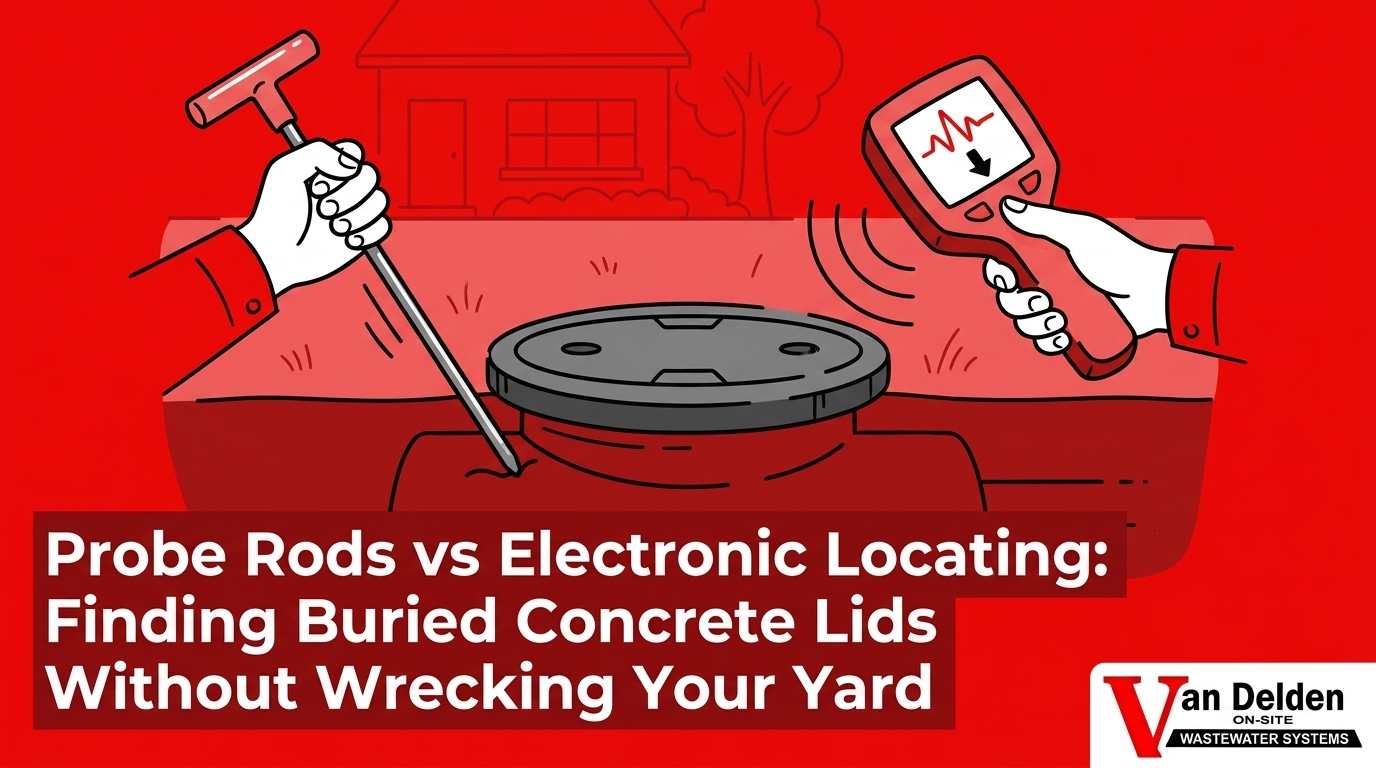
Probe Rods vs Electronic Locating: Finding Buried Concrete Lids Without Wrecking Your Yard
Probe Rods vs Electronic Locating: Finding Buried Concrete Lids Without Wrecking Your Yard
The Myth of the Simple Steel Rod: Why Finding Your Septic Lid Shouldn't Wreck Your Lawn
A common misconception among property owners is that a simple steel rod is the only tool needed to locate underground system components. At Van Delden Wastewater Systems, a pattern we see often is homeowners attempting manual probing, but when evaluating probe rods vs electronic locating: finding buried concrete lids without wrecking your yard is an essential choice for anyone who values their property. The reality of manual probing is often hours of blind stabbing, which leaves your lawn riddled with holes right after the spring landscaping season. Instead of preserving your carefully manicured grass, a probe rod turns your yard into an exploratory excavation site.
For comprehensive information on maintaining your septic tanks, reaching out for professional septic services is the most reliable way to protect your investment.
Deciding between continuing to guess with a metal rod or upgrading to modern electronic locating is a critical choice for property preservation. Blind probing relies entirely on luck and physical endurance, creating unnecessary damage every time you miss the target. Modern professional methods completely eliminate this guesswork. By utilizing pinpoint technology, experts can find the exact access point on the first try, saving both your time and your valuable turf.
The Mechanics and Limitations of Manual Probing
Manual probing involves pushing a long steel or fiberglass rod directly into the ground, hoping to feel the hard resistance of a concrete lid beneath the soil. While the concept sounds incredibly straightforward, our team typically sees how highly flawed the execution is in practice. This technique relies entirely on the user's physical ability to push through packed dirt and their subjective interpretation of what the rod is actually striking. There is no visual confirmation, meaning every "hit" is just an educated guess.
This method also requires significant physical exertion, especially when the lid is buried deeper than a few inches. Pushing a blunt rod through dense soil repeatedly strains the shoulders and back. Without an exact starting point, probing becomes a frustrating game of trial and error spread over a massive surface area. If you are struggling with locating your septic tank, relying on a manual probe rod often multiplies the effort required while yielding highly inconsistent results.
The High Rate of False Positives
The most significant flaw in manual probing is the inability to differentiate materials. A steel rod cannot tell you whether you have struck a concrete lid, a piece of buried debris, or a natural geological formation. The tactile feedback traveling up the shaft of the rod feels nearly identical regardless of what lies beneath the surface.
Striking a false positive invariably leads to unnecessary digging. You grab a shovel, dig down a foot or more, only to discover a large rock. This cycle repeats itself, leaving unsightly, hazardous holes scattered across your property. Each false positive wastes time, damages the root systems of your grass, and leaves your yard looking like a construction zone.
Common Obstacles: What Your Probe Rod is Actually Hitting
When a probe rod stops abruptly, it is rarely the concrete lid you are hoping to find. Our technicians routinely encounter residential yards full of hidden underground hazards that mimic the feel of a solid access cover. Understanding these obstacles highlights exactly why manual probing fails so frequently.
1. Buried Construction Debris: When homes are built, contractors frequently bury leftover materials in the yard before laying sod. Chunks of foundation concrete, discarded bricks, and hardened mortar deposits are routinely mistaken for a concrete lid. Because these items are flat and dense, they provide the exact same solid "thud" against a steel rod.
2. Thick Tree Roots: Mature trees send massive taproots deep into the soil, often extending far beyond the canopy line. When struck blindly from above, a thick, water-dense oak or pecan root feels surprisingly solid. The rod stops instantly, tricking the user into believing they have found the edge of a concrete tank.
3. Large Rocks and Boulders: Natural subterranean rocks present the exact same tactile feedback as a manufactured cover. Depending on the soil composition, a single yard might hide dozens of large boulders just below the surface. Probing through rocky terrain is an exercise in frustration, as every third push results in a hard stop.
4. Compacted Clay Layers: In some yards, distinct layers of ultra-dense clay can stop a fiberglass probe rod completely. The user assumes they have hit a flat surface, but they have simply encountered a soil density too thick for manual penetration.
Every single false positive requires manual digging to verify. You cannot know what the rod hit until you expose it with a shovel. This multiplies the physical labor exponentially and guarantees widespread yard destruction before the actual lid is ever found.
Why Hard-Baked Soil and Shallow Limestone Defeat Probe Rods
The effectiveness of a manual probe rod is entirely dependent on the soil conditions. In peak July summer heat, dry, compacted soil transforms into a brick-like consistency, making manual probing exponentially more difficult and physically grueling. We know firsthand that pushing a blunt instrument through baked earth requires massive downward force, often resulting in bent or snapped equipment rather than successful location.
Regional geology plays a massive role in this difficulty. Properties we service in Boerne TX and across the Edwards Plateau sit on Karst topography, which is characterized by highly irregular, shallow limestone bedrock. This geological reality means the soil depth is wildly inconsistent. In one spot, you might have three feet of topsoil; two feet away, solid limestone sits just inches below the grass.
Because of this shallow limestone, a probe rod will constantly strike bedrock shelves, creating an endless series of false positives. You might map out what feels like a rectangular concrete lid, only to dig down and realize you have outlined a natural limestone shelf. Attempting to manually probe through these specific geological conditions is not just inefficient; it is nearly impossible without causing extreme frustration and ruining your equipment.
How Electronic Locating Pinpoints Concrete Lids
Electronic locating completely bypasses the physical limitations of manual probing by utilizing advanced electromagnetic technology. Instead of guessing what lies beneath the dirt, professionals use a specialized frequency transmitter, often operating at 512 Hz. This small, durable transmitter—commonly called a sonde—is either flushed down a main cleanout or pushed directly into the plumbing lines using a rigid fiberglass camera cable.
Once the transmitter is positioned securely inside the underground structure, a technician uses a highly sensitive handheld receiver above ground. This receiver tracks the exact path and signal strength of the transmitter through the soil, grass, and concrete. As the technician walks the yard, the receiver provides visual and auditory feedback, guiding them directly to the strongest point of the electromagnetic field.
This technology does much more than just find the general area. It pinpoints the exact X and Y coordinates of the concrete lid while simultaneously calculating the precise depth of the transmitter. Knowing that the lid is exactly 24 inches below the surface allows for a targeted, minimal excavation. It completely eliminates exploratory digging, ensuring that the heavy machinery or shovels only break ground exactly where necessary. For property owners managing complex septic systems, this precision is the difference between a minor, clean access hole and a destroyed lawn.
Side-by-Side Comparison: Manual Probing vs. Electronic Precision
Choosing the right method comes down to evaluating the hidden costs of manual labor against the efficiency of modern technology. A direct comparison reveals exactly why relying on a probe rod is an outdated strategy.
• Accuracy — Manual Probe Rods: Relies entirely on guesswork, feel, and subjective interpretation. — Electronic Locating: Provides exact X and Y coordinates using a 512 Hz frequency.
• Depth Calculation — Manual Probe Rods: Impossible to determine until the hole is completely dug. — Electronic Locating: Calculates precise depth to the inch before any digging begins.
• Property Impact — Manual Probe Rods: Causes multiple holes, turf damage, and severed plant roots. — Electronic Locating: Requires only one precise dig spot, preserving landscaping.
• Physical Labor — Manual Probe Rods: Grueling, back-breaking work, especially in dry, hard summer soil. — Electronic Locating: Relies on smart technology, requiring zero blind digging.
• False Positives — Manual Probe Rods: Extremely high; constantly tricked by rocks, roots, and debris. — Electronic Locating: Zero false positives; the receiver only tracks the active sonde.
The reliability factor: Professional locating equipment can easily uncover components that previous manual attempts entirely missed. One recent situation our crew handled highlights this perfectly. A buried tank was completely overlooked by a previous company relying on outdated, manual searching methods. By utilizing precise electronic locating, we pinpointed the missing tank immediately upon arrival. This allowed the system to be accessed and serviced professionally without tearing up the entire yard in a blind search.
Probe Rods vs. Electronic Locating
Preserving Your Property: The True Value of Professional Locating
The financial and aesthetic impact of ruined landscaping almost always exceeds the price of a professional locating service. When you factor in the cost of replacing premium sod, replanting disturbed flower beds, or repairing irrigation lines cut by blind shoveling, the DIY probing method quickly becomes the most expensive option. Professional locating prevents this collateral damage entirely.
Furthermore, expert locating ensures that critical maintenance can begin immediately. Rather than wasting four hours sweating in the July heat trying to find the access point, technicians can spend their time actually servicing the system. This efficiency keeps your property functioning smoothly and prevents minor backups from turning into major household disruptions.
Methods have evolved significantly over the decades, moving away from brute force and toward refined technological precision. As a family-owned business operating since 1937, our team at Van Delden Wastewater Systems has experienced this transition firsthand. Decades ago, probing was the only option available; today, we know it is an unnecessary risk. Choosing modern locating methods protects your property's aesthetics, eliminates physical frustration, and ensures highly accurate system mapping for all future maintenance needs.
Frequently Asked Questions About Locating Concrete Lids
How do you find a buried septic tank lid?
The most reliable way to find a buried lid is by using an electronic 512 Hz transmitter and a handheld receiver. A technician flushes or pushes the transmitter into the system, then tracks the signal from above ground. This pinpoints the exact location and depth without any exploratory digging. Manual probing is an older alternative, but it frequently results in damaged grass and false positives.
Can a metal detector find a concrete septic lid?
Metal detectors generally struggle to find concrete lids unless the concrete was poured with heavy steel rebar inside. Because most standard concrete covers lack sufficient metal mass, a standard detector will either miss it entirely or pick up irrelevant debris nearby. Electronic sondes are required for accurate, non-metallic locating.How deep are septic tank lids usually buried?
Concrete access lids are typically buried anywhere from a few inches to over three feet below the surface, depending on the yard's grading and the original installation. This wide variance in depth is exactly why manual probing is so difficult. Pushing a rod three feet into compacted soil requires immense force and rarely yields accurate results.
Why is my probe rod hitting solid objects that aren't the tank?
Your probe rod is likely striking shallow limestone bedrock, thick tree roots, or buried construction debris left over from when the house was built. Because a steel rod cannot differentiate between materials, any hard object feels like a concrete lid. This leads to high rates of false positives and unnecessary digging.
How does a 512 Hz transmitter work for septic locating?
A 512 Hz transmitter emits a specific, low-frequency electromagnetic signal that easily penetrates dense soil, clay, and concrete. A technician walks the yard with a specialized receiver tuned to that exact frequency. The receiver triangulates the signal, providing the precise location and depth of the transmitter resting beneath the lid.
Stop Guessing and Start Pinpointing Your Septic Components
Protecting your yard and preserving your landscaping is well worth stepping away from the manual probe rod. Blind digging and endless false positives only lead to physical exhaustion and unnecessary property damage. By relying on advanced electronic tracking, you guarantee a clean, efficient process that targets the exact access point on the very first try.
If you are tired of struggling with hard-baked soil and shallow limestone, it is time to utilize the right technology. Reach out for professional septic services to pinpoint your system's components accurately. The right equipment makes accessing a buried lid clean, efficient, and completely stress-free.
Peter was personable, professional and thorough. Highly recommend Van Delden. You might be able to find a cheaper company but not better!
Wendell E
On time. 100% professional, knowledgeable, and courteous. Very helpful and straightforward. That is the bar all businesses should strive for.
Andy R
It has been a pleasure working with your company. Not only did y’all communicate very well but your workers were always polite! Thank you!
Kate R.
“I thank Van Delden for such prompt service. Honest people are hard to come by these days. I will certainly recommend Van Delden to anyone! Jesse is an upstanding young man and very nice to talk to. I thank everyone at Van Delden for taking such good care of me.”
Charles H
This is just a note to thank you for explaining the problem with my system. You didn’t have to be so kind and I appreciate your good business ethics and time spent. In the future you will have mine in return!