
How Deep Is a Septic Tank Buried in the Texas Hill Country?
Generic online advice assumes septic tanks are buried deep in soft soil, but Texas Hill Country limestone changes everything. See why your system may sit much shallower.
How clay and rocky soils create septic challenges is something thousands of Texas homeowners discover the hard way — often after a drain backs up, sewage surfaces in the yard, or a soil evaluation reveals their land simply cannot support a standard system.
Here is a quick breakdown of why these soil types cause problems:
• Clay soil has extremely fine, tightly packed particles that absorb water slowly, sometimes less than 1 inch per hour. Wastewater has nowhere to go, so it pools, backs up, or surfaces.
• Rocky soil and shallow bedrock limit how deep a drainfield can be dug. Without enough soil depth, effluent cannot be properly filtered before it reaches groundwater.
• Both soil types can make conventional gravity-fed septic systems fail — sometimes within just a few years of installation.
• Soils with more than 35% clay content are often considered unsuitable for standard septic systems without engineered alternatives.
• Limestone bedrock within 12 to 24 inches of the surface — common in the Texas Hill Country — can make a traditional drainfield physically impossible to install.
The bottom line: soil is not just the ground your system sits in. It is the treatment system. When the soil cannot do its job, your entire septic setup is at risk.
This guide breaks down exactly what happens underground in clay and rocky soils, what warning signs to watch for, and what your options are when standard systems will not work on your property.
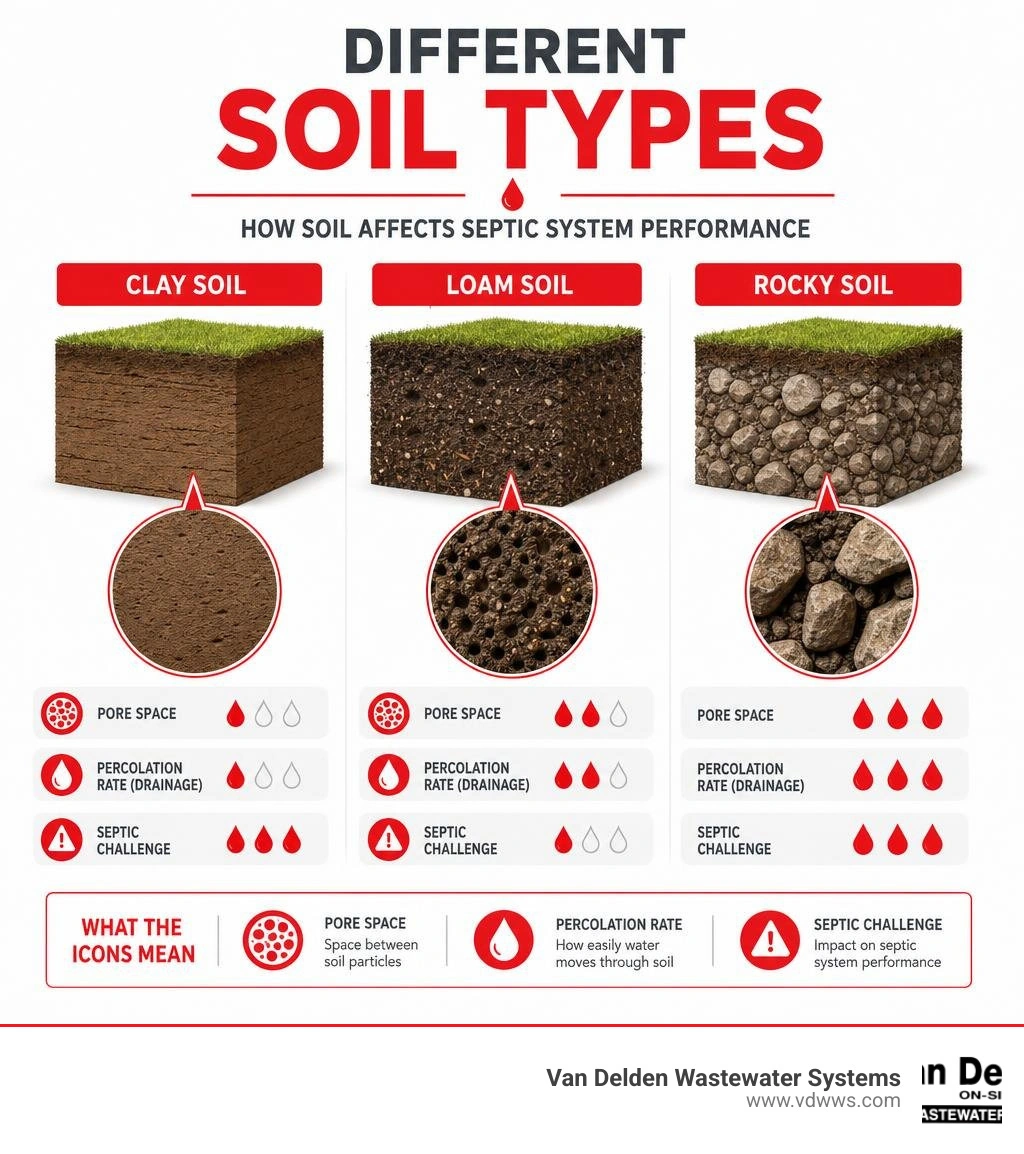
To understand how clay and rocky soils create septic challenges, we have to look at soil the way a wastewater engineer does. Soil is not a solid mass; it is a complex network of mineral particles, organic matter, and the spaces between them.
Soil texture is determined by the relative proportions of sand, silt, and clay. These proportions dictate the size of the "pore spaces" (the tiny pockets of air and water between soil particles). In a properly functioning septic drainfield, these pore spaces are where the magic happens. They hold oxygen, allow wastewater to percolate downward at a controlled rate, and provide a home for the aerobic bacteria that feast on pathogens, viruses, and organic waste.
The rate at which water moves through these pore spaces is known as soil permeability. If the permeability is too high, wastewater rushes through too quickly without being treated. If it is too low, the water stalls, creating a swampy, anaerobic mess.
Before any septic system can be designed or installed in areas like Spring Branch or Bulverde, a professional must perform a soil evaluation. This is where a Soil Percolation Test Spring Branch TX or a comprehensive soil profile analysis comes into play. It measures how fast water is absorbed by the ground, giving us the exact metrics needed to determine what kind of system your land can handle.
To see how these soil types stack up against ideal conditions, consider the properties of clay, rocky, and loam soils:
• Particle Size — Clay Soil: Extremely fine (<0.002 mm) — Rocky Soil / Bedrock: Coarse fragments to solid stone — Loam Soil (Ideal): Balanced mix of sand, silt, and clay
• Pore Space Size — Clay Soil: Microscopic, highly compacted — Rocky Soil / Bedrock: Large, irregular gaps or solid barriers — Loam Soil (Ideal): Moderate, highly connected pores
• Permeability Rate — Clay Soil: Extremely slow (often <0.1 in/hr) — Rocky Soil / Bedrock: Extremely fast (through cracks) or zero — Loam Soil (Ideal): Moderate (ideal for filtration)
• Wastewater Treatment — Clay Soil: Poor (suffocates aerobic bacteria) — Rocky Soil / Bedrock: Poor (bypasses filtration entirely) — Loam Soil (Ideal): Excellent (optimal contact time)
• Septic Suitability — Clay Soil: Unsuitable for conventional systems — Rocky Soil / Bedrock: Unsuitable for standard trenching — Loam Soil (Ideal): Highly suitable for gravity systems
Clay is the ultimate party pooper for conventional septic systems. Clay particles are microscopic—roughly 1,000 times smaller than sand grains—and flat, like tiny plates. Because they are so small and tightly packed, the pore spaces between them are incredibly minute.
Worse yet, many Texas clays (such as the infamous Houston Black Clay found in parts of our region) are "expansive." This means they act like a sponge: they swell when they absorb water and shrink and crack when they dry out. When expansive clay swells, it completely closes off whatever microscopic pore space was left, driving drainage rates down to nearly zero.
This extreme soil compaction prevents wastewater from moving downward. Instead of filtering through the earth, the effluent becomes trapped. When the drainfield cannot absorb the daily volume of water your household produces, you end up with a saturated system. If you are struggling with this issue, understanding the options for Addressing Poor Drainfield Percolation is the first step toward reclaiming your yard.
On the opposite end of the spectrum is rocky soil, which presents an entirely different set of headaches. In the Texas Hill Country—including Boerne, Helotes, and Fair Oaks Ranch—we frequently encounter Brackett-Eckrant complex soils, where hard limestone bedrock sits just 12 to 24 inches below the surface.
When you hit solid limestone bedrock, you run into two major issues:
1. Lack of Depth: Standard gravity drainfield trenches require at least 24 to 36 inches of usable, unsaturated soil below the bottom of the trench to filter out bacteria. If solid rock is just a foot down, there is physically nowhere to dig.
2. Karst Topography: The limestone beneath our feet is full of fractures, cracks, and caves—a geological structure known as karst topography. If raw or partially treated wastewater is allowed to drain directly into these rocky cracks, it finds "preferential pathways." Instead of filtering slowly through soil, the untreated effluent flows rapidly through these underground highways, leading directly to groundwater contamination and threatening the Edwards Aquifer.
If you already have a septic system installed on a property with challenging soil, the ground will eventually tell you if something is wrong.
The most common warning signs of soil-related septic failure include:
• Surface Breakout: This is when wastewater cannot percolate downward and instead forces its way upward, creating soggy, muddy patches directly over your drainfield lines.
• Unusually Lush, Bright Green Grass: While a green lawn is usually a good thing, a strip of hyper-vibrant, fast-growing grass directly over a trench line means the grass is drinking up raw, nutrient-rich wastewater that should be filtering deep underground.
• Slow Drains and Gurgling Pipes: If your toilets are slow to flush or your sinks gurgle, it may not be a simple clog. It often means your septic tank is backed up because the saturated drainfield can no longer accept water.
• Foul Odors: A distinct, swampy, or sulfurous sewage smell around your yard is a clear sign that anaerobic conditions have taken over.
These issues are frequently compounded by environmental factors, such as high water tables. When heavy rains hit, a perched water table can saturate the shallow soil layer from below, leaving no room for your septic system to drain. You can read more about how this happens in our guide on High Water Tables Impact on Drainfields.
A standard gravity septic system is beautifully simple: waste flows from the house into a septic tank, solids settle to the bottom, and the liquid effluent flows by gravity into gravel-filled trenches in the yard. The surrounding soil then absorbs and treats the liquid.
However, this simple design relies entirely on the soil's natural ability to accept water. In heavy clay, gravity systems quickly run into trouble due to biomat buildup. Biomat is a naturally occurring, jelly-like layer of anaerobic bacteria and organic matter that forms along the bottom and sides of drainfield trenches. In healthy, well-draining soil, this biomat is kept in check by oxygen and aerobic microbes.
But in tight clay, the soil stays constantly saturated, cutting off the oxygen supply. The biomat grows thick and impermeable, acting like a waterproof liner in your trenches. This complete soil saturation means the effluent has nowhere to go, often leading to surface runoff and severe erosion. If you are dealing with sloping yards or runoff issues, protecting your property requires active measures like Preventing Drainfield Soil Erosion.
In our local service areas—from Shavano Park and Hollywood Park to Timberwood Park and Garden Ridge—the geology is highly unforgiving.
During wet seasons, rainwater sinks through the thin topsoil and pools on top of the underlying solid limestone. This creates a temporary, shallow "perched water table." If your drainfield is buried in this shallow zone, it becomes completely submerged in groundwater. When this happens, you will notice standing water that smells of sewage, and your system will completely stop draining.
Additionally, managing these systems requires careful attention to topography. Many Hill Country properties are built on rolling hills, meaning effluent can easily run downhill if the system is not perfectly graded. For homes built on these beautiful but challenging terrains, Managing Drainfield Slopes and Grades is absolutely critical to prevent system failure.
If your property has heavy clay or sits on solid limestone, does that mean you cannot build or live there? Absolutely not. It simply means a standard gravity system is off the table.
Today, wastewater technology allows us to install advanced, engineered septic systems that treat wastewater to a high standard before it ever touches the ground. These systems bypass the limitations of poor soil by treating the effluent inside specialized tanks or distributing it in highly controlled ways. To understand which setup is right for your property, you can explore the Best Septic System Designs for Properties.
Aerobic Treatment Units (ATUs) are essentially miniature, highly advanced municipal wastewater treatment plants for your home.
While a conventional septic tank relies on anaerobic bacteria (which work slowly without oxygen), an ATU uses an electric aerator pump to constantly bubble oxygen through the wastewater. This oxygen fuels highly active aerobic bacteria, which break down organic waste much faster and more thoroughly.
The process typically involves:
1. Pre-treatment: Wastewater enters a trash tank where heavy solids settle.
2. Aeration: The water moves to the aeration chamber, where oxygen is injected to promote rapid bacterial breakdown.
3. Clarification: Remaining fine solids settle out, leaving clear, highly treated water.
4. Disinfection: The treated water passes through a chlorinator or UV light system to kill any remaining pathogens.
5. Spray Distribution: The sparkling clean, disinfected water is pumped to specially designed surface sprinkler heads, which spray it onto your lawn.
Because the water is fully treated and disinfected before it leaves the system, it does not need to filter through feet of deep soil. This makes ATUs the premier choice for properties with solid limestone bedrock or heavy clay in Texas, fully complying with strict Texas Commission on Environmental Quality (TCEQ) regulations.
Another highly effective engineered solution is a pressurized drip irrigation system.
Instead of spraying treated wastewater into the air, a drip system uses a network of flexible, specially designed tubes buried just 6 to 10 inches below the surface. A pump doses the wastewater into these lines under pressure at precise, timed intervals.
Drip irrigation is incredibly effective in clay soil because it delivers water in tiny, slow micro-doses. This prevents the clay from becoming saturated and gives the soil plenty of time to absorb the moisture. If you want to dive deeper into how this works, check out our guide on Drip Irrigation Benefits for Challenging Soil Types.
For many properties with tight soils or limited space, choosing this setup is a game-changer. Learn more about When a Drip Irrigation System is Better Than a Drainfield to see if it is the right fit for your yard.
If you have shallow bedrock but still want a subsurface soil absorption system, a sand mound system is a classic engineered solution.
With a sand mound, we essentially build a natural soil filter above the ground. We import specific, clean septic sand and build an elevated mound over your native soil.
Wastewater is pumped from the septic tank into a gravel bed inside the sand mound. As the effluent trickles down through the sand, the pathogens and organic matter are filtered out. By the time the water reaches the shallow native soil or bedrock below, it is already clean and safe. This ensures the required vertical separation distance is maintained, protecting local groundwater.
If you are planning to buy land or build a home in the San Antonio or Texas Hill Country area, taking the right steps early can save you from massive headaches down the road.
Here is what you should do before signing any contracts:
1. Schedule a Site Evaluation Early: Never buy a piece of land without making the purchase contingent on a successful soil evaluation.
2. Look for Soil Borings: A professional site evaluator will use an auger or dig test pits (soil borings) to examine the soil profile down to 5 feet. This reveals hidden clay layers, shallow bedrock, or signs of seasonal high water tables (such as soil mottling).
3. Know the Local Regulations: In Texas, septic installations are governed by the TCEQ, but local authorities (such as county environmental departments) often enforce even stricter rules. For example, properties located within the Edwards Aquifer Recharge Zone face rigorous design standards and setback requirements to prevent contamination.
4. Consult with Experienced Professionals: Designing a system for challenging soils is not a DIY job. It requires a licensed septic designer or professional engineer who understands the local geology.
Generally, no. If your soil evaluation reveals a high clay content (often classified as Group IV soil under Texas regulations), a standard gravity-fed conventional system will not be permitted. This is because clay's slow percolation rate leads to inevitable system failure, backups, and surface pooling. In these areas, alternative designs like aerobic spray or drip irrigation systems are required.
Shallow limestone bedrock physically prevents the excavation of standard drainfield trenches. Because there is not enough soil depth to filter wastewater before it hits the rock, a conventional system would allow untreated sewage to enter the fractures in the limestone, threatening the Edwards Aquifer. To overcome these excavation limits, property owners must use aerobic systems with surface spray or drip distribution, or construct elevated sand mounds.
If you have a system that relies on clay soil for absorption, you should have your septic tank pumped every 2 to 3 years, compared to the standard 3 to 5 years for homes with ideal soil. Because clay has very little tolerance for suspended solids, even minor solids carryover from an overfilled tank can permanently clog the tiny pore spaces in the clay, leading to rapid drainfield failure. Regular pumping keeps the effluent as clear as possible, protecting your investment.
Understanding how clay and rocky soils create septic challenges is the key to protecting your property, your wallet, and our beautiful Texas environment. Whether you are dealing with the heavy clays of Garden Ridge or the solid limestone of Boerne and Helotes, a standard "one-size-fits-all" approach to septic systems simply will not work.
At Van Delden Wastewater Systems, we have been solving these exact geological puzzles since 1937. As a family-owned business, we believe in doing things the right way. Our honest, background-checked, and non-commissioned technicians are dedicated to educating you about your system. We back up our quality work with detailed service forms and extensive photo documentation, ensuring you know exactly how your system is performing.
If you are planning to build, buy land, or suspect your current system is struggling with local soil conditions, do not wait for a backup to happen. Contact us today to schedule a professional site evaluation and find the Expert Septic Solutions your property deserves.

Peter was personable, professional and thorough. Highly recommend Van Delden. You might be able to find a cheaper company but not better!
On time. 100% professional, knowledgeable, and courteous. Very helpful and straightforward. That is the bar all businesses should strive for.
It has been a pleasure working with your company. Not only did y’all communicate very well but your workers were always polite! Thank you!
“I thank Van Delden for such prompt service. Honest people are hard to come by these days. I will certainly recommend Van Delden to anyone! Jesse is an upstanding young man and very nice to talk to. I thank everyone at Van Delden for taking such good care of me.”
This is just a note to thank you for explaining the problem with my system. You didn’t have to be so kind and I appreciate your good business ethics and time spent. In the future you will have mine in return!