Translating a Septic Inspection Report for Kendall County Homebuyers
Don't let technical septic jargon derail your late-summer closing. We break down which inspection findings are routine maintenance items and which are true dealbreakers.
The clock is ticking on your option period, and you just opened an email containing a dense, highly technical inspection document. Translating a Septic Inspection Report for Kendall County Homebuyers is often one of the most stressful parts of a real estate transaction. Here at Van Delden Wastewater Systems, our team sees this pattern constantly during the August back-to-school closing season, when tensions are high and timelines are incredibly tight. You scan the pages, spot unfamiliar terms like "baffle deterioration" or "drainfield saturation," and immediately wonder if you are about to buy a money pit.
Your anxiety is completely valid, but a long inspection report does not automatically mean you should walk away from your dream home. As local experts who frequently consult with real estate agents and buyers, we know that many terrifying-sounding findings are actually routine maintenance items. The key is separating the simple fixes from the catastrophic failures so you can negotiate effectively. If you need immediate help evaluating a property's wastewater infrastructure, explore our septic systems overview and schedule septic system consultations today.
If you are moving to the area from a region with deep, loamy dirt, you might be surprised by the complexity of your inspection report. The Texas Hill Country's rocky limestone soil fundamentally changes wastewater management. Specifically, the Kendall County / Boerne TX rocky terrain sits on the Edwards Plateau, which features very shallow limestone bedrock. This geological reality frequently disqualifies properties from using traditional conventional leach fields.
Because the soil cannot naturally filter effluent deep underground, local regulations often mandate the use of Aerobic Treatment Units (ATUs). These systems act like miniature municipal water treatment plants right in your backyard. Because they rely on mechanical aeration and surface application, they are inherently more complex than a standard gravity-fed tank. Therefore, it is completely normal to see specialized terminology like "spray heads," "chlorinators," and "drip lines" on your paperwork.
Understanding what happens during a septic system inspection requires knowing how these specific systems operate. Since our family at Van Delden Wastewater Systems began operating in this region in 1937, we have watched these local soil requirements and regulations evolve over decades. This unmatched historical knowledge allows our technicians to quickly identify whether a system was built to the standards of its time and how it holds up against modern Kendall County requirements.
• Conventional Gravity — Typical Soil Requirement: Deep, permeable, loamy soil — Common Report Terminology: Leach field, lateral lines, distribution box — Maintenance Complexity: Low (mostly regular pumping)
• Aerobic Treatment Unit (ATU) — Typical Soil Requirement: Shallow bedrock, rocky terrain — Common Report Terminology: Aerator, chlorinator, spray heads, pump tank — Maintenance Complexity: High (requires ongoing maintenance contract)
In our experience serving Boerne homebuyers, we know that when you are staring down a tight option period, every flagged item feels like an emergency. However, we often find that many technical terms simply indicate that the previous owner deferred basic maintenance. These items can easily be addressed by a licensed professional without overhauling the entire system.
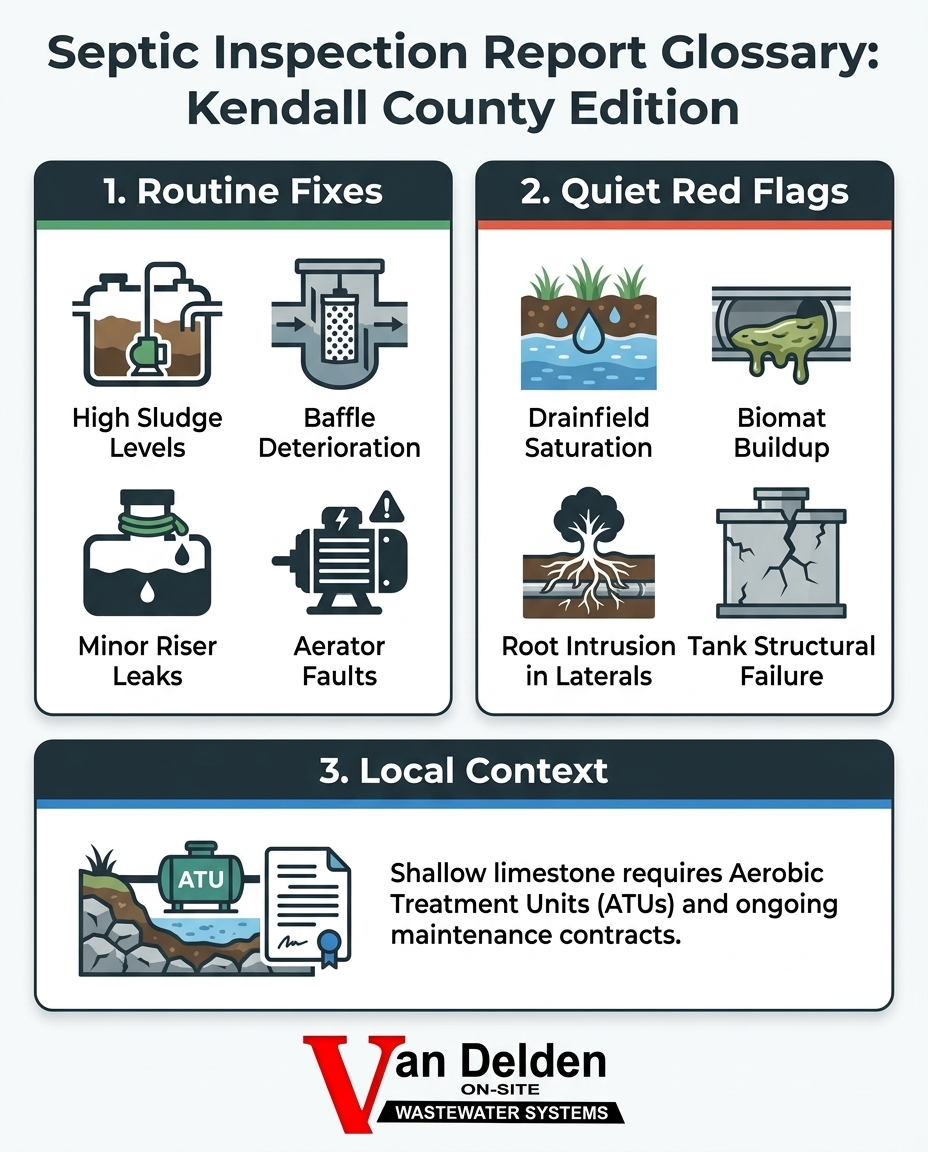
The Problem: The inspector notes that the sludge or scum layers exceed acceptable limits.
The Cause: Waste separates inside the tank. Heavy solids sink to the bottom (sludge), and lighter fats float to the top (scum). Over time, these layers naturally accumulate.
The Solution: This is the equivalent of a car needing an oil change. It is standard maintenance, not a structural failure. A routine pumping service clears the tank and resets the system. If you are negotiating, requesting that the seller pump the tank before closing is a very common and reasonable ask.
The Problem: The report flags "baffle wear" or "missing baffles."
The Cause: Baffles are internal components that direct the flow of wastewater and prevent the floating scum layer from escaping into the drainfield. Because they are exposed to corrosive wastewater gases, older concrete or metal baffles eventually deteriorate.
The Solution: Replacing a worn baffle is a standard, highly manageable repair. A licensed technician can typically install a modern, corrosion-resistant PVC baffle directly through the access port, protecting the rest of your septic tanks from future blockages.
The Problem: The inspector identifies cracks in the access lids or poor seals around the risers.
The Cause: Risers are the pipes that bring the tank access up to ground level. Ground shifting, lawnmower strikes, or simple weathering can damage lids or break the watertight seal where the riser meets the tank.
The Solution: These components are specifically designed to be accessible and replaceable. Resealing a riser or swapping out a cracked lid takes very little time and ensures surface water does not flood the system during heavy rains.
While many findings are routine, certain subtle notes on an inspection report require immediate attention. These quiet red flags indicate severe, systemic failure that goes far beyond basic maintenance. Furthermore, our technicians often warn buyers that the dry August soil conditions we experience in late summer can temporarily hide drainfield saturation that would be glaringly obvious during wet spring months, making a professional inspector's technical measurements absolutely critical.
• Drainfield Saturation: This occurs when the soil surrounding the lateral lines can no longer absorb effluent. The water has nowhere to go, causing it to back up into the tank or surface in the yard. This often points to a failing drainfield that requires complete replacement.
• Biomat Buildup: A biomat is a black, slimy layer of bacteria that forms where the gravel meets the soil in a drainfield. While a thin layer is normal, excessive biomat buildup clogs the soil pores entirely. Once a drainfield is completely sealed off by biomat, it cannot be "cleaned"—it must be replaced.
• Root Intrusion in Lateral Lines: In rocky terrain, tree roots aggressively seek out moisture. If roots have crushed or severely infiltrated the underground pipes, clearing them is often a temporary fix. The structural integrity of the lines is likely compromised.
• Tank Structural Failure: Notes about "cracked tanks," "collapsing walls," or "root penetration through the tank seam" are hard stops for a buyer. A structurally compromised tank cannot safely hold wastewater and poses a sinkhole risk. Replacement is the only viable option.
Because aerobic systems dominate the local market, your report will likely include a section dedicated specifically to ATU components. These systems rely on electricity and mechanical parts to treat wastewater, which means they have moving parts that eventually wear out.
If your report mentions "Aerobic Pump Faults" or "Aerator Failure," do not panic. The aerator is essentially a specialized air compressor that pumps oxygen into the treatment tank to keep the bacteria alive. The effluent pump pushes the treated water out to the spray heads or drip lines. Like any mechanical device, these pumps have a distinct lifespan. Replacing a burnt-out aerator or a faulty pump is a straightforward process for a licensed technician. Similarly, findings related to "Spray Area Runoff" or "Drip Line Clogs" often require adjusting the spray heads, cleaning the filters, or flushing the lines—not necessarily replacing the whole system.
Beyond the mechanical components, you must pay attention to the paperwork. The Texas Commission on Environmental Quality (TCEQ) and Kendall County OSSF regulations require homeowners with ATUs to maintain an ongoing maintenance contract with a licensed provider. During your option period, verify the status of the current maintenance contract. Ask if the contract is transferable to you upon closing, and check if the county has any unresolved compliance violations on file for the property. Inheriting a lapsed contract can result in immediate regulatory headaches.
Once you understand the severity of the findings, you can take actionable steps before your option period expires. The goal is to protect your investment without letting minor issues derail the purchase.
1. Categorize the Findings: Group the report items into routine maintenance (like pumping), mechanical repairs (like a broken aerator), and structural failures (like drainfield saturation).
2. Request Formal Estimates: Never rely on guesswork or the seller's verbal assurances. Have a licensed septic professional provide a formal estimate for the flagged items. This documentation is vital for your real estate agent to support negotiations.
3. Decide Between Repairs or Concessions: You can request that the seller complete specific repairs before closing. For example, our team recently helped a homebuyer who found several tank issues during their purchase inspection. We inspected the tank, identified the specific problems, and advised the buyer to have the seller correct them. The seller handled the issues professionally, allowing the buyer to proceed with the purchase on time. Alternatively, you can request seller concessions—a credit at closing—so you can hire a professional of your choice to handle the repairs after you take ownership.
4. Avoid DIY Solutions: Remind the seller (and yourself) that attempting DIY fixes on any flagged items violates local OSSF regulations and voids warranties. All work must be performed by a licensed professional.
To keep your closing on track, you can request a repair estimate as soon as you receive your inspection report, giving you the hard data you need to negotiate effectively.
A true "failure" usually refers to structural collapse, surfacing effluent, or illegal unpermitted modifications. Routine maintenance needs, like a high sludge level or a broken sprinkler head, are considered repair items rather than total system failures. If the tank is cracked or the drainfield is entirely saturated, the system is fundamentally failing to manage wastewater safely.
Yes, a property can legally be sold with a failing system, but lenders often require repairs before they will fund the loan. If you purchase a home with a known failure, you as the buyer assume all the liability, repair costs, and regulatory burden to bring it up to code. It is critical to negotiate these terms clearly before the option period ends.
A high sludge level simply means the solid waste at the bottom of the tank has accumulated to a point where routine maintenance is necessary. It is not an indicator that the tank is broken or that the system is failing. Having a licensed professional pump the tank will resolve the issue and reset the system's capacity.
Look for sections divided by mechanical function (such as the aerator and pump) and the disposal method (like spray heads or drip lines). Focus primarily on the "action required" or "deficient" items. Because aerobic systems have many moving parts, expect to see notes about filter cleaning or chlorine levels—these are normal operational notes, not necessarily red flags.
Not necessarily. If the seller is willing to negotiate repairs, replace broken components, or offer closing concessions, the property can still be a sound investment. The key is understanding exactly what the repairs entail and ensuring they are completed by a licensed professional rather than relying on a quick, unpermitted fix.
Receiving a highly technical inspection report does not have to be a dealbreaker if you understand exactly what you are reading. By separating routine maintenance from structural red flags, you can navigate your real estate transaction calmly and strategically. The Van Delden Wastewater Systems team frequently guides buyers through this exact scenario. During a recent property inspection, we walked a client through the entire process step by step, explaining every mechanical component and answering all their questions to ensure they felt completely comfortable moving forward with their purchase.
Do not let unfamiliar terminology rush you into a poor decision. Lean on local experts to translate those findings and provide clear, actionable paths forward. Before your option period expires, reach out to schedule septic system consultations so you can close on your new home with total confidence.

Peter was personable, professional and thorough. Highly recommend Van Delden. You might be able to find a cheaper company but not better!
On time. 100% professional, knowledgeable, and courteous. Very helpful and straightforward. That is the bar all businesses should strive for.
It has been a pleasure working with your company. Not only did y’all communicate very well but your workers were always polite! Thank you!
“I thank Van Delden for such prompt service. Honest people are hard to come by these days. I will certainly recommend Van Delden to anyone! Jesse is an upstanding young man and very nice to talk to. I thank everyone at Van Delden for taking such good care of me.”
This is just a note to thank you for explaining the problem with my system. You didn’t have to be so kind and I appreciate your good business ethics and time spent. In the future you will have mine in return!