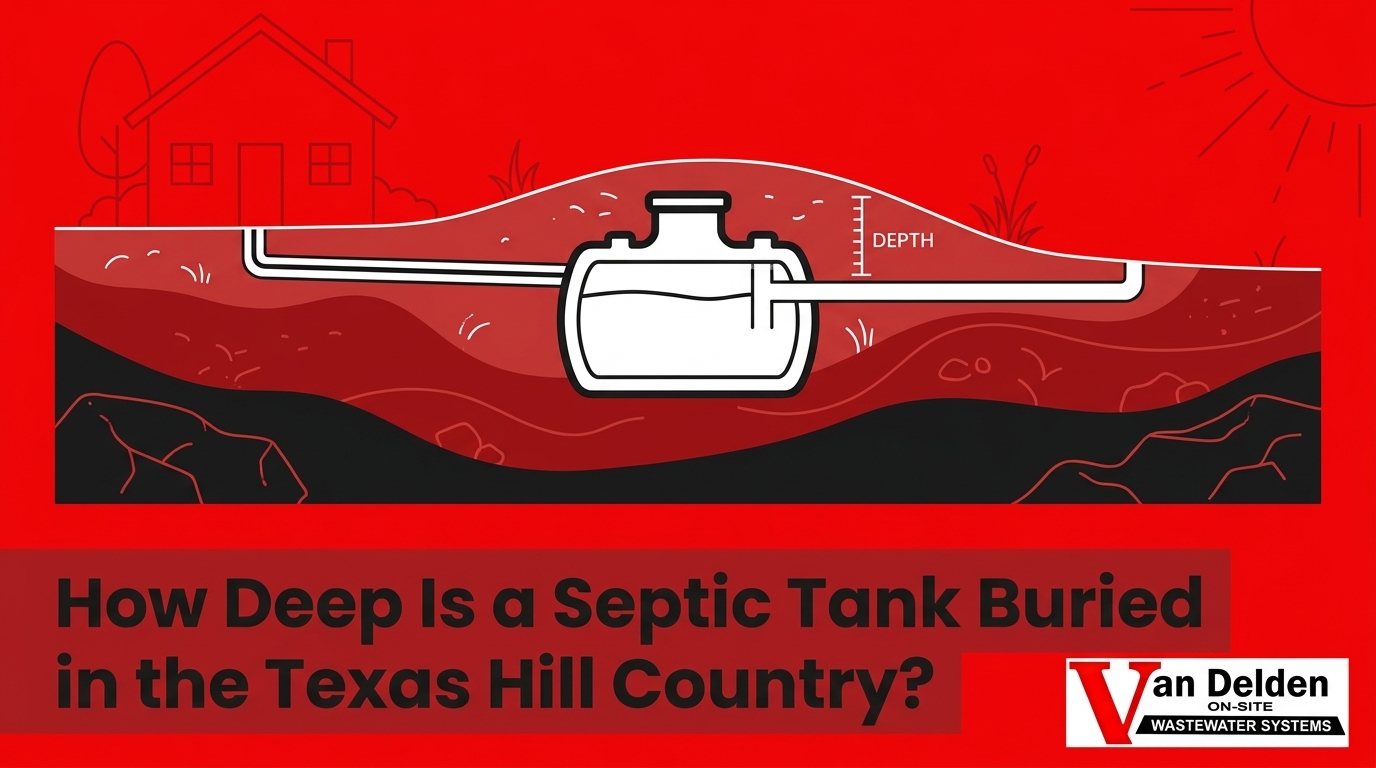
How Deep Is a Septic Tank Buried in the Texas Hill Country?
Generic online advice assumes septic tanks are buried deep in soft soil, but Texas Hill Country limestone changes everything. See why your system may sit much shallower.
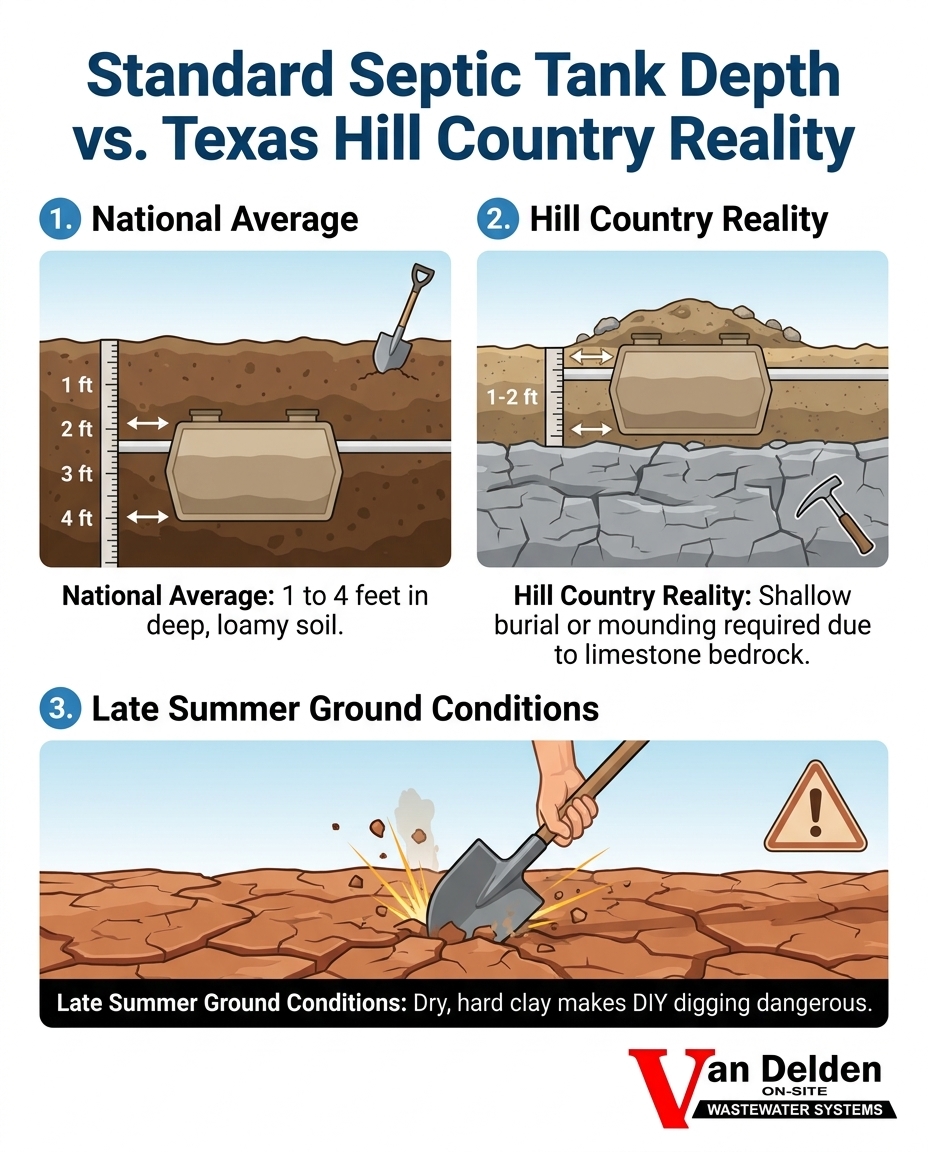
Are you trying to figure out how to locate your system for maintenance, only to find that standard online advice doesn't match your property? When customers ask our team, "How Deep Is a Septic Tank Buried in the Texas Hill Country?", the generic answers they find on the internet usually assume they live somewhere with deep, soft dirt. The short answer is: While national averages suggest 1 to 4 feet, we routinely see Texas Hill Country septic tanks buried much shallower or requiring mounding due to solid limestone bedrock.
If you are planning a new installation or searching for an existing lid in the Boerne area, relying on national averages will quickly lead to frustration. Standard depths simply do not apply when you are digging into solid rock. Understanding the unique geological makeup of your property is the first step in properly maintaining or planning your wastewater management setup. For comprehensive guidance on how these regional factors impact your property, learning about custom septic systems designed for rocky terrain is essential.
The problem with one-size-fits-all advice: Most online guides fail to account for the physical limitations of the Edwards Plateau. When homeowners expect a tank to be buried three feet deep, they often dig right past a shallow lid or assume their system is missing entirely. In our experience, understanding how local geology dictates installation depth helps you avoid unnecessary digging, prevent damage to your property, and ensure your system operates exactly as intended.
In most parts of the country, excavators have the luxury of working with deep, loamy soil. In these regions, tanks are typically buried 1 to 4 feet below the surface. This depth protects the tank from heavy surface loads, provides adequate soil coverage for the drain field, and—in northern states—keeps the system safely below the frost line so it does not freeze during the winter.
However, the Texas Hill Country sits directly on the Edwards Plateau. This region is characterized by highly permeable, cracked limestone bedrock covered by very thin layers of stony clay. When our crews attempt to dig a standard hole in Boerne, TX, we often hit impenetrable rock just a few inches beneath the topsoil. Solid rock physically prevents standard deep excavation without specialized, heavy-duty rock-milling equipment, which drastically changes how and where we can place a tank.
Furthermore, the regional climate compounds this challenge. The extreme heat of the late Texas summer bakes the thin topsoil, turning the stony clay into a concrete-like surface. Because frost lines do not dictate burial depth in this warm climate, our installers are not forced to dig deep to prevent freezing. Instead, we modify the design to work with the bedrock rather than fighting against it.
• Typical Burial Depth — National Average (Deep Soil): 1 to 4 feet below the surface — Texas Hill Country Reality: Often inches below the surface, or mounded above ground
• Primary Soil Type — National Average (Deep Soil): Loam, sand, or deep clay — Texas Hill Country Reality: Thin stony clay over solid limestone bedrock
• Excavation Equipment — National Average (Deep Soil): Standard backhoe or excavator — Texas Hill Country Reality: Specialized rock saws, hammers, or alternative designs
• Climate Consideration — National Average (Deep Soil): Buried deep to avoid winter frost lines — Texas Hill Country Reality: Shallow placement permitted; extreme summer heat hardens topsoil
When our installers hit solid rock just below the surface, we cannot simply stop digging and leave the tank exposed, nor can we always blast through the bedrock. Instead, the design of the entire wastewater setup must be altered to accommodate the terrain. Since 1937, our team at Van Delden Wastewater Systems has gained decades of hands-on experience designing custom systems that meet strict state regulations despite these challenging rock formations.
Understanding how a standard septic system must be modified for the Texas Hill Country requires looking at both state laws and practical engineering solutions we implement daily.
The Texas Commission on Environmental Quality (TCEQ) enforces Chapter 285 regulations, which dictate specific soil depth requirements for On-Site Sewage Facilities (OSSF). These rules exist to ensure that wastewater is properly treated before it reaches the groundwater supply. In areas like Boerne, the highly permeable, cracked limestone poses a risk of wastewater moving too quickly into the aquifer without adequate filtration.
To comply with TCEQ regulations, we must prove there is enough suitable soil beneath the drain field to treat the effluent. When minimum soil depth requirements cannot be met naturally due to shallow bedrock, alternative designs must be engineered and approved. This often dictates that the main holding tank must also be placed shallower than average to maintain the proper gravity flow or pumping dynamics required for the modified drain field.
When underground burial is physically impossible or prohibitively difficult due to solid limestone, our installers utilize mounded or shallow-burial configurations. In a shallow burial, the top of the tank may sit just inches below the grass line.
If the rock is completely impenetrable at the surface, a mounded system may be required. In this configuration, the tank and the drain field are built partially or entirely above the natural grade. We bring in specialized sandy loam or suitable fill dirt to create an artificial mound over the components. This provides the necessary soil depth required by TCEQ regulations and protects the tank from the elements, even though it is technically sitting above the original bedrock line. These modified depths directly impact the overall design, often requiring pump tanks to move effluent upward into the mounded drain field.
Because tanks in the Texas Hill Country are frequently installed at non-standard depths to bypass rock shelves, locating the access lid for routine maintenance can be incredibly frustrating. You might assume that a shallow tank would be easier to find, but that is rarely the case. Over the years, landscaping, overgrown vegetation, and topsoil runoff can completely obscure the lid, making it invisible to the naked eye.
Older systems present an even greater challenge. Decades ago, installers often had to get creative to navigate around massive limestone boulders or solid rock shelves. As a result, we frequently find older tanks tucked away at an odd angle or buried just deep enough under a layer of stony clay to remain hidden, rather than sitting directly behind the house.
Finding these hidden components often requires professional persistence. Recently, a homeowner in the Texas Hill Country reached out to us after struggling to find a tank that a previous service company had completely missed. By relying on our specialized tracking equipment and a thorough understanding of local installation quirks, our technicians successfully located the hidden tank, proving the value of our local expertise in this unpredictable terrain.
When a lid is hidden, many homeowners are tempted to grab a shovel and start probing the yard. However, exploratory digging is always risky. You run the very real danger of striking buried electrical lines, plumbing pipes, or physically damaging the fiberglass or concrete of the tank itself.
This risk is magnified by the regional climate. By late summer—specifically during dry August stretches as families are busy transitioning back to school—we see the Texas topsoil become extremely compacted. The combination of intense heat and a lack of moisture turns the stony clay into a surface that feels like concrete. Attempting to dig through this baked earth with hand tools is physically exhausting and highly ineffective. Understanding how rock depth dictates septic tank burial is crucial, but it does not mean you should attempt to excavate it yourself.
The dangers of blind probing:
• Physical Injury: Striking shallow limestone forcefully with a metal probe rod or shovel can cause severe jarring injuries to your wrists and shoulders.
• Equipment Damage: Many online DIY guides suggest probing the yard blindly with metal rods. If you strike a PVC pipe or a shallow fiberglass tank lid, you can puncture it, leading to costly repairs.
• Utility Strikes: Digging without precise knowledge of underground utility lines is a safety hazard that can disrupt service to your home or cause serious harm.
Because DIY excavation is dangerous and often fruitless in the Hill Country, our professionals at Van Delden use specialized, non-destructive methods to locate hidden lids. These techniques rely on technology and historical records rather than blind digging.
1. Reviewing County As-Built Records: The first step is often administrative. We can pull permit drawings and "as-built" records from the county. These documents provide a map of where the system was originally installed, offering a highly accurate starting point.
2. Electronic Locating Devices: If records are missing or inaccurate, our technicians use flushable electronic transmitters. A small transmitter is flushed down a toilet, and as it travels through the main sewer line into the tank, a technician walks the yard with a specialized receiver to track its exact path and final resting spot.
3. Targeted Probing: Once the general area is identified via records or electronics, our experienced technicians use safe, targeted probing methods. Because we know exactly what we are feeling for, we can differentiate between a natural limestone shelf and the concrete lid of a tank.
4. Installing Risers: Once the lid is finally uncovered, we highly recommend installing access risers. Risers are durable pipes that bring the access point up to ground level. Installing risers eliminates the need for any future digging, making routine maintenance completely hassle-free regardless of how hard the ground gets in August.
If you are buying land or a new home in the Boerne area, understanding how the geology affects your property plans is vital. You cannot simply assume that a standard, deep-soil system will work on your lot. Buying land in the Hill Country requires a thorough site evaluation to identify the exact depth of the bedrock before any construction begins.
Soil testing and site planning dictate the entire design of your wastewater facility. Our evaluators dig test holes to determine how much workable soil exists before hitting solid limestone. This data tells our engineers whether a standard system can be squeezed in, or if a mounded, aerobic, or alternative design is required to meet state codes.
Working with local experts who understand this process is invaluable. For example, our team recently worked with a first-time homeowner in the Boerne area who had numerous questions about their unfamiliar setup just before the school year started. A thorough site evaluation and step-by-step explanation from our inspector gave them the confidence to understand exactly how their system operated in the rocky terrain. Proper planning and clear communication prevent costly surprises during excavation and ensure your home has a reliable wastewater solution for decades to come.
While national averages suggest 1 to 4 feet, we often install Texas Hill Country tanks much shallower due to limestone bedrock. In areas with deep soil, you might find them a few feet down, but in rocky terrain, the lid may be just inches below the surface. The exact depth depends entirely on the geological makeup of your specific property.
The safest way to find a lid without digging is to review your county's "as-built" permit records, which provide a map of the installation. If records are unavailable, our professionals use flushable electronic transmitters and specialized receivers to track the exact location of the tank from above ground. This prevents the need for dangerous and exhausting blind probing in hard soil.
TCEQ regulations and manufacturer specifications generally require a minimum of a few inches of topsoil to protect the lid and components from surface traffic and weather. However, in rocky Texas terrain, we minimize the dirt cover to avoid digging deeper into the bedrock. Once located, we recommend installing a riser so no dirt needs to be removed for future maintenance.
Yes, when solid limestone bedrock prevents underground burial, tanks and drain fields can be incorporated into mounded systems. In these setups, the components are placed at or slightly above natural grade, and suitable fill dirt is brought in to cover them. This creates an artificial mound that complies with state environmental regulations.
Your tank is likely shallow because the original installer hit impenetrable limestone bedrock shortly after breaking ground. Rather than utilizing expensive rock-milling equipment to dig a deep hole, the system was designed to sit higher in the soil profile. This is a standard and legally compliant practice in the rocky terrain of the Edwards Plateau.
The Texas Commission on Environmental Quality (TCEQ) Chapter 285 dictates that there must be adequate soil depth below the drain field to properly treat wastewater before it reaches groundwater. If the natural soil is too shallow due to bedrock, alternative designs like mounded or aerobic systems must be used to meet the treatment requirements.
Understanding the local geology is the key to proper wastewater management in Boerne and the surrounding areas. Whether you are trying to locate a hidden lid buried under hard August clay or planning a new build on a rocky lot, generic advice simply won't cut it. Finding a lid in rock-hard ground shouldn't be a DIY guessing game, and designing a new system requires precise knowledge of the Edwards Plateau bedrock.
Don't risk injury or property damage by probing blindly in the yard. If you need assistance finding your tank, or if you are ready to plan a custom septic tank installation tailored to your property's unique geology, reach out to our team at Van Delden Wastewater Systems. Schedule an inspection or consultation today to ensure your system is properly located, legally compliant, and ready for years of reliable service.

Peter was personable, professional and thorough. Highly recommend Van Delden. You might be able to find a cheaper company but not better!
On time. 100% professional, knowledgeable, and courteous. Very helpful and straightforward. That is the bar all businesses should strive for.
It has been a pleasure working with your company. Not only did y’all communicate very well but your workers were always polite! Thank you!
“I thank Van Delden for such prompt service. Honest people are hard to come by these days. I will certainly recommend Van Delden to anyone! Jesse is an upstanding young man and very nice to talk to. I thank everyone at Van Delden for taking such good care of me.”
This is just a note to thank you for explaining the problem with my system. You didn’t have to be so kind and I appreciate your good business ethics and time spent. In the future you will have mine in return!