How Late-Summer Soil Compaction Threatens Your Shallow Aerobic Lines
How Late-Summer Soil Compaction Threatens Your Shallow Aerobic Lines
The Hidden Danger Beneath Your Late-Summer Lawn
The relentless August heat is here, and your lawn is feeling the burn. As summer peaks, the ground beneath your grass undergoes a drastic physical transformation that most homeowners never see coming. Understanding exactly how late-summer soil compaction threatens your shallow aerobic lines is critical to preventing thousands of dollars in property damage. When heavy lawn maintenance equipment meets rapidly shifting soil conditions, your buried wastewater infrastructure is suddenly put at risk. Shallow aerobic lines are uniquely vulnerable right now, requiring proactive awareness rather than reactive panic. Ignoring those mysterious wet spots in your yard can quickly lead to a total system backup.
Why Clay Soil Turns Into Concrete Under the Texas Sun
The transition from spring to late summer brings a massive environmental shift beneath your feet. In the spring, regular rainfall keeps the ground spongy and forgiving. But as the severe August heat sets in across Boerne TX and the Texas Hill Country, that moisture rapidly evaporates. This isn't a random weather event; it is a predictable, seasonal environmental shift that fundamentally changes how your yard handles physical stress.
The Problem: Severe Soil Desiccation
Local clay and rocky soils shrink and harden significantly when subjected to prolonged dry, hot periods. As the water leaves the soil matrix, the clay particles bind tightly together. What was once a flexible, shock-absorbing layer of earth transforms into a solid, unyielding mass that resembles concrete. This hardpan clay loses all of its natural ability to cushion and protect the fragile utilities buried within it.
The Cause: Loss of the Natural Buffer
Under normal conditions, healthy soil acts as a buffer. When weight is applied to the surface, the soil compresses slightly, distributing the pressure outward rather than straight down. However, when the soil bakes into a solid block, that buffer disappears completely. The ground can no longer absorb the kinetic energy of footsteps, wheelbarrows, or heavy machinery.
The Solution: Decades of Local Insight
As a family-owned business serving the area since 1937, Van Delden Wastewater Systems has watched decades of seasonal shifts impact local septic infrastructure. We know exactly how Texas Hill Country clay behaves in late summer. The key to protecting your system is adjusting your lawn care habits to match the soil conditions. By recognizing that your yard has lost its protective cushion, you can take steps to keep heavy weight off the most sensitive areas of your property.
• Spring Clay — Moisture Level: High — Shock Absorption: Excellent (Spongy) — Risk to Buried Lines: Low
• Early Summer — Moisture Level: Moderate — Shock Absorption: Fair — Risk to Buried Lines: Moderate
• Late Summer (August) — Moisture Level: Severely Depleted — Shock Absorption: None (Hardpan) — Risk to Buried Lines: Extremely High
The Anvil Effect: Riding Mowers vs. Shallow PVC
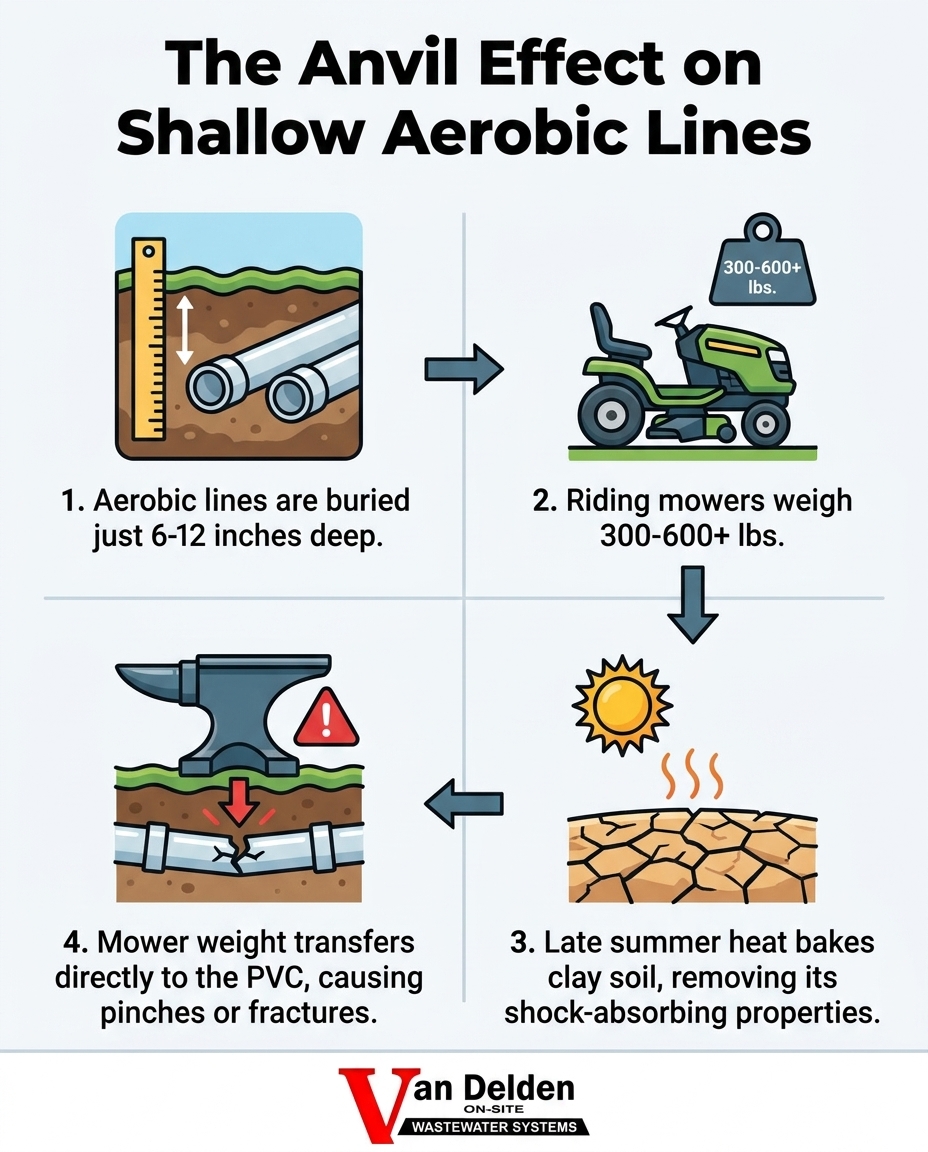
To understand why your aerobic system is at risk during the intense August heat, you have to look at the exact mechanism of injury. It comes down to a dangerous combination of shallow pipe depth, extreme surface weight, and the hardened soil we just discussed. We call this dangerous combination the "anvil effect."
The depth factor: Unlike deep septic tanks, the distribution lines for an aerobic system with spray irrigation are buried very shallow. In most cases, these PVC pipes sit just 6 to 12 inches below the surface of your grass. They are designed this way to properly disburse treated effluent into the upper layers of the soil, but this shallow placement leaves them highly exposed to surface pressure.
The weight factor: Standard riding lawn mowers are exceptionally heavy. A typical residential riding mower weighs between 300 and 600 pounds, while zero-turn mowers and compact tractors can weigh significantly more. When you drive that much weight across your lawn, the pressure is concentrated onto the small footprint of the mower's tires, creating massive pounds per square inch (PSI) of downward force.
The anvil effect in action: During the driest parts of the year, the hardpan clay acts as an unyielding anvil. The concentrated PSI from your mower tires acts as a heavy hammer. Because the soil cannot compress to absorb the weight, the force transfers directly into the shallow PVC pipes. Caught between the hammer (the mower) and the anvil (the baked clay), the PVC simply pinches, cracks, or shatters.
The Anvil Effect on Shallow Aerobic Lines
Identifying the Warning Signs of a Pinched or Fractured Line
Catching the early warning signs of line damage can save your entire system from a cascading failure. When the ground in the Texas Hill Country hardens, you must stay vigilant. If an aerobic line fractures or gets pinched flat, the treated wastewater cannot escape. Here is what you need to look for during your late-summer yard checks:
• Surfacing effluent in dry weather: If you notice persistent, unexplained wet spots, puddles, or unusually lush patches of grass in your yard when it hasn't rained, a line is likely leaking underground.
• Pressure alarms triggering: Aerobic systems are equipped with sensors. If you hear an alarm going off shortly after lawn maintenance, it often means a pinched line is causing back-pressure in the system.
• Poor spray performance: Watch your system during its spray cycle. If sprinkler heads fail to pop up, or if the water distribution is uneven and weak, a fractured line may be robbing the system of water pressure.
• Foul odors near the spray field: While aerobic effluent is treated, a pooling, stagnant puddle from a broken line will eventually develop a noticeable odor in the heat.
Early detection is vital. If a restriction in the line is ignored, the pump will continue to push water against a dead end. This can burn out your expensive pump or cause a massive backup into the main tanks, turning a localized pipe repair into a major property emergency.
Why Repairing Aerobic Lines is Never a DIY Project
When a homeowner spots a broken sprinkler head or a cracked pipe, the first instinct is often to grab a shovel and some PVC glue. However, dealing with aerobic wastewater lines during the brutal August heat is never a do-it-yourself project. The risks are simply too high.
The Problem: Regulatory and Sanitary Risks
Aerobic systems are highly regulated by state and local environmental guidelines, including strict rules from the Texas Commission on Environmental Quality (TCEQ). These systems manage biological waste, and handling surfacing effluent without proper training, vaccinations, or personal protective equipment poses a severe sanitary risk to you and your family.
The Cause: Complex Subsurface Pressures
Unlike a standard garden irrigation system, aerobic lines operate under specific pressures designed to atomize treated wastewater. Improper PVC repairs can easily fail under this pressure. Using the wrong fittings, failing to properly prime the pipe, or letting dirt enter the line during a messy repair can lead to immediate blowouts or clogged spray heads further down the line.
The Solution: Professional Diagnostics
Diagnosing the exact location of a subsurface fracture requires specialized professional assessment. A licensed technician knows how to isolate zones, test system pressure, and perform an aerobic system repair safely and legally, ensuring your system remains fully compliant with local health codes.
Protecting Your Drainfield for the Rest of the Season
The best way to handle late-summer soil compaction in the Texas Hill Country is to prevent the damage before it happens. By adjusting your landscaping routine, you can protect your shallow lines until the softer, wetter weather returns.
Actionable Steps for Drainfield Protection
1. Establish strict physical boundaries: Keep all heavy machinery off the spray field. This includes riding mowers, zero-turn mowers, utility vehicles, and contractors' trucks.
2. Switch your equipment: Recommend using lightweight push mowers or handheld weed trimmers around the immediate vicinity of your spray heads and distribution lines.
3. Map out your system: Take the time to map out the exact location of your shallow lines and sprinkler heads. Share this map with any landscaping crews so they know exactly where they need to tread lightly.
4. Monitor after mowing: Always walk your drainfield after the grass is cut to check for damaged heads or newly formed wet depressions.
Establishing a relationship with a reliable local service provider is also crucial. One Boerne homeowner recently reached out after noticing persistent wet spots in their yard following a landscaping service. Our team arrived promptly to provide efficient and reliable service, identifying a pinched line before it caused a pump failure, leaving the customer relieved and happy to recommend our work. Having a trusted professional on speed dial means you get fast answers when things go wrong.
Protect Your Aerobic System Before the Damage Deepens
Understanding how seasonal soil changes affect your property is the key to preventing major aerobic system failures. The August heat completely transforms the ground beneath your grass, turning it into a hazard for shallow, delicate pipes under heavy weight.
If you notice pressure alarms, poor spray performance, or mysterious wet spots in your yard, do not wait for the problem to resolve itself. Act immediately to protect your home and your investment. Consult a licensed wastewater professional to evaluate your system's integrity today. Request an estimate to ensure your aerobic lines are safe, secure, and ready to handle the rest of the season.
Frequently Asked Questions
Why is my aerobic system alarm going off after mowing? An alarm after mowing usually indicates a sudden pressure change caused by a pinched or damaged line. The weight of the mower on hard soil can crush the shallow PVC, causing back-pressure that triggers the system's sensors. You should silence the alarm and call a professional immediately.
Can a riding mower damage aerobic sprinkler lines? Yes, riding mowers are a leading cause of damage to aerobic sprinkler lines, especially in late summer. The immense weight of the mower transfers directly through hardened, dry clay soil, crushing the shallow pipes beneath. Switching to a push mower over the drainfield is highly recommended.
What happens if you run over a shallow septic line? Running over a shallow septic line can fracture the pipe, break the sprinkler head, or pinch the line completely closed. This prevents treated effluent from spraying properly, which can lead to pooling wastewater in your yard or a severe backup into your main tanks.
How deep are aerobic sprinkler lines buried? Aerobic spray distribution lines are typically buried very shallow, usually between 6 and 12 inches below the surface. This shallow depth is required for proper effluent evaporation and absorption, but it leaves the pipes highly vulnerable to heavy surface traffic.
How do you spot a broken aerobic system line? The most common signs of a broken aerobic line include persistent wet spots or puddles in dry weather, unusually lush patches of grass, and foul odors. You may also notice that the sprinkler heads fail to pop up or that the spray pressure is noticeably weak.
What should I do if I find a wet spot near my spray heads in late summer? Keep all people, pets, and lawn equipment away from the wet spot immediately, as it may contain surfacing effluent. Do not attempt to dig up the area yourself. Call a licensed aerobic system technician to safely diagnose and repair the damaged line.
Peter was personable, professional and thorough. Highly recommend Van Delden. You might be able to find a cheaper company but not better!
Wendell E
On time. 100% professional, knowledgeable, and courteous. Very helpful and straightforward. That is the bar all businesses should strive for.
Andy R
It has been a pleasure working with your company. Not only did y’all communicate very well but your workers were always polite! Thank you!
Kate R.
“I thank Van Delden for such prompt service. Honest people are hard to come by these days. I will certainly recommend Van Delden to anyone! Jesse is an upstanding young man and very nice to talk to. I thank everyone at Van Delden for taking such good care of me.”
Charles H
This is just a note to thank you for explaining the problem with my system. You didn’t have to be so kind and I appreciate your good business ethics and time spent. In the future you will have mine in return!