Managing Sudden Wastewater Spikes During Back-to-School Laundry Marathons
The late August rush to wash piles of clothes can overwhelm your septic tank's settling process. Discover how spacing out your laundry prevents irreversible drainfield damage.
The advantages of a septic specialist vs general contractor come down to one thing: your septic system is not a general construction project. It is a living, biological wastewater treatment system buried in your yard — and in April 2026, nearly 90% of households that rely on septic systems depend on them as a critical part of their daily wastewater treatment. When something goes wrong, who you call makes an enormous difference.
Here is a quick breakdown of why a septic specialist has the edge:
For homeowners trying to decide who to trust with their septic system, the difference is not just about skill. It is about safety, compliance, and protecting one of the most important utilities your home has.
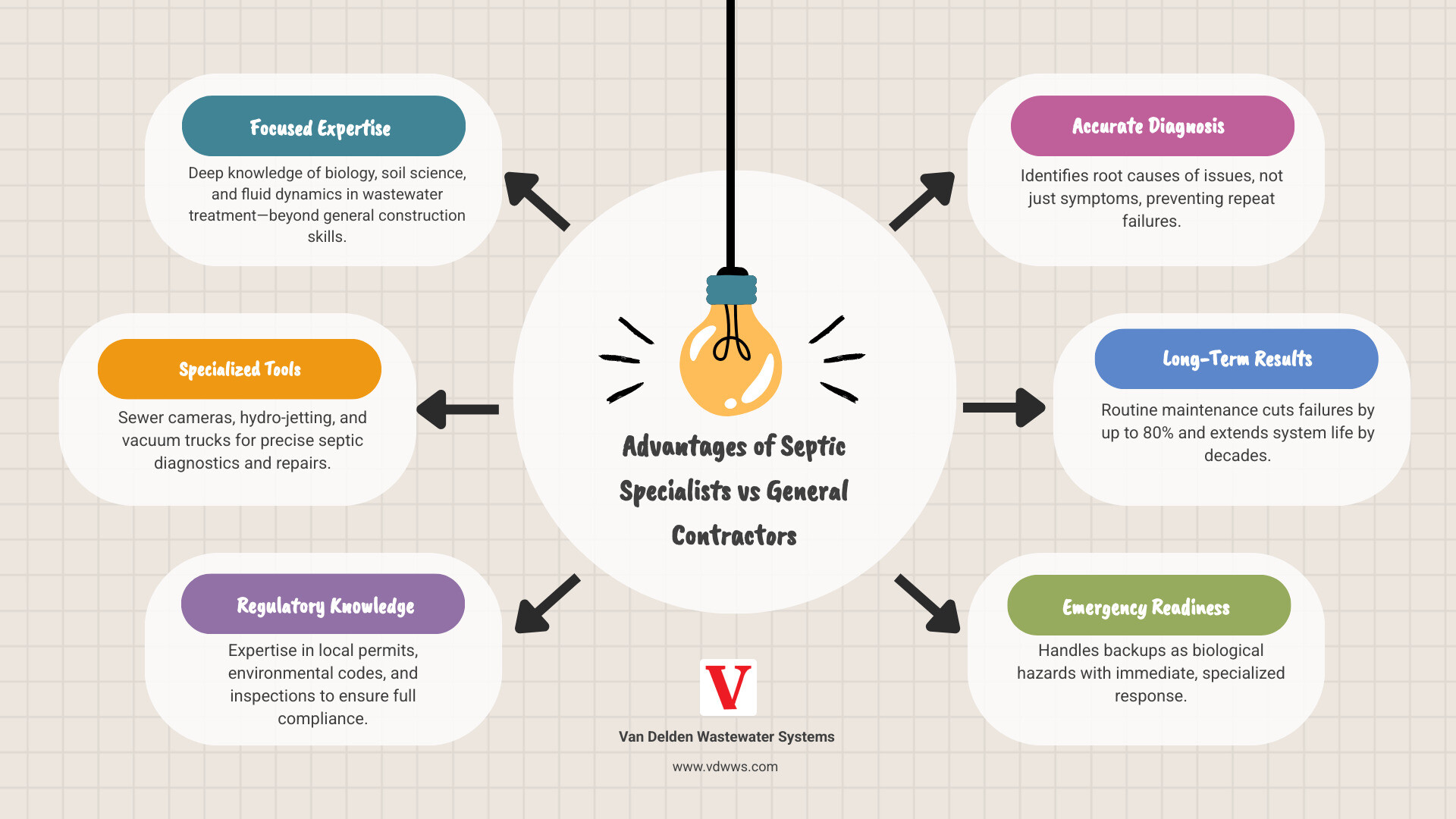
When you think about your home's infrastructure, it is easy to lump everything "underground" into the same category. However, a septic system is far more than just a series of pipes; it is a miniature wastewater treatment plant. Understanding the advantages of a septic specialist vs general contractor begins with recognizing the complexity of what is happening beneath your lawn.
A general contractor (GC) is a jack-of-all-trades. They are excellent at coordinating home builds, renovations, or framing. But septic systems require a deep understanding of biological treatment, fluid dynamics, and soil science. While a GC might know how to dig a hole with an excavator, a specialist knows exactly how that hole interacts with the local water table and soil composition.
Because septic systems rely on bacteria to digest waste, any disruption to the biological balance can lead to system failure. Specialists are trained to recognize these delicate mechanics. This is why you should check credentials when choosing a septic inspector to ensure they have the specific training required to handle these biological "engines."
The primary advantage lies in diagnostic precision. When a general contractor sees a slow drain, their first instinct is often to reach for a plumbing snake to clear a clog. They are treating the symptom. In contrast, a septic specialist asks why the drain is slow. Is the baffle in the tank broken? Are roots penetrating the pipe three feet underground? Is the effluent filter clogged?
By identifying the root cause, a specialist prevents you from paying for the same repair twice. In the San Antonio and Boerne areas, where soil conditions can vary from rocky terrain to heavy clay, this specialized knowledge is vital. For a deeper look at how these roles differ in our region, you can see Texas septic professionals decoded to understand the specific licensing and skills involved.
Knowing when to skip the general handyman and call in the experts can save your drainfield from total destruction. You should contact a septic specialist immediately if you experience:
For those living in areas like Spring Branch or Bulverde, our local septic repair companies guide provides more detail on identifying these critical warning signs.
The tools of the trade are another area where the specialist stands apart. A general contractor might have a standard excavator and a set of wrenches, but they lack the high-tech diagnostic equipment necessary for modern septic care.
| Feature | Septic Specialist | General Contractor |
|---|---|---|
| Diagnostic Tools | High-resolution sewer cameras | Limited or rented snakes |
| Cleaning Method | High-pressure hydro-jetting | Manual cabling/snaking |
| Waste Removal | Specialized vacuum trucks | No pumping capability |
| Permit Handling | Expert knowledge of TCEQ/Local codes | May rely on homeowner to permit |
| Soil Analysis | Professional percolation & soil testing | General site assessment |
Using the right tools prevents damage. For example, a specialist uses a vacuum truck to remove sludge completely, whereas a non-specialist might only remove the liquid, leaving the heavy solids behind to clog your pipes later. When you are finding a reliable contractor to design and install your septic system, ensure they own and operate this specialized equipment.
In Texas, septic systems are strictly regulated by the Texas Commission on Environmental Quality (TCEQ) and local authorities in counties like Bexar, Comal, and Kendall. One of the most significant advantages of a septic specialist vs general contractor is their familiarity with these specific environmental standards and health codes.
A general contractor might try to "save time" by bypassing certain permits or skipping a required site inspection. This is a massive risk. If a system is installed or repaired without the proper paper trail, you could face heavy legal fines or be forced to dig up the entire system. You must protect yourself from unscrupulous septic contractors who suggest cutting corners on compliance.
Beyond the trucks, specialists utilize:

Hiring a generalist for septic work is a gamble that rarely pays off. One of the most common mistakes we see is soil compaction. General contractors often use heavy machinery without considering where the drainfield is located. Driving a heavy truck over a leach field can crush the pipes or compact the soil so tightly that it can no longer absorb wastewater.
Other risks include:
It is essential to be able to spot an unscrupulous septic maintenance provider before they cause thousands of dollars in damage to your property.
The fallout from a botched septic job isn't just a smelly yard; it can be a health and legal nightmare. Improperly treated wastewater can lead to groundwater contamination, potentially affecting your own well water or that of your neighbors in communities like Fair Oaks Ranch or Timberwood Park.
Furthermore, septic service providers' company values can make all the difference when it comes to standing behind their work. A generalist may move on to the next kitchen remodel, leaving you to deal with the legal fines and property damage when the system backs up six months later.
A septic system is an investment in your home’s longevity. When handled by specialists, a properly installed concrete tank can last for many decades. The goal of specialized care is preventative maintenance — catching a small issue before it becomes a catastrophic failure.
The EPA recommends that septic tanks be pumped every three to five years. A specialist doesn't just pump the tank; they inspect the baffles, check the sludge layers, and ensure the bacterial digestion is healthy. This level of sludge management is something a general contractor simply isn't equipped to do.
When finding a qualified company to pump your septic tank, you are looking for someone who understands that pumping is part of a larger health check for your home. Routine professional maintenance can reduce system failures by up to 80% by identifying problems during these 3-5 year intervals.
Simple, expert maintenance can extend a system’s longevity by as much as three decades. Conversely, neglect or poor work by a generalist can cause a total failure in just 5 to 10 years.
Benefits of Specialist Maintenance:
Choosing between a specialist and a generalist isn't just about who can dig a hole faster. It's about who understands the science of your yard and the safety of your family. At Van Delden Wastewater Systems, we have been providing comprehensive septic solutions since 1937. As a family-owned business serving Boerne, San Antonio, and the surrounding Texas Hill Country, we pride ourselves on our honest, background-checked, non-commissioned technicians.
We don't just "fix" things; we educate our customers, providing photo documentation and detailed service forms so you know exactly what is happening with your system. Knowing how to choose a quality septic company is the first step toward a worry-free home. We invite you to learn more about why you should choose Van Delden for your next inspection, repair, or installation.
You should call a specialist for any diagnostic needs involving slow drains, foul odors, or pooling water. While a general contractor might be able to handle a simple surface-level pipe repair, anything involving the septic tank, the pump system (especially for aerobic systems), or the drainfield requires a specialist's eye. Tank pumping and real estate evaluations should always be performed by a certified septic professional to ensure the system’s integrity is accurately assessed.
While a general contractor can technically apply for permits, they often lack the specific regulatory knowledge required by the TCEQ and local health departments. Septic permits require detailed site evaluations, soil morphology reports, and specific design plans that most general contractors are not licensed to provide. A specialist handles the entire process, including inspection coordination, ensuring your system is 100% compliant with local laws.
Several critical services absolutely require a specialist:
Don't gamble with your home's most vital utility. Choose the expertise that comes with nearly a century of specialized service.

Peter was personable, professional and thorough. Highly recommend Van Delden. You might be able to find a cheaper company but not better!
On time. 100% professional, knowledgeable, and courteous. Very helpful and straightforward. That is the bar all businesses should strive for.
It has been a pleasure working with your company. Not only did y’all communicate very well but your workers were always polite! Thank you!
“I thank Van Delden for such prompt service. Honest people are hard to come by these days. I will certainly recommend Van Delden to anyone! Jesse is an upstanding young man and very nice to talk to. I thank everyone at Van Delden for taking such good care of me.”
This is just a note to thank you for explaining the problem with my system. You didn’t have to be so kind and I appreciate your good business ethics and time spent. In the future you will have mine in return!