Surface Spray Irrigation vs. Subsurface Drip for Sloping Boerne Properties
Surface Spray Irrigation vs. Subsurface Drip for Sloping Boerne Properties
Navigating Aerobic Septic Choices on Steep Texas Terrain
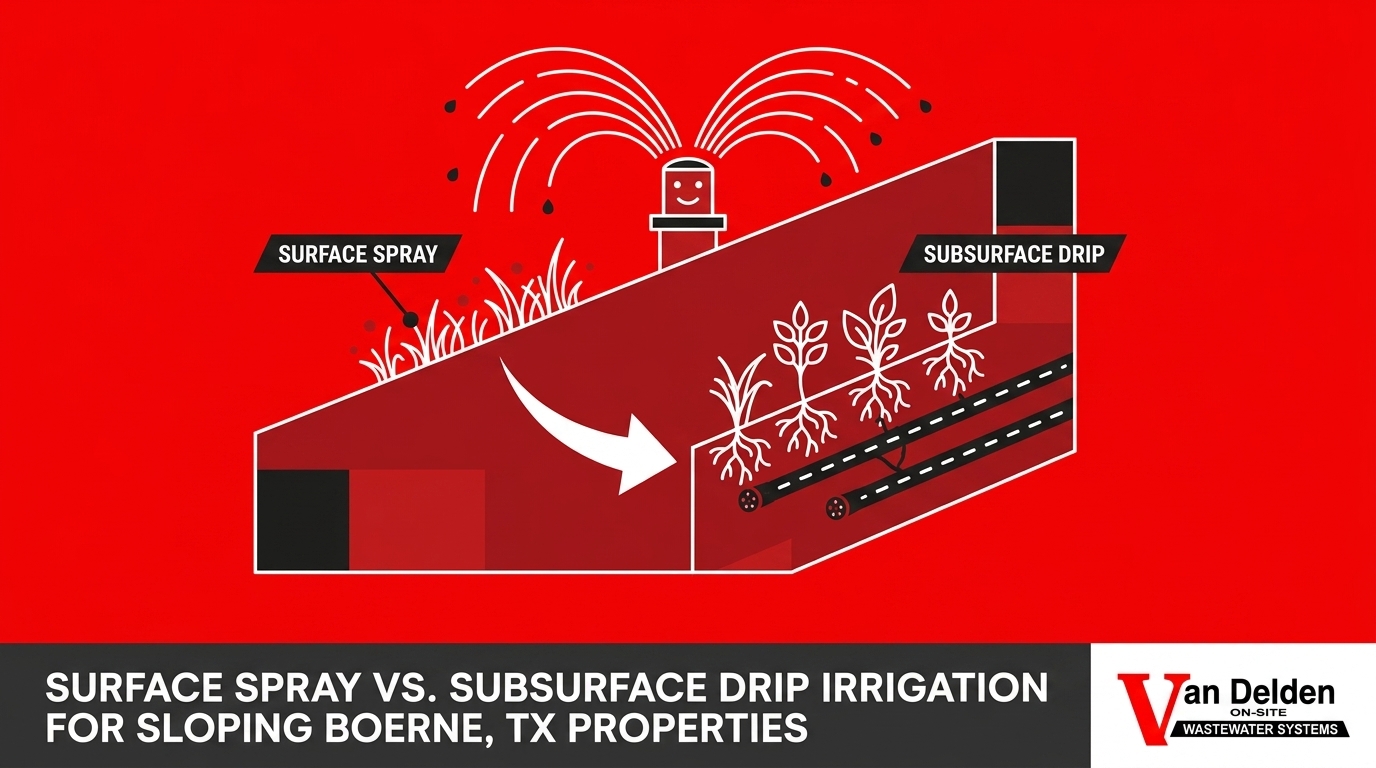
At Van Delden Wastewater Systems, a pattern we see often is homeowners weighing the choice between surface spray irrigation vs. subsurface drip for sloping Boerne properties, wondering which method will actually keep their yard safe and usable. When you live on a hill, gravity becomes your biggest challenge in wastewater management. Managing aerobic effluent safely without causing hazardous runoff, soil erosion, or pooling in your neighbor's yard is a major concern for local homeowners. In our experience, the primary decision point usually comes down to choosing between surface spray heads and buried subsurface drip lines when dealing with severe elevation changes.
To understand how these disposal methods fit into your overall wastewater management plan, explore our comprehensive guide on septic systems. The Boerne Hill Country steep grades dictate everything about how an aerobic system must be designed. A disposal field that works perfectly on a flat, grassy plain can quickly become a muddy, hazardous liability on a 15-degree incline. Because gravity pulls surface water downward, any effluent applied to the top of a hill will naturally seek the lowest point. If the soil cannot absorb the treated wastewater fast enough, that water will travel overland, carrying potential contaminants and stripping away your valuable topsoil.
Topography dictates design: Our team knows you cannot force a one-size-fits-all septic solution onto a complex landscape. The elevation changes on your property require a customized approach to ensure that treated wastewater is absorbed slowly and safely into the ground. In the following sections, we will share what our technicians have learned about how the local terrain impacts your system, the risks associated with surface application, and why certain methods provide much better long-term stability for your property.
How Boerne's Rocky Limestone Exacerbates Runoff Risks
The unique geographical and climate challenges of this area make aerobic disposal on slopes particularly difficult. Our installers know firsthand that the ground beneath your feet is not just dirt; it is a complex matrix of rock, clay, and shallow topsoil that drastically alters how water behaves.
1. The Limestone Barrier: The local limestone soil naturally resists deep water absorption. Unlike deep, loamy soils that act like a sponge, rocky terrain has a very low percolation rate. When treated effluent is applied to the surface, it often hits a solid layer of rock just inches below the grass and stops absorbing.
2. The Incline Accelerator: When you combine this rocky, impenetrable soil with severe inclines, you create a high-risk environment for effluent pooling. Water that cannot go down into the ground will immediately go sideways, accelerating down the slope and creating highly concentrated streams of runoff.
3. The Weather Multiplier: This environmental reality becomes critical during August late-summer sudden downpours. When the ground is already managing its daily load of aerobic effluent, a sudden influx of heavy rain can quickly overwhelm saturated soil. The combination of irrigation water and storm runoff can wash out landscaping and push wastewater beyond your property lines.
Many homeowners we consult with don't initially realize that the lack of soil permeability in the rocky terrain interacts violently with sudden heavy rainfall, making slope management critical. We always remind our clients: you are not just designing a system for a dry, sunny Tuesday; you are designing a system that must hold up when the skies open up over already-wet ground. These environmental factors force a careful evaluation of disposal methods, as the wrong choice can lead to significant property damage and regulatory violations.
Evaluating Surface Spray on Severe Elevation Changes
Surface spray irrigation is one of the most common disposal methods for aerobic systems in Texas, but applying it to a sloped property introduces a host of complications. This method operates by pumping treated, disinfected effluent through pressurized lines to pop-up sprinkler heads, distributing the water over a designated grassy area.
For a foundational look at how this equipment operates, read more about an aerobic system with spray irrigation. While our crews successfully maintain these systems on flat land, we see the risks multiply when they are installed on an incline. The most significant threat is the compounding risk of erosion over time. Because the spray heads distribute water onto the surface of the Boerne Hill Country steep grades, the effluent is highly susceptible to gravity before it can soak into the shallow topsoil. Over months and years, this constant surface moisture can carve micro-channels into your hillside, gradually washing away the dirt and exposing tree roots and rocks.
Regulatory and maintenance hurdles: Local environmental regulations, including TCEQ (Texas Commission on Environmental Quality) and county rules, often heavily restrict spray applications on grades exceeding certain percentages. If your slope is too steep, surface spray may not even be legally permissible due to the high risk of runoff entering adjacent properties or local waterways. Furthermore, the maintenance realities of keeping spray heads perfectly calibrated on a hill are demanding. If our technicians find a single spray head out of alignment or a timer running too long, it can immediately cause severe downhill pooling, turning the lower half of your property into a swampy, unusable hazard.
Why Subsurface Drip Excels in Complex Topography
When dealing with difficult terrain, our team typically recommends subsurface drip systems for their completely different mechanical approach to managing effluent. Instead of spraying water into the air, this method involves burying a network of flexible, pressure-compensating drip tubing directly into the topsoil. These lines contain specialized emitters that release the treated wastewater slowly, drop by drop, directly into the root zone of your grass and plants.
Learn more about the components and mechanics of an aerobic system with drip irrigation. The primary advantage we see in the field is that subsurface delivery entirely bypasses the immediate runoff risks associated with surface saturation. Because the water is delivered underground at a highly controlled rate, the soil has adequate time to absorb the moisture through capillary action. Even during August late-summer sudden downpours, a subsurface system is far less likely to contribute to surface erosion because the effluent is already safely integrated into the soil matrix below the surface layer.
The reality of installation: The installation complexity involved in trenching rocky, uneven terrain is significant. Cutting into limestone requires our crews to use specialized rock saws and heavy equipment, which makes the initial installation more intensive. However, we consider this a necessary investment in long-term stability. Once installed, the visual and functional footprint of drip lines is virtually invisible. You can maintain usable, terraced yard space on a hill without having to block off restricted spray zones or worry about sprinkler heads spraying in the wind. The landscape remains dry on top, safe for children and pets, and heavily protected against the erosive forces of gravity.
Side-by-Side Comparison: Spray vs. Drip on an Incline
To make the best decision for your property, you need to see how these two methods stack up against each other specifically through the lens of sloped property management. Since 1937, our family-owned team at Van Delden Wastewater Systems has watched these systems age in the Hill Country, and that historical perspective informs this specific comparison. We know exactly how Boerne Hill Country steep grades impact the longevity and safety of wastewater disposal.
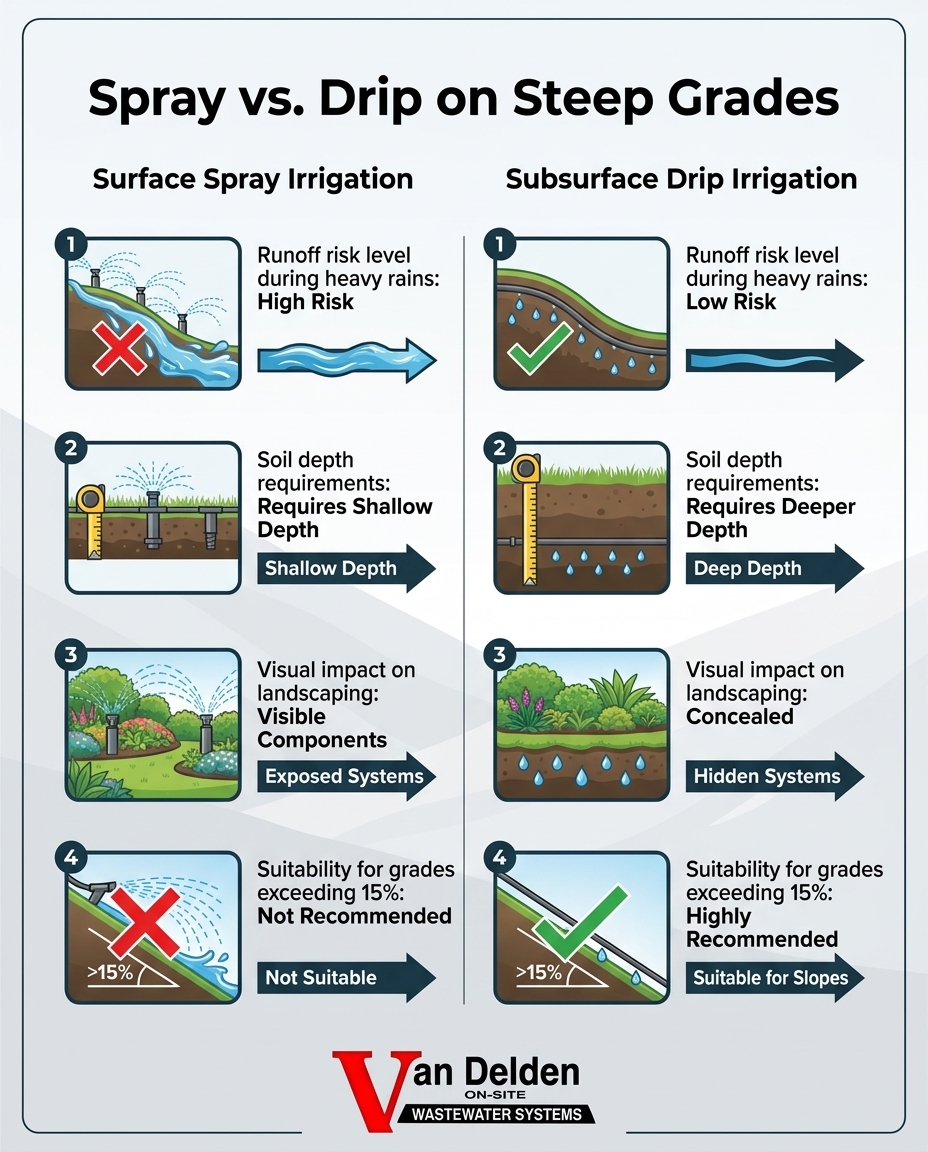
• Installation Complexity — Surface Spray Irrigation: Lower initial complexity, but requires strict grading, vegetation establishment, and specific spacing to meet slope regulations. — Subsurface Drip Irrigation: High complexity. Requires specialized trenching equipment to cut through rocky limestone and adapt to natural terraces.
• Erosion & Runoff Risk — Surface Spray Irrigation: High risk. Immediate surface saturation can easily lead to downhill channeling and topsoil loss over time. — Subsurface Drip Irrigation: Very low risk. Controlled, slow-release underground absorption prevents surface pooling and protects the slope.
• Property Usability — Surface Spray Irrigation: Restricted. The spray area must remain clear, and the surface is frequently wet, limiting how you can use the yard. — Subsurface Drip Irrigation: Unrestricted. Lines are buried out of sight, leaving the surface dry and preserving your landscaping and usable space.
• Regulatory Compliance — Surface Spray Irrigation: Difficult on steep grades. Often restricted or banned by county rules if the incline exceeds safe runoff thresholds. — Subsurface Drip Irrigation: Highly adaptable. Easily meets strict environmental regulations for steep slopes and complex topographical boundaries.
Installation Complexity and Terrain Adaptation
Trenching requirements in limestone are not for the faint of heart. Installing a drip system means adapting to existing tree roots, natural terraces, and solid rock shelves. While surface spray avoids this deep trenching, it forces you to adapt the surface of your yard to the system, often requiring you to maintain specific vegetation that may struggle to grow on a rocky slope. If you are evaluating the financial scope of trenching through rock, review our drip irrigation cost comparison to understand the long-term value of doing it right the first time.
Long-Term Erosion and Runoff Prevention
Managing daily effluent loads without saturating the top layer is the key to protecting your property. Surface spray constantly threatens to overwhelm the topsoil, especially when gravity is pulling the water down toward your property lines. Subsurface drip protects downhill neighbors and preserves your own topsoil by ensuring the water is absorbed exactly where it is released, rather than traveling overland.
Spray vs. Drip on Steep Grades
Assessing a Sloped Property for Septic Viability
If you are buying a home on a hill or preparing to replace an aging system, a simple visual inspection of the slope is never enough. You cannot determine the viability of a septic system just by looking at the grass. Soil depth and rock composition must be rigorously tested through site evaluations and profile holes to determine exactly how much permeable dirt sits above the solid limestone bedrock.
The importance of professional evaluation: This evaluation is especially critical during real estate transactions for sloped lots. Our team recently helped a client who needed assurance that their septic system worked perfectly before buying a property situated on one of the Boerne Hill Country steep grades. A Van Delden technician performed a thorough, knowledgeable, honest, and efficient septic inspection. By examining the soil profile and the existing disposal field, the clients were completely assured of the system's functionality before closing the deal.
A thorough inspection can reveal hidden challenges, such as underground rock ledges that force water to the surface, or it can dictate the absolute necessity of a specific disposal method. Working with inspectors and designers who deeply understand local topographical constraints ensures that your system will be designed to handle the specific geological realities of your yard, rather than relying on guesswork that could lead to a catastrophic failure down the road.
Frequently Asked Questions About Sloped Aerobic Systems
Can you install an aerobic septic system on a steep hill?
Yes, you can install an aerobic system on a steep hill, provided the design is specifically engineered for the terrain. The treatment tanks are typically installed on a leveled pad or near the home, while the disposal field is carefully mapped across the incline. Engineers must account for the slope percentage, soil depth, and local regulations to ensure the effluent is dispersed safely without causing downhill pooling or erosion.
Is drip irrigation better than spray for rocky soil?
In our professional experience, subsurface drip is generally vastly superior to surface spray in rocky soil environments. Rocky terrain lacks the deep, spongy loam required to quickly absorb surface water, meaning spray irrigation often leads to immediate runoff. By burying drip lines into the available topsoil or imported soil matrix, the effluent is released slowly and directly into the root zone, bypassing the poor surface absorption rates of rocky ground.
Does surface spray cause erosion on sloped properties?
Surface spray poses a very high risk of causing erosion on sloped properties if not perfectly managed. Because the water is applied to the top of the ground, gravity immediately pulls it downhill before it can fully soak in. Over time, this constant flow of surface water can carve channels into the hillside, washing away topsoil, exposing roots, and degrading the structural integrity of the landscaping.
How steep of a slope can you put a septic system on?
The maximum allowable slope for a septic disposal field depends heavily on local county regulations and the specific disposal method being used. Generally, surface spray is heavily restricted or banned on grades exceeding 15% due to severe runoff risks. Subsurface drip systems can often be engineered for much steeper grades, provided the trenches follow the natural contours of the hill and sufficient soil depth is present to cover the emitters.
How do sudden heavy rains impact an aerobic system on a hill?
Sudden heavy rains, like the August late-summer sudden downpours typical of the region, can severely impact surface disposal fields by overwhelming the soil's capacity to absorb water. If the ground is already saturated with aerobic effluent, the addition of storm runoff will wash the treated wastewater downhill. Subsurface drip systems handle heavy rains much better, as the effluent is already secured beneath the top layer of soil, protecting it from surface washout.
Secure Your Property Against Erosion with the Right Aerobic Design
Making the right choice between disposal methods is the only way to prevent hazardous runoff and protect your property's valuable landscaping. Severe elevation changes, like the Boerne Hill Country steep grades, require custom, terrain-specific planning that respects the power of gravity and the limitations of rocky soil. You cannot afford to guess when it comes to wastewater management on a hill.
If you are navigating the complexities of surface spray irrigation vs. subsurface drip for sloping Boerne properties as you wrap up end-of-summer projects and transition into the back-to-school season, the next step is gathering hard data about your specific terrain. Promptly schedule a professional site evaluation with our team to test your soil depth, map your elevation changes, and determine the safest, most reliable disposal method for your unique slope. Protecting your property starts with a design built specifically for your landscape.
Peter was personable, professional and thorough. Highly recommend Van Delden. You might be able to find a cheaper company but not better!
Wendell E
On time. 100% professional, knowledgeable, and courteous. Very helpful and straightforward. That is the bar all businesses should strive for.
Andy R
It has been a pleasure working with your company. Not only did y’all communicate very well but your workers were always polite! Thank you!
Kate R.
“I thank Van Delden for such prompt service. Honest people are hard to come by these days. I will certainly recommend Van Delden to anyone! Jesse is an upstanding young man and very nice to talk to. I thank everyone at Van Delden for taking such good care of me.”
Charles H
This is just a note to thank you for explaining the problem with my system. You didn’t have to be so kind and I appreciate your good business ethics and time spent. In the future you will have mine in return!