Managing Sudden Wastewater Spikes During Back-to-School Laundry Marathons
The late August rush to wash piles of clothes can overwhelm your septic tank's settling process. Discover how spacing out your laundry prevents irreversible drainfield damage.
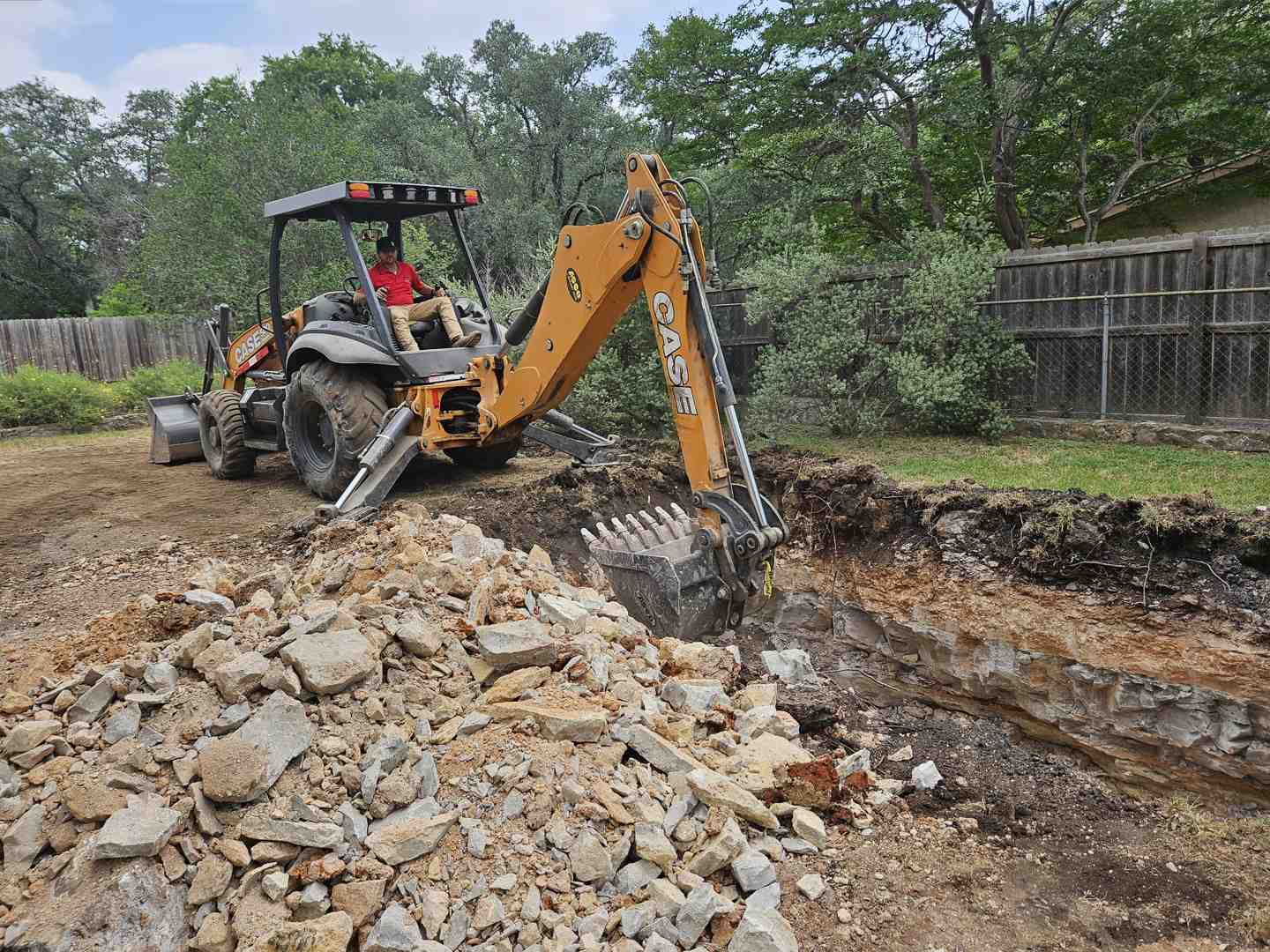
If you're planning a new home in Bulverde or replacing an aging system, septic installation in bulverde, tx requires careful planning, proper permitting, and professional expertise. Unlike municipal sewer connections, septic systems must be customized to your property's unique soil conditions, household size, and Comal County regulations. Many new homeowners underestimate how critical the right system design and installation are to preventing system failures down the road.
Quick Guide to Septic Installation in Bulverde, TX:
For expert guidance through every step of the process, explore our complete septic services in Bulverde or contact Van Delden Wastewater Systems to schedule a site evaluation.
Bulverde's rocky terrain and varying soil depths mean not every property can support a conventional system. You'll need a certified professional to evaluate your land, design a compliant system, coordinate permitting with Comal County, and handle installation to TCEQ standards. This guide walks you through what to expect, how to choose the right system type, and what regulatory steps you must complete before breaking ground.
When we talk about septic installation in bulverde, tx, we aren't just talking about digging a hole and dropping in a tank. Every property in the Hill Country is unique, and because we are dealing with On-Site Sewage Facilities (OSSF), the system must be engineered specifically for your piece of land.
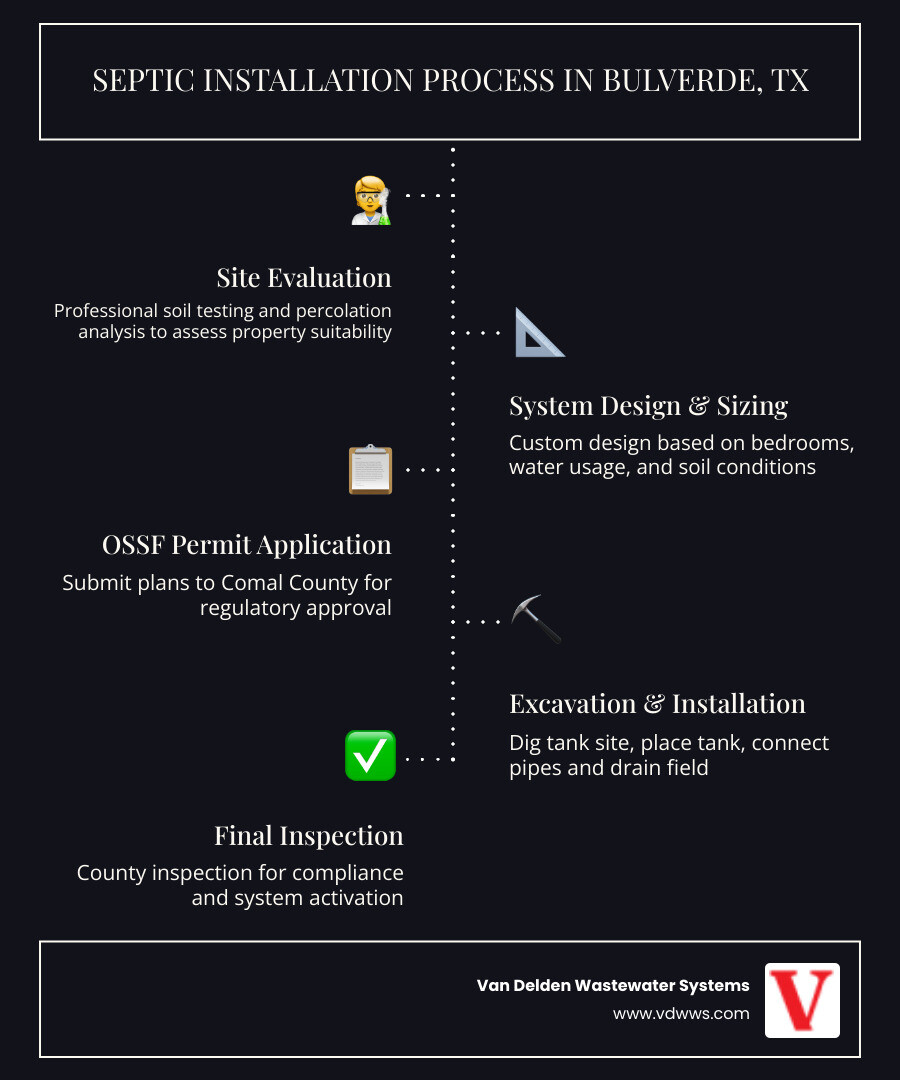
The process begins with a comprehensive site evaluation. This is where a professional assesses the physical characteristics of your lot to determine where a system can legally and functionally go. At Van Delden Wastewater Systems' Bulverde location, we see a wide variety of terrains, from flat grassy areas to steep, rocky inclines.
To design a system that works, we have to look at several critical data points:
Soil is the most important factor in determining what kind of system you can have. In Bulverde, we often encounter "Class IV" soils, which are heavy clays, or very thin soil layers sitting right on top of solid limestone rock.
For a conventional system to work, you generally need at least four feet of "good" soil—soil that can actually absorb and treat the water. If you hit rock too early, a conventional drain field won't work because the wastewater would just sit on top of the rock or run off into the groundwater without being cleaned.
A certified Site Evaluator must perform a percolation test (or "perc test") and a soil profile analysis. They dig a "test hole" to see the different layers of earth. If the soil is too shallow or too dense, we have to look at alternative methods, such as aerobic treatment. For those with existing systems, keeping these areas clean is vital, as outlined in our drain field cleaning guide for Bulverde.
Sizing is not a "one size fits all" deal. If a system is too small, it will be constantly overwhelmed, leading to backups and a shortened lifespan. If it’s unnecessarily large, it may lead to inefficient operation.
We calculate the required tank capacity and drain field dimensions based on the potential water usage of the home. This includes considering whether you have a garbage disposal (which adds significantly more solids to the tank) or high-efficiency laundry machines. The goal is to ensure the tank is large enough to allow solids to settle properly before the liquid effluent moves to the next stage of treatment.
Bulverde sits in a beautiful but geologically challenging area. Because of the limestone and clay, many homeowners find that an aerobic system is their only viable option. However, if you have deep, sandy, or loamy soil, a conventional system might still be on the table.
The main difference between these two systems is how they treat the "bugs" in the waste.
Conventional Systems: These are the "old school" systems. They use a single or double-compartment tank where solids settle. The liquid then flows by gravity into a drain field (lines buried in gravel). The soil does the final cleaning. These have no mechanical parts, which is great for simplicity, but they require specific soil conditions.
Aerobic Systems: Think of these as a miniature municipal sewage plant in your backyard. They use an air pump to force oxygen into the waste. This allows aerobic bacteria (which are much faster and more efficient than the bacteria in conventional tanks) to convert solids into liquid. The water is then disinfected—usually with chlorine—and sprayed onto the lawn via sprinklers or dispersed through drip irrigation.
| Feature | Conventional Septic | Aerobic System |
|---|---|---|
| Treatment Method | Anaerobic (No Oxygen) | Aerobic (Oxygen Injected) |
| Soil Requirement | Deep, permeable soil needed | Works in rocky or clay soil |
| Mechanical Parts | None | Air compressor and water pump |
| Disinfection | Not usually required | Chlorine or UV required |
| Maintenance | Low (Pumping only) | Higher (Regular inspections required) |
| Disposal | Underground drain field | Surface spray or drip lines |
Knowing which system you have is the first step in maintenance. If you aren't sure where your components are, you can learn how to locate a buried septic tank in Bulverde.
The drain field (or absorption area) is where the "magic" happens in a conventional system. It consists of perforated pipes buried in trenches filled with gravel or specialized chambers. The effluent slowly leaches into the ground, where the soil naturally filters out remaining pathogens.
In Bulverde, if you don't have the space or soil depth for a traditional gravel pit or field lines, we might design a "mound" system or use "low-pressure dosing" to spread the water more evenly. Protecting this area is paramount—you should never drive over it or plant trees with aggressive roots nearby. If you suspect your current field is struggling, it's important to find a specialist in drain field repair immediately to avoid a total system failure.
Installing a septic system is a highly regulated activity in Texas. Because Bulverde is in Comal County, we must adhere to both Texas Commission on Environmental Quality (TCEQ) standards and local county ordinances.
Once the design is approved and the permits are in hand, the physical work begins:
You cannot legally install a septic system in Bulverde without an OSSF Permit. This involves submitting a detailed application to the Comal County Engineer's Office. This application must include the site evaluation and a formal design created by a Registered Sanitarian or a Professional Engineer.
The county will review the plans to ensure the system is sized correctly for the home and that it won't impact neighboring wells or sensitive environmental areas. Once the installation is complete and the final inspection is passed, the county issues a "Notice to Operate," which is your official green light to start using the system.
If you are a new homeowner moving into an existing property in Bulverde, you might be wondering if the current system is up to par. Septic systems don't last forever, and neglecting them can lead to a messy (and smelly) situation.
If you notice these signs, a drain field inspection in the Timberwood Park or Bulverde area can help determine if you need a repair or a full replacement.
With proper care, a concrete septic tank can last 40 years, and the overall system typically lasts between 20 and 40 years. However, "proper care" is the operative phrase.
The biggest enemy of a septic system is sludge accumulation. Over time, the solids that don't break down build up at the bottom of the tank. If the sludge level reaches more than 30% of the tank's volume, it can start flowing out into the drain field, clogging the soil and ruining the system. This is why regular pumping is non-negotiable. For a detailed look at how to maintain your system, check out our septic pumping guide for Bulverde.
The physical installation of the tank and lines usually takes 1 to 3 days. However, the entire process—from the initial site evaluation and design to getting county permit approval and scheduling the final inspection—can take anywhere from 2 to 6 weeks. Weather is always a factor; heavy Hill Country rains can delay excavation and inspections.
For a conventional system, we generally recommend a professional inspection and pumping every 3 to 5 years, depending on your household size. If you have an aerobic system, Texas law typically requires a maintenance contract that includes inspections every 4 months. These regular checks ensure the aerator is working, the pump is functional, and the chlorine levels are correct.
A successful septic installation in bulverde, tx is the foundation of a healthy, functional home. By understanding your soil, choosing the right system for the terrain, and following the proper regulatory channels, you can ensure your wastewater system operates invisibly and efficiently for decades.
Van Delden Wastewater Systems provides comprehensive septic solutions for homeowners throughout the Bulverde area. As a family-owned business established in 1937, we pride ourselves on our deep roots in the community and our commitment to quality. Our honest, background-checked, non-commissioned technicians don't just fix problems—they educate customers. We ensure every job is done right the first time, providing detailed service forms and photo documentation for your peace of mind.
Ready to start your project or need an expert opinion on your current system? Visit our Bulverde Septic Installation Services page to learn more about how we can help you build or maintain a reliable wastewater system.

Peter was personable, professional and thorough. Highly recommend Van Delden. You might be able to find a cheaper company but not better!
On time. 100% professional, knowledgeable, and courteous. Very helpful and straightforward. That is the bar all businesses should strive for.
It has been a pleasure working with your company. Not only did y’all communicate very well but your workers were always polite! Thank you!
“I thank Van Delden for such prompt service. Honest people are hard to come by these days. I will certainly recommend Van Delden to anyone! Jesse is an upstanding young man and very nice to talk to. I thank everyone at Van Delden for taking such good care of me.”
This is just a note to thank you for explaining the problem with my system. You didn’t have to be so kind and I appreciate your good business ethics and time spent. In the future you will have mine in return!