Why How Regular Pumping Prevents System Failure Is the Most Important Thing You Can Do for Your Septic System
How regular pumping prevents system failure is simple: when solids are removed from your tank on schedule, they can't overflow into your drain field, clog your pipes, or contaminate your soil and groundwater.
Here's a quick breakdown of how it works:
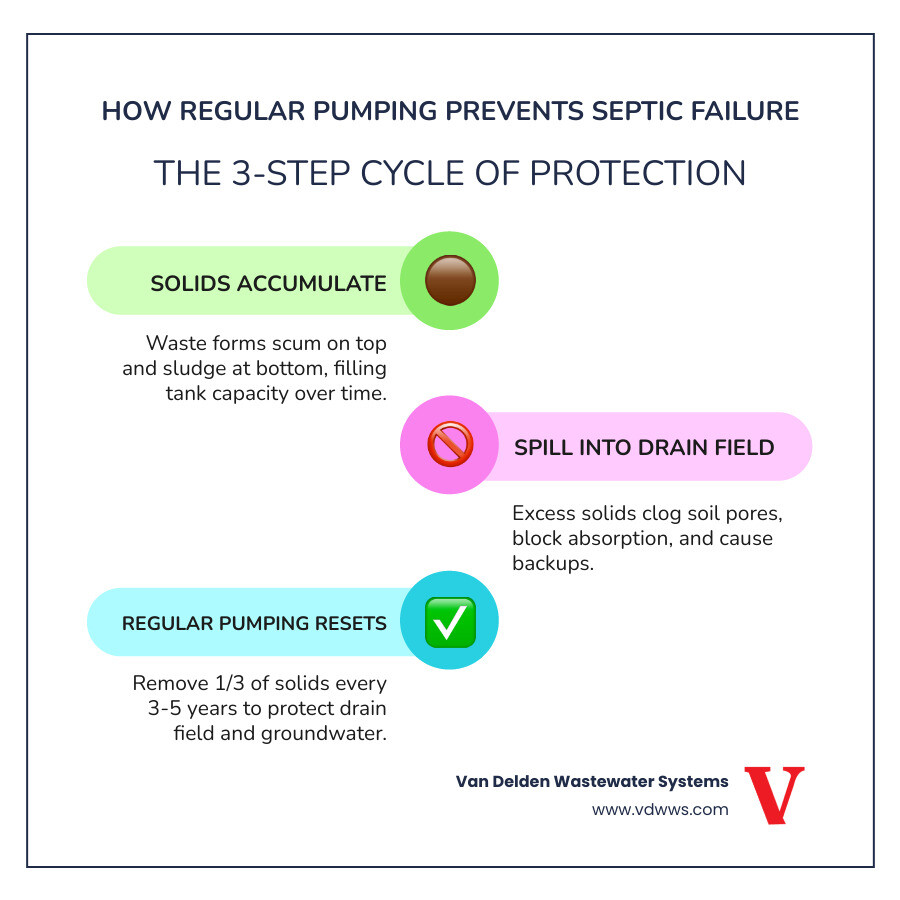
- Solids build up in your tank over time, forming a scum layer at the top and a sludge layer at the bottom.
- If not removed, those layers grow until they spill into your drain field.
- A clogged drain field can't treat wastewater properly — leading to backups, odors, and costly repairs.
- Regular pumping (typically every 3–5 years) resets the cycle and keeps your system working as intended.
- Early pumping visits also let a technician spot cracks, leaks, or failing components before they become emergencies.
More than one in five U.S. households rely on septic systems, according to the EPA — and for homeowners in San Antonio and the surrounding area, that system is your sole line of defense against untreated sewage entering your yard or home. Skipping maintenance doesn't just risk a messy backup. It risks a full system replacement.
The good news? Staying ahead of failure is straightforward when you know what to watch for and when to act.
Understanding Your Septic System and How It Works
To understand why your septic tank needs regular cleaning, you first have to look at what's happening under your lawn. Your septic system is essentially a small-scale, on-site sewage treatment plant. It uses a combination of nature and engineering to keep your home clean and the environment safe.
When wastewater leaves your home from the toilet, shower, or sink, it flows into the septic tank. Inside the tank, the magic of gravity takes over. The waste naturally separates into three distinct layers:
- The Scum Layer: This is the top layer, made up of fats, oils, and grease (FOG). These lighter-than-water substances float to the surface.
- The Effluent: This is the middle layer of relatively clear liquid. This is the only part of the waste that is supposed to leave the tank.
- The Sludge Layer: This is the bottom layer, consisting of heavy solids and inorganic materials that don't break down easily.
Inside the tank, anaerobic bacteria go to work. These "good" bacteria live in the oxygen-free environment and eat away at the organic solids, liquefying some of them and reducing the volume of the sludge. However, they can’t eat everything. Over time, that sludge layer at the bottom and the scum layer at the top will inevitably grow.
The effluent in the middle eventually exits the tank through an outlet pipe and flows into the drain field. This is a series of perforated pipes buried in gravel-filled trenches. Here, the water slowly seeps into the soil, which acts as a final natural filter, removing harmful bacteria and viruses before the water eventually recharges the groundwater.
How Regular Pumping Prevents System Failure
The primary goal of a septic tank is to protect the drain field. Think of the tank as a filter. If you never change the filter in your car, eventually the engine fails. The same logic applies here. How regular pumping prevents system failure is by ensuring the "filter" (the tank) never gets so full that it stops doing its job.
As we move into April 2026, we are seeing more households in areas like Timberwood Park and Spring Branch putting higher demands on their systems than ever before. If you don't pump the tank, the sludge and scum layers become so thick that the "settling zone" for the effluent disappears. When this happens, solid waste is pushed out of the tank and into the drain field. This is widely considered the 1 cause of septic system failure.
How regular pumping prevents system failure in the drain field
The drain field is the most expensive and sensitive part of your system. It relies on the soil's ability to absorb water. When solids escape the tank because it hasn't been pumped, they clog the pores of the soil and the holes in the drain field pipes.
This leads to the formation of a "biomat"—a thick, slimy layer of bacteria and organic matter that eventually becomes waterproof. Once the soil is sealed off by this biomat, the wastewater has nowhere to go. It will either back up into your house or bubble up to the surface of your yard. By pumping the tank, you ensure that only liquid effluent reaches the soil, preserving the absorption capacity of your land and protecting the local groundwater from contamination. This is why we always emphasize that you should have your septic tank cleaned before problems start, not after.
The consequences of neglecting sludge removal
If you choose to ignore the sludge buildup, the consequences are rarely subtle. Neglect often leads to:
- Sewage Backups: The most immediate and unpleasant sign. Raw sewage can back up into your lowest sinks, tubs, and toilets.
- Environmental Hazards: Untreated waste can leach into the soil or nearby water sources, creating a health risk for you and your neighbors in communities like Fair Oaks Ranch or Shavano Park.
- Structural Damage: An overloaded system can lead to soil compaction or even the collapse of older tank structures.
- Total System Replacement: Once a drain field is truly "clogged" with solids, it often cannot be cleaned. You may be looking at a total replacement, which can cost tens of thousands of dollars.
Learning what happens if you don't pump your septic tank is a lesson most homeowners prefer to learn through reading rather than experience.
Determining Your Ideal Septic Pumping Schedule
There is no "one-size-fits-all" answer for how often you should pump, but there are very reliable guidelines. In April 2026, we recommend looking at three main factors: your tank size, the number of people in your home, and your water usage habits.
| Household Size | 1,000 Gallon Tank | 1,250 Gallon Tank | 1,500 Gallon Tank |
|---|
| 1-2 People | 5 Years | 6 Years | 7 Years |
| 3 People | 3.5 Years | 4.5 Years | 5.5 Years |
| 4 People | 2.5 Years | 3.5 Years | 4 Years |
| 5 People | 2 Years | 2.5 Years | 3 Years |
Note: These are estimates. Heavy use of garbage disposals or high water volume can shorten these intervals.
Knowing how often your septic tank should be cleaned is the first step in a proactive maintenance plan.
How regular pumping prevents system failure for a family of four
A family of four is the standard benchmark for many septic designs. If you have a 1,000-gallon tank—which is common in many Boerne and San Antonio homes—a 2.5-year interval is often the "sweet spot."
Why so frequent? A family of four generates a significant volume of wastewater from daily showers, laundry loads, and dishwashing. This constant flow doesn't give solids much time to settle. By pumping every 2.5 years, you ensure that the sludge layer never reaches a critical height. If you've been wondering, "When should I pump my septic tank?" and you have a full house, the answer is likely "sooner than you think."
Warning signs that your tank is full
Your system will usually try to tell you when it’s struggling. If you notice any of the following, it’s time to call us:
- Slow Drains: If all the drains in your house are sluggish, the problem isn't a simple clog in one pipe; it's a full tank.
- Sewage Odors: If you smell rotten eggs around your yard or near your drains, gases are escaping because the waste isn't being processed correctly.
- Pooling Water: Standing water or muddy patches over the drain field are clear signs the soil can no longer absorb liquid.
- Lush, Green Grass: If the grass over your septic tank or drain field looks significantly greener and healthier than the rest of your yard, it's because it's being "fertilized" by escaping waste.
- Gurgling Pipes: If your toilet or drains make a gurgling sound after you flush or run the washer, it means air is being trapped by rising waste levels.
Don't wait for a backup to decide when it is time for septic tank pumping.
Maintenance habits to extend system life
While pumping is the most important task, your daily habits play a huge role in how quickly that tank fills up.
- Conserve Water: Spread out laundry loads throughout the week. A "laundry marathon" on Sunday can flood the tank and push solids into the drain field.
- Watch the Disposal: Garbage disposals can increase the solids in your tank by up to 50%. It's better to compost or toss food scraps in the trash.
- Know What Not to Flush: Your septic system is not a trash can. Never flush:
- "Flushable" wipes (they don't actually break down)
- Feminine hygiene products
- Paper towels or tissues
- Cigarette butts
- Fats, oils, and grease
- Harsh chemicals or bleach (these kill the "good" bacteria)
Many people ask, "Do I need to pump my tank if I use additives?" The short answer is yes. While some additives can help maintain bacterial balance, they do not eliminate the need for physical sludge removal. There is no "magic pill" that makes sludge disappear.
Frequently Asked Questions about Septic Maintenance
How often should a typical household pump their tank?
For most households in the San Antonio area, we recommend a professional inspection and pumping every 3 to 5 years. However, if you have a large family or a smaller tank, you may need to move that up to every 2 to 3 years to ensure the system remains healthy.
Can I use additives instead of pumping?
No. While bacteria are essential for breaking down organic matter, they cannot digest inorganic materials, sand, or certain fibers. These will always settle at the bottom of the tank. Pumping is the only way to physically remove these solids and prevent them from entering your drain field.
What happens if I wait too long to pump?
If you wait too long, the sludge and scum layers will eventually exit the tank and clog your drain field pipes and soil. This often leads to sewage backing up into the home, foul odors in the yard, and a very expensive repair bill that could have been avoided with a simple pumping service.
Conclusion
At Van Delden Wastewater Systems, we believe that an educated homeowner is our best customer. Since 1937, our family-owned business has been serving the communities of Boerne, San Antonio, Bulverde, and beyond with a commitment to honesty and quality.
Our technicians are non-commissioned, which means they aren't there to "sell" you on services you don't need. They are there to educate you, provide detailed service forms, and offer photo documentation of your tank’s condition. Whether you are in Garden Ridge or Spring Branch, regular maintenance is the only "secret" to a system that lasts 25 years or more.
Don't wait for the alarm to sound or the drains to stop. If it's been more than three years since your last service, it's time to protect your home and your investment. For more information on how we can help keep your system running smoothly, explore our services for septic tanks and schedule your inspection today.