Managing Sudden Wastewater Spikes During Back-to-School Laundry Marathons
The late August rush to wash piles of clothes can overwhelm your septic tank's settling process. Discover how spacing out your laundry prevents irreversible drainfield damage.
How professionals locate a buried septic tank follows a clear, step-by-step process that moves from the simplest methods to the most advanced tools — only digging when absolutely necessary.
Here is a quick overview of the methods professionals use:
1. Check property records - Pull permits and as-built drawings from the county health department to find the system's original location on paper.
2. Read the yard - Look for surface clues like rectangular depressions, unusually lush or brown grass patches, or slight mounding above the tank.
3. Trace the sewer line - Follow the 4-inch main waste pipe from the house foundation into the yard, typically 10 to 25 feet, to establish the likely tank zone.
4. Probe the soil - Use a steel rod in a grid pattern to feel for the solid top of the buried tank at 1 to 3 feet below grade.
5. Deploy electronic tools - Flush a sonde transmitter through the plumbing and track it with a surface receiver to pinpoint the exact location without digging.
6. Use ground-penetrating radar (GPR) - For complex cases, GPR scans the soil and maps the tank and drainfield as cross-sectional images.
7. Mark and document - Once found, mark the lid with flags or a permanent surface feature and record measurements from two fixed reference points.
More than 20 percent of American homes rely on a septic system, according to EPA data. Most homeowners never think about theirs until something goes wrong — a slow drain, a soggy patch in the yard, or a pump-out that's overdue. The problem? A large number of homeowners cannot accurately point to where their tank is buried. Systems get hidden under years of landscaping changes, grading work, and simple neglect. With proper maintenance, a septic system can last 30 years or more — but that maintenance starts with knowing exactly where your system is. At Van Delden Wastewater Systems, we use a proven, least-disruption workflow to find your system fast without tearing up your yard.
For more on how to find your system before calling for service, see our guide on How to Find Septic. Ready to have a professional handle it? Schedule a septic locating service with our team today.
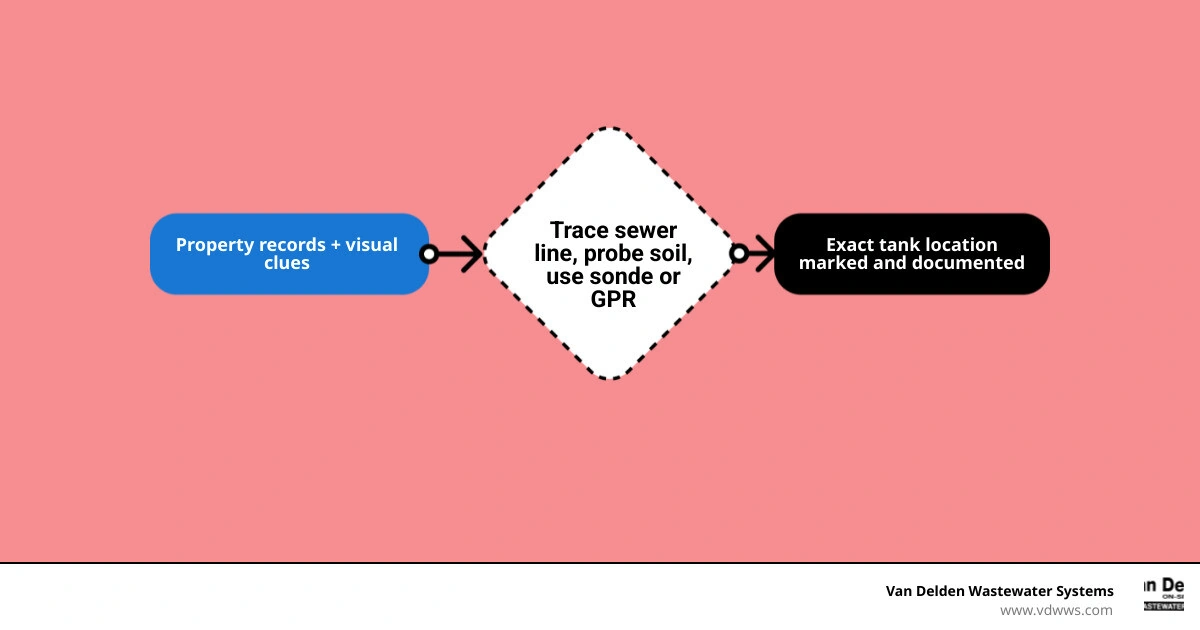
When we begin looking for a buried septic tank, we do not just start digging random holes in your pristine lawn. Instead, we start with an initial investigation that relies on historic data and visual observation. This phase is divided into researching official records and closely reading the landscape.
Property records, particularly as-built drawings and permit maps, are the absolute fastest and cleanest ways to narrow down a search area. These sketches, often filed with the local health department or environmental services office, show the exact layout of the home's plumbing footprint relative to the foundation. Having these plans on hand can turn a potentially hours-long search into a quick, ten-minute confirmation. For homeowners in our local service areas, studying a localized guide like our Septic Locating Boerne TX Guide can provide excellent regional context on how these records are managed.
If your home was built or remodeled after 1970, there is a very high probability (around 73%) that an official septic system permit is on file with your local county environmental health office. When we look for these records, we search by the property's tax account number, parcel ID, or physical street address.
A standard permit site plan or "as-built" drawing will outline:
• The exact exit point where the main sewer line leaves the home's foundation.
• The distance (often marked in feet) from the corner of the house to the septic tank.
• The orientation of the tank (whether it sits parallel or perpendicular to the house).
• The layout, size, and location of the drainfield trenches.
If you live in the surrounding areas of San Antonio, utilizing resources like our Septic Tank Locating Guide Comfort TX can help you understand how to navigate county offices to obtain these records before our team arrives.
When paperwork is missing — which is common for homes built before 1970 — we rely on our trained eyes to "read" the yard. Septic systems are heavy, underground structures that naturally influence the soil and vegetation directly above them. Over time, these influences create distinct visual patterns on the surface.
During a thorough site walk, we look for several key surface indicators:
• Vegetation Differences: The soil directly above a septic tank is often shallower than the rest of the yard (typically only 1 to 3 feet deep). Because of this shallow soil, grass over the tank may dry out and turn brown much faster during hot Texas summers. Conversely, if there is a minor, invisible leak near the tank's inlet or outlet, the grass directly above might look exceptionally lush, dark green, and fast-growing compared to the surrounding lawn.
• Subsidence and Mounds: Soil naturally settles over time. A rectangular depression in the ground measuring roughly 5 feet by 8 feet is a classic sign of a settling septic tank hole. In other cases, installers may have left a slight mound of dirt over the tank to allow for natural settling that never fully occurred.
• Snow and Frost Melt: While rare in South-Central Texas, during our occasional winter freezes, the natural heat generated by the active bacteria inside a working septic tank will cause frost or light snow to melt in a perfect rectangular shape directly above the tank.
For a deeper dive into what our technicians look for during a physical assessment, read our guide on Professional Septic Inspection and learn more about the physical process of Finding Septic Tank Lid locations.
If property records are blank and the yard shows no obvious visual clues, we move to the next logical step: following the path of the wastewater. Every septic system relies on gravity to move waste from your household drains down to the tank. This means the tank must sit downhill from your home’s main plumbing exit point.
To start this process, we locate the main sewer line (or sewer main) inside the house. This is typically a thick, 4-inch diameter pipe made of cast iron or modern Schedule 40 PVC. We look for this pipe in crawlspaces, basements, or along the exterior of the slab foundation. Often, there is a cleanout pipe — a capped access point — sticking out of the ground just outside the home where the main line exits. Finding this starting point is crucial, as it establishes the trajectory of the entire system. You can learn more about this starting phase in our resource on the Best Way to Find Septic Tank Lid locations.
Once we identify the exit point and direction of the main sewer line, we can project its path into the yard. Because residential sewer lines are designed to flow straight to prevent clogs, the septic tank is almost always located in a direct line from this exit point.
Standard building codes require septic tanks to be placed a minimum of 10 feet away from the home's foundation to protect the structure from moisture. Most tanks are installed between 10 and 25 feet from the house. By following the straight path of the 4-inch pipe, we can narrow our search area down to a narrow corridor.
If you are a homeowner in Bulverde dealing with a hidden tank, our specialized local guide on how to Locate Buried Septic Tank Bulverde TX walks through these physical layout principles in detail.
While basic physical tracing works for many standard properties, modern homes, complex landscaping, and deep soil can make manual locating difficult. That is where professional-grade locating technology comes in. By using specialized tools, we can pinpoint the exact footprint of your tank and the depth of its lids without digging up your entire yard.
• Electronic Sonde Transmitter — How It Works: Flushed down toilet; emits radio frequency tracked by surface receiver. — Best Use Case: Pinpointing exact tank inlet and lid location. — Success Rate: ~95%
• Sewer Inspection Camera — How It Works: Rigid fiber-optic cable pushed through sewer line to visually locate baffles. — Best Use Case: Finding blockages, pipe damage, and tank entry points. — Success Rate: ~90%
• Ground-Penetrating Radar (GPR) — How It Works: Emits high-frequency radio waves; maps underground density changes. — Best Use Case: Locating plastic/fiberglass tanks and mapping drainfields. — Success Rate: ~90% (Best in dry, sandy soils)
• Metal Soil Probe — How It Works: Heavy-duty steel rod manually pushed into soil to feel for solid structures. — Best Use Case: Confirming depth and boundaries of concrete tanks. — Success Rate: ~85% (Best in moist, clay-free soil)
To understand why using the right tool for the job is so important for the long-term health of your system, read our guide on Septic Tank Locating Services and Why They Matter.
One of the most reliable and non-invasive methods we use involves a combination of a fiber-optic sewer camera and a small, water-tight radio transmitter called a sonde.
First, we insert the sewer camera into the main cleanout pipe. As we push the camera through the pipe, we can view the inside of the line in real-time on a monitor. This allows us to inspect the structural integrity of the line, check for root intrusion, and see exactly where the pipe enters the septic tank's inlet baffle.
Attached to the camera cable (or flushed down a toilet independently) is the sonde transmitter. As the transmitter travels down the line and stops at the tank's entrance, it emits a specific radio frequency. Up on the surface, our technician sweeps the yard with a handheld receiver. The receiver detects the signal and guides us directly to the spot where the transmitter has stopped. This method is incredibly precise, often locating the inlet of the tank within a 6-inch margin of error.
For emergency situations where a backup is occurring and the tank must be found immediately, this technology is a lifesaver. Learn more about how we deploy these tools quickly in our guide on Emergency Septic Tank Locating in Helotes TX.
For highly complex properties — such as those with multiple additions, heavy landscaping, or non-metal tanks buried deep underground — we utilize advanced physical locating tools.
• Ground-Penetrating Radar (GPR): GPR is the gold standard for completely non-invasive locating. The GPR unit is rolled across the yard in a systematic, grid-like pattern. It sends high-frequency electromagnetic radio waves into the ground. When these waves hit objects of different densities (like a concrete, plastic, or fiberglass septic tank), they bounce back to the receiver. The GPR software translates these signals into a real-time cross-sectional image of the subsurface. On the screen, the pipes and the edges of the tank appear as distinct parabolic curves (upside-down U-shapes). GPR can easily map out not only the tank but also the exact layout of the drainfield trenches.
• Soil Probing: Once GPR or electronic tracing gives us a target zone, we use a heavy-duty, 3-to-4-foot steel soil probe to physically confirm the tank's boundaries. We gently push the probe into the soil at 2-foot intervals. When the probe hits a solid, unyielding surface at a consistent depth (typically 1 to 3 feet down), we mark that spot. By probing in a grid pattern, we can physically map out the rectangular shape of the tank (typically 5 feet wide by 8 feet long) and locate the exact edges of the access lids.
If you reside in the Bergheim area, you can learn more about how these advanced physical surveys are conducted by reading our Septic Tank Locating Services Inspection in Bergheim TX guide.
Locating and excavating a septic tank is not without its risks. Safety must always be the top priority for both the technicians on-site and the homeowners.
Before we ever push a steel soil probe into the ground or dig an exploratory hole, we must account for underground utility lines. Striking a buried electrical cable, water line, or gas main can lead to catastrophic accidents, property damage, or severe injury. This is why calling 811 (the national "Call Before You Dig" service) is an absolute requirement before any physical probing or digging takes place.
Additionally, older septic tanks — especially those made of steel or older thin concrete — present a severe collapse hazard. Over decades, sewer gases (like hydrogen sulfide) can corrode concrete and rust steel lids from the inside out. Walking over or aggressively probing an unstable, heavily corroded lid can cause it to cave in. Falling into an active septic tank is often fatal due to toxic fumes and drowning risks. Professional technicians are trained to recognize these structural warning signs and never stand directly on top of a highly compromised tank lid.
Site conditions also heavily dictate our success. In the Texas Hill Country, our soil varies dramatically. Areas around San Antonio and Timberwood Park often feature dense, rocky clay and limestone, which can make manual soil probing incredibly difficult. In contrast, sandy soils can shift, causing tanks to settle deeper over time.
Once we successfully locate your tank, we always recommend taking proactive steps to make future maintenance a breeze:
1. Install Risers: If your tank lids are buried more than 8 to 12 inches below the surface, we highly recommend installing plastic or concrete risers. Risers bring the access lids up to ground level (or just below the grass line), eliminating the need for future excavation every time your tank needs to be pumped.
2. Mark the Location: Mark the exact location of your lids with a permanent, non-movable yard feature, such as a flat decorative stepping stone, a birdbath, or a specific garden planter.
3. Map It: Draw a simple map of your yard, measuring the distance from two permanent corners of your home to the center of the tank lids. Keep this map with your home records.
For residents in the Comfort area, we offer comprehensive resources on maintenance and access solutions, which you can explore in our 24 Hour Septic Tank Locating Services Service in Comfort TX guide, as well as our Affordable Septic Tank Locating Guide Comfort TX. For those closer to Boerne, our Septic Inspection Boerne TX Guide offers excellent advice on post-location care.
In South-Central Texas, most residential septic tanks are buried between 1 and 3 feet below the ground surface. The exact depth depends on the slope of your yard and the depth of the main sewer line as it exits your home. If a tank is buried deeper than 18 inches, we strongly recommend installing professional risers to keep the access lids within easy reach for routine maintenance and pumping.
Yes, but with limitations. A standard metal detector will not detect the concrete itself, but it can locate the steel rebar reinforcement used to strengthen concrete tanks, or the heavy metal handles cast into the concrete access lids. However, a metal detector will not work on plastic, fiberglass, or polyethylene tanks unless the installer placed a metal tracer wire along the pipe or tank during installation.
If your tank does not have risers, the access lids are fully buried under dirt and grass. Every 3 to 5 years when your tank needs to be pumped, you (or the septic technician) will have to shovel away the soil to expose the lids. To prevent this repeated yard disruption and save on labor costs, you should have polyethylene risers and secure lids installed during your next professional pump-out service.
Finding a buried septic tank does not have to involve turning your lawn into a construction zone. By combining historical records, keen visual observation, and state-of-the-art technology like electronic transmitters and ground-penetrating radar, professionals can locate your system quickly, safely, and with minimal disruption to your property.
Since 1937, Van Delden Wastewater Systems has been the trusted, family-owned name in septic solutions across Boerne, Bulverde, Helotes, San Antonio, and the surrounding Texas Hill Country. Our honest, background-checked, and non-commissioned technicians are dedicated to educating homeowners, performing precision work, and providing detailed service forms and photo documentation for every job.
Do not wait for a sewage backup or an emergency to find out where your septic tank is hiding. Contact us today to schedule a professional locating and inspection service, or visit our dedicated Septic Tank Locating Service Page to get started!

Peter was personable, professional and thorough. Highly recommend Van Delden. You might be able to find a cheaper company but not better!
On time. 100% professional, knowledgeable, and courteous. Very helpful and straightforward. That is the bar all businesses should strive for.
It has been a pleasure working with your company. Not only did y’all communicate very well but your workers were always polite! Thank you!
“I thank Van Delden for such prompt service. Honest people are hard to come by these days. I will certainly recommend Van Delden to anyone! Jesse is an upstanding young man and very nice to talk to. I thank everyone at Van Delden for taking such good care of me.”
This is just a note to thank you for explaining the problem with my system. You didn’t have to be so kind and I appreciate your good business ethics and time spent. In the future you will have mine in return!