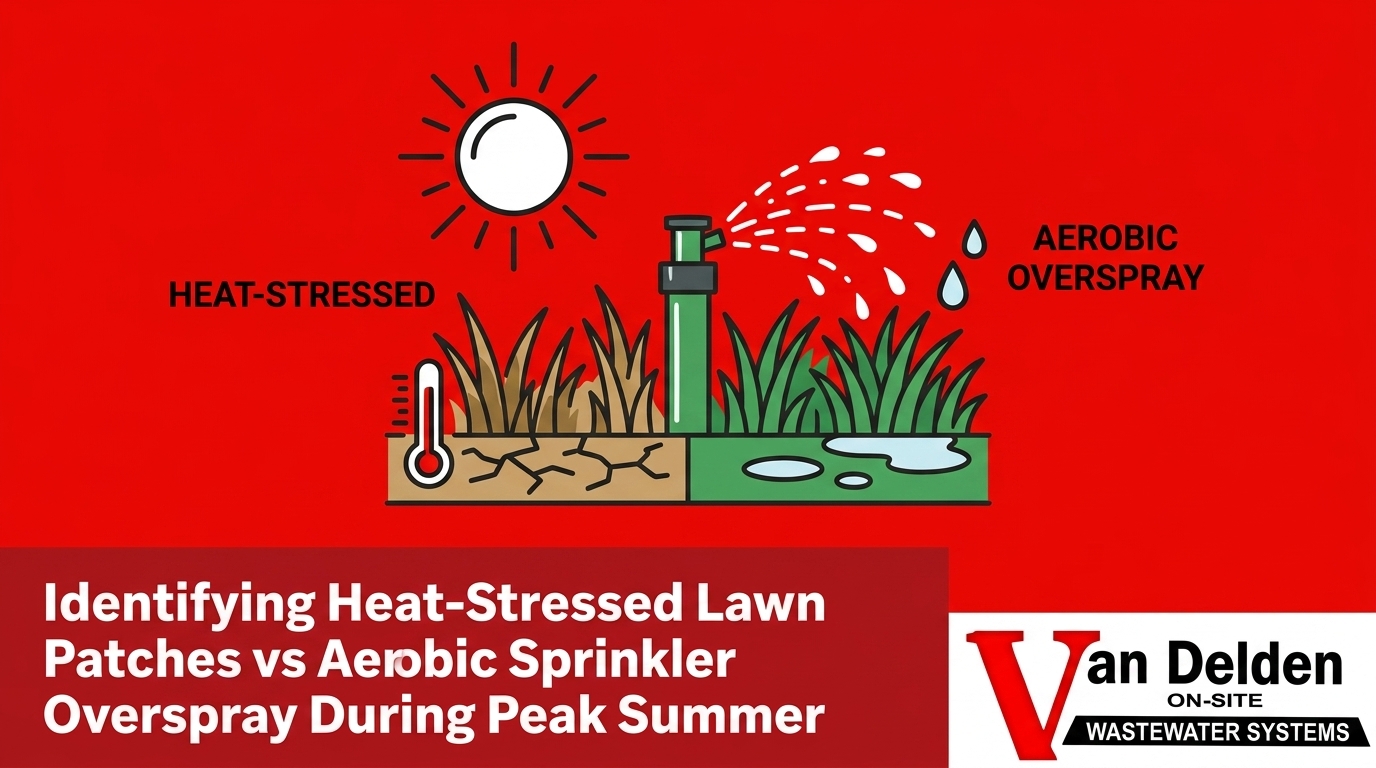
Identifying Heat-Stressed Lawn Patches vs Aerobic Sprinkler Overspray
Identifying Heat-Stressed Lawn Patches vs Aerobic Sprinkler Overspray
Surviving the Summer: Reading Your Lawn's Warning Signs
A Texas July brings relentless heat that can quickly bake your yard into a patchwork of dry, brittle turf. If you are struggling with identifying heat-stressed lawn patches vs aerobic sprinkler overspray, you are not alone. In our decades of servicing Boerne and the surrounding Texas Hill Country, our team at Van Delden Wastewater Systems has noticed that many homeowners see striking contrasts in their landscaping during peak summer and immediately assume their irrigation is failing. The real challenge lies in determining whether you need to adjust your aerobic sprinkler heads or simply increase your general watering schedule to combat severe heat stress.
Reading your lawn's color and moisture patterns correctly is critical. Making the right diagnosis early can save both your grass and your expensive septic equipment from long-term damage. We often caution our customers that a misaligned spray head might seem like a minor nuisance, but it can quickly lead to compliance issues, property damage, and unhealthy pooling. Conversely, overwatering a lawn that is just naturally dormant wastes resources and masks the real condition of your soil. To learn more about aerobic septic systems and managing your aerobic system with spray irrigation, read on for our complete diagnostic breakdown.
How Shallow Hill Country Soil Reacts to Extreme Heat
Our technicians frequently navigate the terrain in Boerne, TX, and the surrounding Hill Country, which presents unique challenges for both landscaping and wastewater management. Unlike regions with deep, loamy topsoil, the properties we service are characterized by shallow, rocky limestone bedrock. Understanding how this specific soil profile behaves under extreme temperatures is the first step we take when diagnosing any unusual patches in a customer's yard.
The Challenge of Low Moisture Retention
Shallow limestone soils have exceptionally low moisture retention capabilities. When temperatures consistently soar past 95 degrees, the thin layer of topsoil bakes rapidly. Any surface moisture evaporates in a matter of hours, and the rocky sub-layer prevents deep root systems from accessing underground water reserves. This geological reality accelerates visible drought stress, causing native and non-native grasses alike to struggle to maintain their vibrant color.
The "Blank Canvas" Effect of Drought
Because the surrounding soil dries out so uniformly and completely, your lawn essentially becomes a blank canvas. Against this backdrop of pale, dormant grass, any localized source of moisture stands out with startling clarity. When an aerobic septic system disperses treated effluent onto this dry canvas, the contrast is immediate and sharp. The shallow soil cannot disperse the water laterally very well, meaning the moisture stays exactly where it lands. This distinct interaction between the aerobic spray and the rocky soil is why our field teams see such dramatic, hyper-localized variations in Hill Country lawns during a severe drought.
Visual Symptoms of Heat and Drought Stress
Before you suspect a malfunction in your wastewater system, we recommend ruling out natural environmental factors. A Texas July will push almost any lawn to its limits, and recognizing the natural signs of heat stress will help you avoid unnecessary service calls.
Assessing the Extent of the Damage
Drought stress is a biological response. Grass blades close their pores to conserve water, which halts photosynthesis and causes the plant to lose its green pigment. This process happens gradually and affects large, contiguous areas of your property that do not receive supplemental irrigation.
• Widespread, uniform discoloration: Drought stress rarely creates distinct, isolated spots. Instead, you will see large swaths of yellowing or browning that blend gradually into the rest of the yard.
• The footprint test: When grass is properly hydrated, it springs back immediately after you step on it. Drought-stressed grass loses its elasticity. If you walk across the lawn and your footprints remain visible in the flattened turf, the grass is severely dehydrated.
• Dry, brittle texture: Heat-stressed grass feels rough and crunchy underfoot. The blades may fold in half or snap when rolled between your fingers.
• Lack of geometric boundaries: Natural heat stress follows the topography of your yard, affecting slopes and high-sun areas first. It does not form perfect circles, straight lines, or sharp arcs.
If your yard exhibits these widespread, non-geometric symptoms, we typically advise that it indicates a need for deeper, less frequent general irrigation, rather than pointing to an issue with your septic spray field.
Recognizing the Distinct Patterns of Aerobic Sprinkler Overspray
In stark contrast to the widespread fading of heat stress, aerobic effluent overspray leaves a highly specific visual signature on your property. Because treated aerobic water contains residual nutrients like nitrogen and phosphorus, it acts as a powerful, localized liquid fertilizer.
The Nutrient Effect in Action
When our crews inspect properties during peak summer, we look for the nutrient effect in action. When this nutrient-rich water hits a specific patch of Boerne, TX soil every single night, that patch thrives while the rest of the yard goes dormant. The grass in these zones will often grow twice as fast, appear a deep, vibrant emerald green, and feel thick and lush. If a spray head is misaligned, this hyper-growth will occur outside the designated spray field, drawing immediate attention.
To help you differentiate between the two conditions, use the diagnostic criteria our technicians rely on:
• Color Profile — Typical Heat & Drought Stress: Pale yellow, tan, or brown — Aerobic Sprinkler Overspray: Deep, vibrant, unnatural emerald green
• Grass Texture — Typical Heat & Drought Stress: Brittle, crunchy, lays flat when stepped on — Aerobic Sprinkler Overspray: Thick, rapid growth, taller than surrounding turf
• Location — Typical Heat & Drought Stress: High-sun areas, slopes, non-irrigated zones — Aerobic Sprinkler Overspray: Directly aligned with a spray head trajectory
If you observe the distinct, lush patterns outlined above, it is highly likely that a spray head has shifted. Addressing this promptly is a critical component of proper aerobic system repair, ensuring your system remains compliant and your yard remains healthy.
Symptoms of Heat Stress vs. Symptoms of Aerobic Overspray
Why Aerobic Spray Heads Become Misaligned in Summer
Aerobic spray heads do not shift on their own. They are designed to remain fixed, distributing treated effluent evenly over a designated area that complies with strict state regulations. However, the extreme environment of a Texas July introduces several variables that our maintenance teams see compromising this alignment.
The Hidden Impact of Soil Contraction
During prolonged dry spells, the soil physically changes. As moisture evaporates from the ground, clay and topsoil contract and shrink away from fixed structures, including your sprinkler housings. This shifting can easily tilt a spray head just a few degrees. While a few degrees might seem insignificant at the source, it translates to a massive shift in the spray trajectory ten feet away.
1. Extreme dry weather ground shifting: The constant cycle of soil expanding during heavy spring rains and contracting violently during summer droughts destabilizes the ground holding the spray heads in place.
2. Landscaping and lawnmower bumps: During the summer, routine lawn maintenance is frequent. A heavy riding mower bumping against a slightly elevated spray head can instantly knock it out of alignment. Similarly, string trimmers and landscaping equipment can inadvertently twist the nozzle.
3. TCEQ regulatory compliance: The Texas Commission on Environmental Quality (TCEQ) dictates exactly where aerobic effluent can be sprayed. The field must avoid property lines, surface water, and structures. When a head shifts, it often violates these boundaries.
4. Structural interference: If you notice overspray hitting fences, pooling against your home's foundation, or spraying onto a driveway, the alignment has been compromised. This requires immediate professional attention to prevent property damage and regulatory fines.
Safe Methods for Evaluating Your Spray Field
If you suspect a misalignment based on the visual patterns in your yard, you must evaluate the situation carefully. Aerobic systems manage treated wastewater, and interacting with the mechanical components carries both health and legal risks if done improperly.
Visual Observation Strategies
Observe from a safe distance: We always tell homeowners that the safest and most effective way to confirm a misalignment is to watch the system during its active spray cycle. Most systems run in the early hours of the morning. Note the exact trajectory of the water. Is it hitting a fence? Is it spraying onto a neighbor's property? Is it concentrating entirely on one small patch instead of fanning out?
Check the soil saturation: Wait until the spray cycle has completely finished and the ground has had a few hours to absorb the moisture. Walk the suspected overspray zones and compare the soil moisture to the rest of the yard. If the ground is spongy, muddy, or if standing water remains hours after the cycle in the heat of a Texas July, the head is likely stuck in a fixed position or improperly angled.
Strict Warnings Against DIY Adjustments
Do not attempt manual realignment: We cannot stress this enough: never attempt to manually twist, dig up, or realign the spray heads yourself. Aerobic systems are heavily regulated, and adjusting the spray trajectory requires an understanding of TCEQ guidelines and proper hydraulic pressure. Forcing a head to turn can snap the underground PVC piping, turning a minor adjustment into a major, costly excavation for our repair crews.
Document the evidence: Instead of touching the equipment, document the location and shape of the lush or soggy patches. Take photos of the yard and note the exact time you observed the spray cycle hitting the wrong area. This information is invaluable when our licensed technicians arrive on site.
When to Consult a Local Expert for System Adjustments
Bridging the gap between noticing a problem and fixing it requires professional intervention. Persistent pooling, foul odors, or spray leaving the designated field are not issues that will resolve themselves when the weather cools down. They require precision correction.
The Value of Local Expertise
Relying on technicians who understand the specific interactions between local soil and aerobic systems is paramount. At Van Delden Wastewater Systems, we have been operating since 1937, possessing a deep, generational understanding of how Boerne native soils react to both drought and treated effluent. This historical knowledge ensures that when we adjust a system, it is calibrated perfectly for the local environment, preventing future shifts as much as possible.
A quick visual inspection and adjustment by our professionals can prevent long-term damage to your lawn and keep your system fully compliant. A pattern we see often played out perfectly when one homeowner in nearby Garden Ridge recently reached out to us for a comprehensive inspection after noticing unusual yard conditions. Our technician, Courtney, walked the property, explained the entire inspection process step by step, and answered every question about how the system was interacting with the local terrain. That level of detailed communication ensures you understand exactly what your system needs without any guesswork.
Realigning heads is a routine maintenance task for our experienced providers, but it requires the right tools and licensing. If your lawn is showing the distinct signs of overspray, it is time to schedule a septic consultation with our trusted local experts.
Frequently Asked Questions About Summer Lawn Patterns
Why is the grass so green around my aerobic sprinklers?
Treated aerobic effluent contains residual nutrients like nitrogen and phosphorus, which act as a localized fertilizer. When this nutrient-rich water is applied to the same spot consistently, it causes the grass to grow thicker and greener than the surrounding, non-irrigated turf. We frequently see this contrast become especially obvious during a dry Texas July.
How can I tell if my aerobic spray heads are misaligned?
Look for spray hitting non-field areas like fences, driveways, or the side of your house during the active cycle. Additionally, watch for distinct pooling, overly soggy patches, or perfectly geometric arcs of lush green grass that fall outside your designated spray zone.
What does drought stress look like in Texas lawns?
Drought stress presents as widespread, uniform yellowing or browning across areas that do not receive supplemental watering. The grass will have a dry, brittle texture, will not spring back when stepped on, and the discoloration will follow the natural slopes and high-sun areas of the yard rather than forming sharp, distinct shapes.
Can aerobic septic water burn grass?
Generally, no; the treated water acts as a fertilizer and promotes growth. However, if a spray head is broken or severely misaligned, it can cause severe over-saturation in one small area. This constant localized flooding can lead to root rot, which will eventually kill the grass in that specific spot.
How often should aerobic sprinklers run during a drought?
Aerobic sprinklers run based on the volume of water usage inside the home, not based on the outside weather or lawn hydration needs. The spray frequency remains consistent as long as your household water use (laundry, showers, dishes) remains consistent, regardless of how hot or dry it is outside.
Does pooling water always mean a broken spray head?
Not always; while a broken or misaligned head is a common culprit we find in the field, pooling water could also indicate a clogged filter, compacted soil, or a failing pump. Because there are multiple potential causes for standing effluent, it requires a licensed professional to diagnose the issue accurately and safely.
Ensure Your System Operates Flawlessly This Summer
Clear visual criteria—specifically the color, shape, and moisture level of the affected patches—are the key to accurately diagnosing what is happening in your yard. Widespread, brittle yellowing points to natural heat stress, while localized, lush green arcs or soggy depressions point directly to aerobic sprinkler overspray. Understanding how the shallow soils of Boerne, TX react to these conditions empowers you to make the right call.
Do not wait until a minor misalignment causes severe lawn damage or results in a regulatory compliance violation. If you notice the distinct signs of overspray, act quickly to protect your property. Schedule a professional inspection with the Van Delden team today to ensure your system is perfectly calibrated and operating flawlessly throughout the peak of summer.
Peter was personable, professional and thorough. Highly recommend Van Delden. You might be able to find a cheaper company but not better!
Wendell E
On time. 100% professional, knowledgeable, and courteous. Very helpful and straightforward. That is the bar all businesses should strive for.
Andy R
It has been a pleasure working with your company. Not only did y’all communicate very well but your workers were always polite! Thank you!
Kate R.
“I thank Van Delden for such prompt service. Honest people are hard to come by these days. I will certainly recommend Van Delden to anyone! Jesse is an upstanding young man and very nice to talk to. I thank everyone at Van Delden for taking such good care of me.”
Charles H
This is just a note to thank you for explaining the problem with my system. You didn’t have to be so kind and I appreciate your good business ethics and time spent. In the future you will have mine in return!