My septic system is acting up. Who provides expert residential drainfield cleaning in Bulverde, TX?
Residential drainfield cleaning in Bulverde, TX is one of the most important — and most overlooked — parts of owning a home in the Texas Hill Country. Nearly every property in Bulverde runs on a private septic system. There's no centralized sewer to fall back on. When your drainfield starts to fail, the consequences hit fast: slow drains, soggy yards, foul odors, and potentially the need for a full system replacement.
Here's a quick overview of what Bulverde homeowners need to know:
- What it is: Drainfield cleaning removes biomat buildup, solids, and clogs from the underground pipes that filter treated wastewater into the soil.
- Why it's urgent in Bulverde: Limestone bedrock and rocky Hill Country soil limit how well the ground absorbs effluent, making clogs more likely and more damaging.
- How often: Most systems benefit from professional inspection every 1-3 years, with septic tank pumping every 3-5 years to protect the drainfield.
- Warning signs: Pooling water over the drainfield, lush green patches of grass, slow indoor drains, gurgling pipes, or sewage odors near the yard.
- Who to call: A licensed local wastewater specialist familiar with Comal County soil conditions and regulations.
Drainfields typically last 15 to 30 years — but only with proper care. Skipping maintenance doesn't just shorten that lifespan. It puts your yard, your home's plumbing, and Bulverde's groundwater at risk.
This guide walks you through everything: the warning signs, the cleaning methods professionals use, and the simple habits that keep your system running longer.
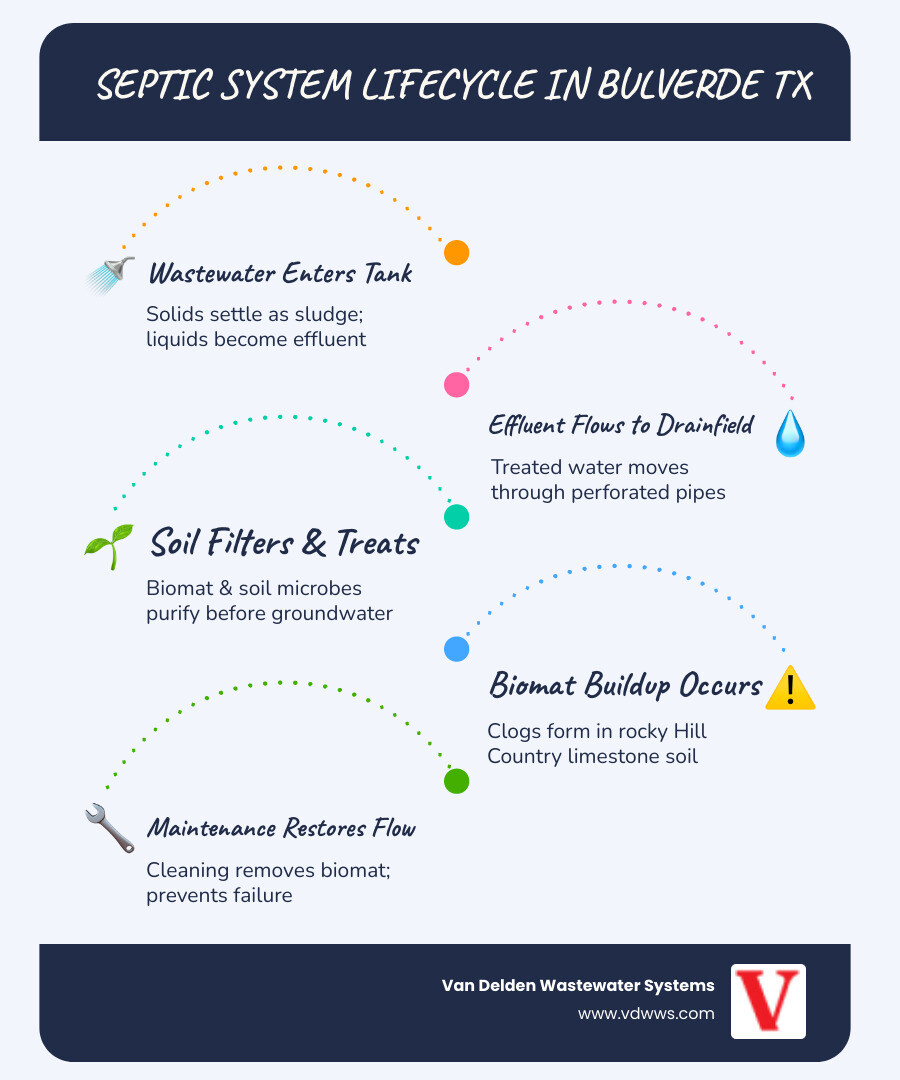
Basic residential drainfield cleaning in bulverde, tx terms:
Why does my home need residential drainfield cleaning in Bulverde, TX?
Living in the Texas Hill Country offers breathtaking views, but the very ground beneath our feet presents a unique set of challenges for wastewater management. In Bulverde, the presence of limestone bedrock and incredibly rocky soil means that a septic system cannot be a "set it and forget it" appliance.
The drainfield (also known as a leach field or absorption field) is the final stage of your septic system. After the septic tank separates solids from liquids, the relatively clear liquid, or effluent, flows into the drainfield. Here, a series of perforated pipes buried in gravel-filled trenches allows the water to slowly seep into the ground.
In many parts of the country, deep, sandy soil acts as a natural sponge. In Bulverde, however, we often deal with thin layers of topsoil sitting directly on top of solid limestone. When these pipes become clogged with sludge or a thick "biomat" (a slimy layer of bacteria and waste), the water has nowhere to go. Because the limestone doesn't absorb water as quickly as loamy soil, any backup in the pipes quickly leads to surfacing sewage or backups into the home.
Regular Drainfield Cleaning is essential because it removes these obstructions before they cause a total system failure. Furthermore, protecting our groundwater is a community responsibility. Bulverde sits over sensitive karst limestone formations where surface contaminants can easily reach the Edwards Aquifer. A failing drainfield isn't just a nuisance for you; it's an environmental hazard for all of Comal County.
How do local soil conditions affect my septic system?
The geology of Bulverde is dominated by the Glen Rose Limestone and Edwards formations. This means that instead of digging into soft dirt, installers often have to contend with solid rock. This rocky terrain significantly impacts how well a drainfield can breathe.
When soil is "tight" or rocky, the permeability—the rate at which water can move through it—is much lower. If your drainfield pipes are even partially restricted by grease, lint, or household solids, the system can quickly reach a state of soil saturation. During periods of heavy Texas rain, the ground becomes even less capable of accepting wastewater. Without proactive Drainfield Maintenance Bulverde TX, the system can experience hydraulic overload, where the volume of water entering the system exceeds the ground's ability to absorb it.
Additionally, Bulverde is home to various natural springs and varying elevations. If a system is poorly maintained, effluent can "daylight" or breakout on a slope, running downhill toward neighboring properties or local waterways.
What are the signs that I need professional drainfield cleaning?
Your septic system will usually try to tell you when it’s struggling, but you have to know what to look for. Often, homeowners mistake a drainfield issue for a simple clog in a single sink or toilet. However, if multiple fixtures are acting up, the problem is likely deeper in the system.
Common indicators that you need to schedule residential drainfield cleaning in Bulverde, TX include:
- Slow Drains and Gurgling: If your bathtub takes forever to drain or you hear a "glug-glug" sound from the pipes when the washing machine runs, your system is struggling to push air and water through the lines.
- Foul Odors: A healthy septic system should be relatively odorless. If you catch a whiff of rotten eggs or "sewer gas" in your yard or near your drains, it’s a sign that gases are being forced back toward the house because the drainfield is blocked.
- Lush, Green Grass: While we all want a beautiful lawn, a specific patch of bright green, fast-growing grass over the drainfield area is a red flag. It means the plants are over-fertilized by surfacing effluent that isn't filtering down into the soil correctly.
- Soggy Ground: If you notice "squishy" spots in your yard during a dry spell, your drainfield is likely saturated.
Keeping up with Drainfield Cleaning for Septic System Maintenance is the best way to catch these symptoms before they escalate into a full sewage backup inside your home.
Recognizing the early symptoms of a clogged residential drainfield in Bulverde, TX
The most dangerous stage of a drainfield problem is the "sluggish" phase. This is when the system still works, but it’s under immense pressure. Surfacing effluent—wastewater that rises to the top of the grass—is a clear sign that the biomat has become too thick or the soil has become compacted.
If you ignore these signs, you move from needing a cleaning to needing a Drain Field Repair Complete Guide level of intervention. Soggy ground is often the final warning before the water has nowhere left to go but back up your main sewer line. In Bulverde’s rocky soil, once a system is completely "dead" or anaerobic (lacking oxygen because it's constantly underwater), it is much harder to restore than a system that is caught early.
Professional methods for restoring your septic leach field
When a drainfield is sluggish, a simple plunger or a bottle of store-bought chemicals won't solve the problem. In fact, many chemical "cleaners" can actually kill the beneficial bacteria in your tank, making the problem worse. Professionals use more advanced, mechanical methods to clear the lines.
| Method | How it Works | Best For |
|---|
| Snaking | A mechanical cable "pokes" a hole through a clog. | Temporary relief of a specific blockage. |
| Hydro-Jetting | High-pressure water scours the entire inside of the pipe. | Deep cleaning, removing sludge, and breaking up biomat. |
| Camera Inspection | A fiber-optic camera is fed into the lines. | Pinpointing roots, crushed pipes, or exact clog locations. |
Using a Drainfield Cleaning Bulverde TX Guide approach, a technician will typically start with a camera inspection to see exactly what is happening underground. This prevents unnecessary digging and helps determine if the pipes are simply dirty or if they have been crushed by shifting Hill Country rock.
Is hydro-jetting the best solution for residential drainfield cleaning in Bulverde, TX?
In our experience, hydro-jetting is the gold standard for restoring a residential drainfield. While a snake might just push a hole through a clog, hydro-jetting uses specialized nozzles that spray water at high pressure in all directions. This scours the pipe walls, removing years of accumulated "sludge" and grease.
More importantly, hydro-jetting helps with biomat breakdown. The biomat is a necessary part of the system, but when it becomes too thick, it acts like a waterproof seal, preventing water from reaching the soil. The pressure from the jetter can help break up this layer and introduce oxygen back into the trenches.
The Importance of Regular Drainfield Cleaning cannot be overstated, especially when dealing with root intrusion. Bulverde’s beautiful oak trees have roots that are experts at finding water. They can slip into the tiny perforations in your drainfield pipes and grow into massive blockages. Hydro-jetting can often cut through these smaller "hair" roots, clearing the path for wastewater without the need for trenching up your entire yard.
How can I extend the life of my Bulverde septic system?
Prevention is always better than a cure. A well-maintained drainfield in Bulverde can last 30 years, while a neglected one might fail in under 10.
One of the best investments you can make is a septic tank riser. In the Hill Country, tanks are often buried deep to get past the rock layer. A riser brings the access lid up to ground level (or just below it), making it much easier and more efficient to perform regular inspections and pumping.
The most critical maintenance task is following a strict pumping schedule. Most households in Bulverde should have their tanks pumped every 3 to 5 years. This prevents solids from overflowing the tank and entering the drainfield. Once solids get into those perforated pipes, they are very difficult to remove. For more on this, check out our Septic Pumping Bulverde TX Guide.
Another lifesaver for your drainfield is the effluent filter. This is a small plastic filter installed on the outlet pipe of your septic tank. It acts as a final "safety net," catching hair, lint, and small bits of plastic before they can reach your soil.
Best practices for Hill Country homeowners
Beyond professional service, your daily habits make a huge difference:
- Manage Tree Roots: Keep large trees and shrubs at least 10 to 20 feet away from your drainfield. If you're struggling with existing trees, Drainfield Cleaning in Smithson Valley TX services can help identify where roots are entering the system.
- Watch the Chemicals: Avoid pouring bleach, paint thinners, or heavy drain cleaners down the sink. These kill the bacteria that keep your system healthy.
- Spread Out the Laundry: Doing five loads of laundry on a Saturday morning can "drown" your drainfield. Stagger your loads throughout the week to avoid hydraulic overload.
- No "Flushable" Wipes: Despite what the package says, wipes do not break down. They are a leading cause of drainfield clogs in Bulverde.
Frequently Asked Questions about Bulverde Drainfield Care
How often should I have my drainfield inspected?
We recommend a professional inspection every 1 to 3 years. If you have an aerobic system (which is common in the rockier parts of Bulverde), you may actually be required by Comal County to have a maintenance contract that includes more frequent checks. Regular inspections help us catch small issues like a leaky toilet (which can flood a drainfield) before they become major disasters.
Can tree roots be removed without digging up the yard?
In many cases, yes! High-pressure hydro-jetting is very effective at clearing out "feeder roots" that have entered the pipes. However, if a massive root has actually cracked or crushed the pipe, a localized repair might be necessary. Using camera technology allows us to find the exact spot, so we only have to dig in one small area rather than trenching the whole yard.
Does regular tank pumping really prevent drainfield failure?
Absolutely. Think of your septic tank like a lint trap in a dryer. If the trap gets too full, the lint starts blowing into the vent pipe. In a septic system, if the tank gets too full of sludge, those solids flow directly into your drainfield pipes. Once those pipes are packed with solid waste, the soil around them becomes "clogged," and the system fails. Pumping is the single most effective way to protect your drainfield.
Conclusion
Owning a home in the beautiful Texas Hill Country comes with the responsibility of managing your own wastewater. Because of the unique limestone and rocky terrain, residential drainfield cleaning in Bulverde, TX isn't just a luxury—it's a necessity for protecting your property value and our local environment.
At Van Delden Wastewater Systems, we’ve been helping families in the area since 1937. We understand the specific challenges of Comal County soil and provide the expert, honest service you need to keep your system running smoothly. Whether you need a routine check-up or a deep hydro-jet cleaning, our background-checked technicians are here to help.
If you’re noticing slow drains or soggy spots in your yard, don’t wait for a total backup. Visit our Bulverde TX Location page to learn more about our local services, or dive deeper into our Best Drainfield Cleaning Guide Smithson Valley TX for more regional tips. Ready to restore your system? Contact us today for professional Drainfield Cleaning.