Why Homeowners Ask If a Septic System Is Better Than Being on City Sewer
Is a septic system better than being on city sewer? The honest answer: it depends on where you live, how much land you have, and what trade-offs you're willing to accept.
Here's a quick breakdown to help you decide:
| Factor | Septic System | City Sewer |
|---|
| Best for | Rural, larger lots | Urban, small lots |
| Monthly utility bill | None | Yes, ongoing |
| Homeowner maintenance | Higher responsibility | Lower responsibility |
| Upfront setup | Higher in rural areas | Lower if main is nearby |
| Environmental impact | Eco-friendly when maintained | More energy and chemicals used |
| Lifespan | 20-40 years | 50-100 years |
| Failure risk | On your property, your cost | Shared infrastructure |
| Independence | High | Low |
For most rural homeowners, a septic system is the only realistic option. For those in cities or dense suburbs, sewer connection is standard. But sometimes you genuinely have a choice — and that's where things get interesting.
Every home produces wastewater. The question is simply where it goes and who's responsible for treating it. Septic systems handle everything on your property using natural processes. City sewer systems pipe waste away to a centralized treatment plant that the municipality manages. Both work. Both have real trade-offs.
Understanding those trade-offs — from long-term costs and maintenance demands to environmental impact and property value — is what this guide is all about.
Septic vs. Sewer Basics: The Core Difference Every Homeowner Should Understand
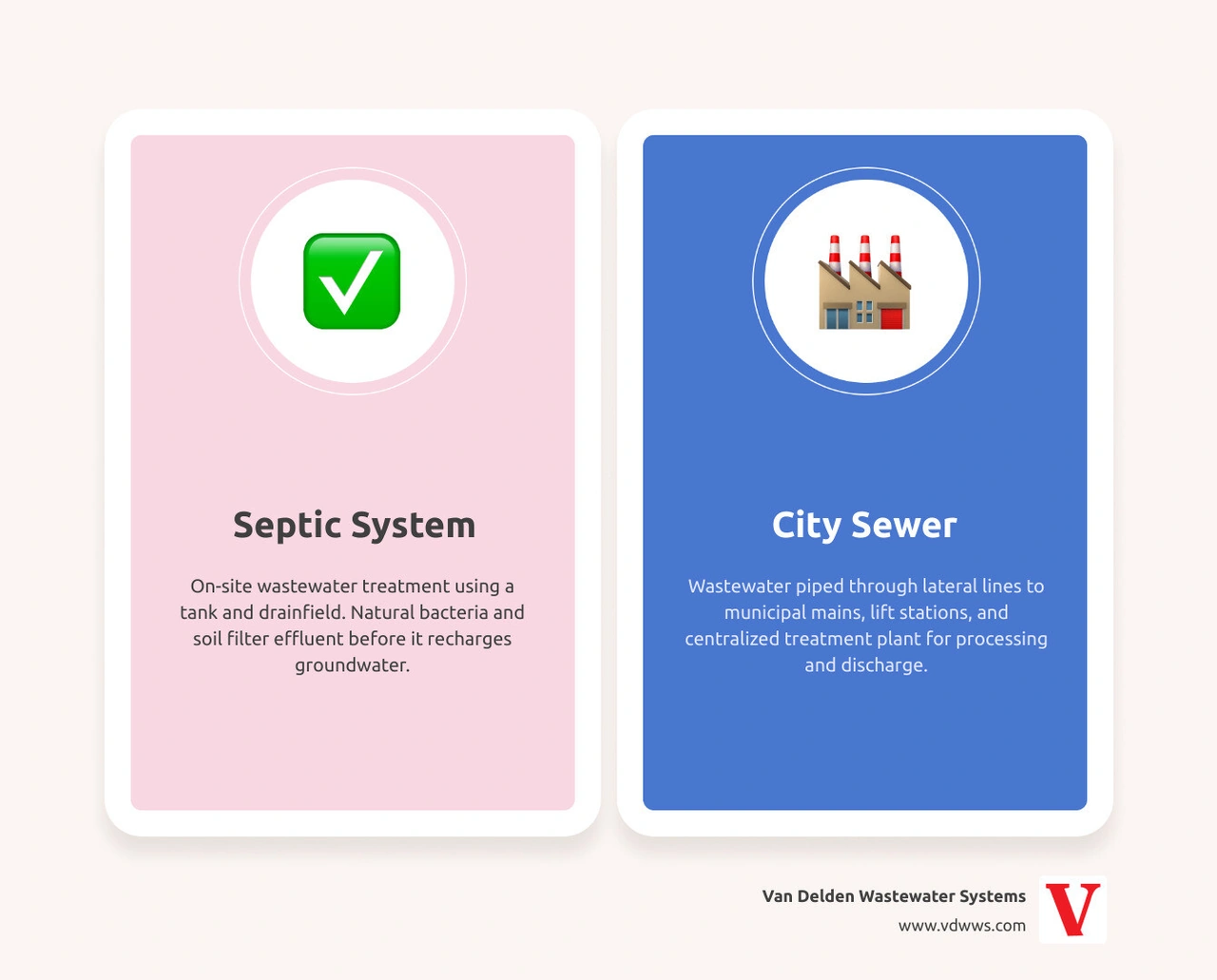
At the most basic level, a septic system treats wastewater on your property, while a public sewer sends it somewhere else for treatment.
That sounds simple because it is simple. The important part is what comes with that difference.
With septic, you own the system and the responsibility. With sewer, the city or utility handles the main system, but you still own the pipe that runs from your home to the public line. If you want a deeper overview, our guide on septic vs. sewer differences breaks down the basics even further.
A septic setup usually includes:
- A tank that separates solids, scum, and liquid effluent
- A drainfield that disperses and filters wastewater through soil
- Space on your lot for proper setbacks and treatment
A sewer-connected home usually includes:
- A building sewer or lateral line from the house
- A connection to the public sewer main
- Off-site treatment at a municipal plant
This core difference affects everything else: maintenance, lot size, repairs, future plans, and even how you use water day to day.
How a Septic System Works on Your Property
A septic system is basically a small wastewater treatment system built into your property.
Wastewater leaves your home and enters the septic tank. Inside the tank, solids settle to the bottom as sludge, oils and grease float to the top as scum, and the liquid layer in the middle flows out to the drainfield. Naturally occurring bacteria help break down waste in the tank, and the soil in the drainfield provides another stage of treatment as the water filters through the ground.
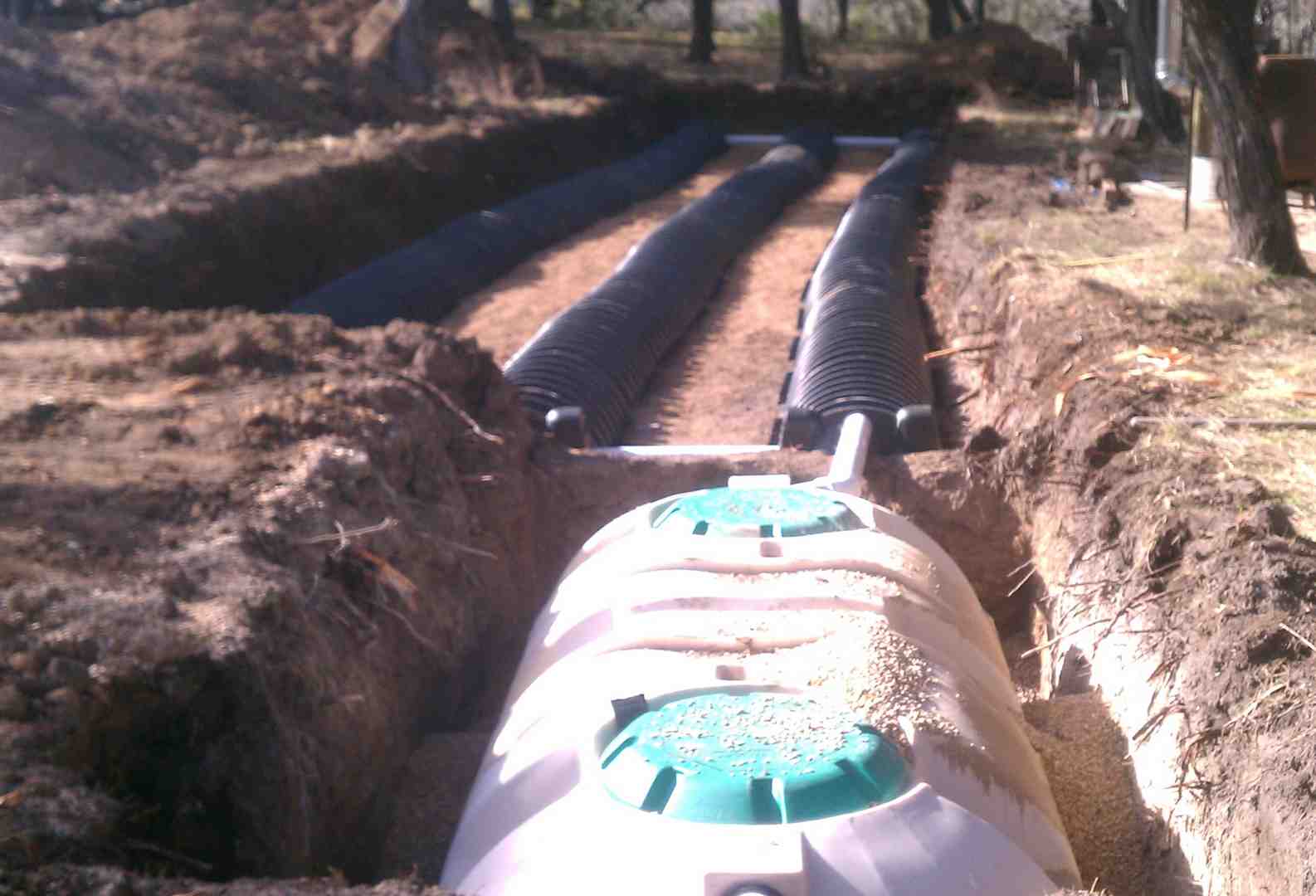
When everything is working as it should, this process is quiet, efficient, and mostly invisible. That is one reason septic systems remain so common in rural and semi-rural parts of Texas. They let homes operate without depending on distant sewer infrastructure.
We talk more about the role these systems play in public health and wastewater treatment in The Surprising Importance Of Septic Systems.
How a Public Sewer System Works Off-Site
A sewer system moves wastewater away from your home through underground pipes. Your home connects to a lateral line, which ties into a larger public main. In some areas, lift stations help move wastewater where gravity alone is not enough.
From there, sewage travels to a centralized treatment facility. That plant removes contaminants and then discharges treated water according to regulatory standards.
For the homeowner, this means less hands-on responsibility for treatment itself. But it does not mean zero responsibility. If the lateral line on your property cracks, clogs, or collapses, that repair usually falls on you.
Is a Septic System Better Than Being on City Sewer for Understanding Ownership and Control?
If you like control, septic has a real appeal.
You are not tied to a monthly sewer bill, you are not exposed to municipal rate changes, and you are not relying on a citywide network to move and treat your wastewater. That independence matters to many homeowners in areas like Boerne, Spring Branch, Bulverde, and other lower-density parts of our service area.
But ownership also means accountability. If your system is neglected, there is no city crew coming to fix it for free. Septic rewards good habits and punishes bad ones. Sewer is more of a shared-service model: easier in some ways, but less in your hands.
Pros and Cons: Is a Septic System Better Than Being on City Sewer for Your Lifestyle?
This is where the answer becomes personal.
Some homeowners want self-sufficiency and lower recurring utility costs. Others want convenience and would rather not think about wastewater at all unless something goes wrong.
Here is the practical comparison:
| Lifestyle Factor | Septic System | City Sewer |
|---|
| Independence | High | Low |
| Day-to-day convenience | Moderate | High |
| Best for heavy volume use | Depends on size/design | Usually better |
| Outdoor space needed | Significant | Minimal |
| Maintenance involvement | Higher | Lower |
| Risk from city infrastructure problems | Lower | Higher |
| Risk from on-property misuse | Higher | Lower |
If you are weighing the lifestyle side of the decision, you may also find our article Why Would I Want A Septic System helpful.
Septic System Advantages and Drawbacks
The biggest advantages of septic are independence, no monthly sewer charges, and strong environmental potential when the system is designed and maintained correctly.
Septic can be a great fit when:
- Your property is outside sewer service areas
- You have enough land for a drainfield
- You want more control over your utility setup
- You are comfortable staying on top of maintenance
The drawbacks are just as real:
- You need regular pumping, usually every 3 to 5 years
- You must watch what goes down the drain
- Overloading the system can shorten its life
- A major failure, especially in the drainfield, can be a serious repair
Septic also requires a little more discipline. Doing all the laundry in one marathon day and treating your garbage disposal like a black hole is not ideal. Septic systems prefer moderation, not chaos.
If you are buying a property with one, our guide on whether to buy a home with a septic system covers what to look for.
City Sewer Advantages and Drawbacks
City sewer's biggest advantage is convenience.
For most homeowners, wastewater simply leaves the house and disappears into the public system. There is no drainfield to protect, no tank to pump, and fewer day-to-day usage concerns. Sewer also tends to handle higher wastewater volumes more easily, which can matter for large households or dense properties.
Still, sewer is not automatically perfect.
Possible drawbacks include:
- Ongoing monthly charges
- Exposure to rate increases
- Potential homeowner responsibility for the lateral line
- Limited control over outages, backups, or public system problems
- Occasional overflow or main-line issues during major storm events
In other words, sewer can be lower-maintenance, but not no-maintenance.
Is a Septic System Better Than Being on City Sewer for Large Households, Small Lots, and Rural Homes?
Usually, yes for rural homes, no for small urban lots, and maybe for everything in between.
For rural properties:
- Septic is often the best or only practical choice
- Large lots make drainfield placement easier
- Extending sewer infrastructure may not be realistic
For small lots and dense neighborhoods:
- Sewer is usually the better fit
- Septic may not be allowed or may not fit setback requirements
- Landscaping and future additions are often easier with sewer
For large households:
- Sewer often has the advantage because it can better absorb high, frequent wastewater volume
- Septic can still work well, but only if properly sized, installed, and maintained
For multi-unit or high-density properties:
- Sewer is usually better suited
For suburban-edge properties:
- Either may be possible, depending on access, lot size, soil, and local rules
Space, Cost Factors, and Long-Term Ownership Considerations
Even when homeowners focus on convenience first, the practical issues usually decide things: space, access, regulations, upkeep, and long-term planning.
A septic system needs room to function safely. In many jurisdictions, that means at least about 1/4 to 1/3 of an acre, and sometimes more depending on local conditions. Soil also matters. A property may need a percolation test or site evaluation to determine whether wastewater can disperse properly.
Sewer, by contrast, needs nearby infrastructure. If the public main is close, connection can be straightforward. If it is far away, the equation changes fast.
Installation and Connection Factors That Shape the Decision
For septic, the main decision factors include:
- Lot size
- Soil conditions
- Slope and drainage
- Required setbacks from wells, structures, and property lines
- Local permitting and inspection requirements
For sewer, the main issues are:
- Whether a public line is available
- The condition and length of the lateral
- Municipal connection requirements
- Any decommissioning rules if an old septic system is being retired
New construction often makes the choice more obvious. Existing homes can be trickier, especially when a neighborhood expands and sewer becomes newly available. If that happens, our article on transitioning from a septic system to a city sewer explains the process.
Ongoing Maintenance and Repair Responsibilities
This is where the long-term difference really shows up.
Septic maintenance typically includes:
- Pumping the tank every 3 to 5 years
- Periodic inspections
- Watching for slow drains, odors, or wet spots
- Protecting the drainfield from vehicles, deep roots, and construction
- Keeping records of service and repairs
City sewer maintenance is lighter, but not zero. Homeowners should still:
- Monitor for clogs or repeated backups
- Maintain the private lateral line
- Address root intrusion or pipe damage if it occurs
- Respond quickly to signs of sewer smell or drainage trouble
Over a typical 3-year septic pumping cycle, septic service can be less expensive than paying ongoing sewer charges, but that does not mean septic is always cheaper overall. A major septic repair can be expensive, and sewer users may also face lateral line repairs. The real answer depends on usage, condition, and local requirements over time.
Property Value, Resale, and Buyer Perception
A working system helps value. A failing system hurts value. That is the short version.
In rural areas around our Texas service region, septic is normal. It usually does not scare informed buyers if the system has been maintained and documented. In fact, good records can build confidence.
In dense urban areas, buyers often expect sewer because it feels more familiar and hands-off. In those settings, sewer may be perceived as easier for resale.
What matters most is:
- Whether the system is functioning properly
- Whether inspections are current
- Whether maintenance records exist
- Whether there are visible warning signs or unresolved repairs
Lenders and buyers tend to care more about condition than ideology. A healthy septic system is far better than a sewer connection with a broken lateral, and vice versa.
Environmental Impact, Reliability, and Local Rules
Wastewater is not just a plumbing issue. It is also a groundwater, soil, and public health issue.
That is why the environmental and regulatory side matters so much when deciding whether is a septic system better than being on city sewer is the right question for your property.
Which System Is More Environmentally Friendly—and When?
A properly maintained septic system can be very environmentally friendly.
It treats wastewater on-site, relies on natural bacteria, uses less centralized infrastructure, and allows treated effluent to filter through soil and return locally. That local treatment can support groundwater recharge under the right conditions. We cover this in more detail in Keeping Your Septic System Environmentally Friendly and Can Septic Systems Be Green.
But the phrase "when properly maintained" is doing a lot of work there.
A neglected septic system can contaminate nearby soil or groundwater. Research cited by septic industry sources has noted that a large share of U.S. septic systems are not functioning properly, which is a reminder that maintenance is not optional.
Sewer systems can remove a very high percentage of contaminants at treatment plants, which is a major environmental benefit in dense communities. But sewer treatment also relies more on energy, chemicals, and large-scale infrastructure. During extreme weather or system overloads, sewer overflows can affect larger waterways.
So which is greener?
- Septic is often greener for lower-density properties with good soil and responsible maintenance
- Sewer is often better for dense development where centralized treatment is more practical and protective
Reliability: Backups, Outages, and Failure Risks
Neither system is fail-proof. Wastewater has a way of reminding us that gravity and biology have opinions.
Septic risk factors include:
- Missed pumping
- Excess water use
- Drainfield saturation
- Root intrusion
- Tank or baffle damage
- Soil problems
Sewer risk factors include:
- Lateral line clogs
- Root intrusion
- Main-line blockages
- Municipal outages
- Storm-related overloads
Common warning signs for either system include:
- Slow drains
- Gurgling plumbing
- Sewage odors
- Wet or unusually green patches in the yard
- Repeated backups
With septic, failures are usually localized to your property. With sewer, problems may come from beyond your property line, which can make them harder to predict and fully control.
Regulations, Permits, and Incentives That May Decide for You
In many cases, homeowners do not get a completely free choice.
Local rules may determine whether septic is allowed, whether sewer connection is required, what setbacks apply, and how inspections must be handled. Around San Antonio and nearby communities, wastewater regulations can vary by jurisdiction, property type, and development status.
Things that often shape the decision include:
- Minimum lot size requirements
- Soil and site evaluation results
- Distance from existing public sewer lines
- Health department or permitting authority requirements
- Mandatory hookup rules when sewer becomes available
- Decommissioning requirements for old septic systems
In some areas, there may be public programs, grants, or financing options that encourage septic-to-sewer conversion. Those programs are local and change over time, so homeowners should always verify current rules before planning a switch.
When Switching Makes Sense: Moving from Septic to Sewer or Sewer to Septic
Most homeowners do not switch systems for fun. This is not exactly a hobby category.
Usually, conversion happens because the property changes, the neighborhood changes, or the existing system no longer makes sense.
When Converting From Septic to Sewer Is the Smart Move
Moving from septic to sewer can make sense when:
- Public sewer service becomes newly available
- Connection becomes mandatory under local rules
- The septic system is aging and facing major repairs
- The property's water demand has increased
- Resale goals favor sewer in that neighborhood
In these cases, switching can remove the burden of on-site treatment and future septic replacement. The process usually involves permits, connection work, and proper abandonment or decommissioning of the old septic system.
When a Septic System Makes More Sense Than Sewer Access
Septic may still be the better fit when:
- The property is remote or outside practical sewer reach
- The lot is large enough and soils are suitable
- You prefer local, on-site treatment
- You want independence from ongoing sewer billing
- The home is in an area where septic is standard and expected
This is especially common for rural and semi-rural homes around our service area, where larger lots and lower density make septic a natural choice.
Frequently Asked Questions About Is a Septic System Better Than Being on City Sewer
Does a septic system lower property value?
Not automatically. In rural markets, septic is often standard and expected. Value tends to depend more on condition, documentation, and inspection results than on whether the property is septic or sewer. A neglected septic system can hurt value, but a well-maintained one usually does not.
Which system usually needs more homeowner attention?
Septic, without question.
Septic owners need to monitor water use, schedule pumping every few years, protect the drainfield, and stay alert to warning signs. Sewer owners have fewer ongoing tasks, but they still need to maintain the private lateral and respond to backups or pipe problems.
What are the biggest warning signs that either system has a problem?
Watch for:
- Gurgling drains or toilets
- Slow sinks, tubs, or showers
- Sewage odors inside or outside
- Wet patches or standing water in the yard
- Toilets or drains backing up repeatedly
If you notice these signs, do not wait and hope they become a personality trait of the house. They usually do not.
Conclusion: The Better Choice Depends on Your Property, Priorities, and Local Rules
So, is a septic system better than being on city sewer?
Sometimes yes. Sometimes no. Most of the time, the better answer is: it depends on the property.
Septic often makes the most sense for rural homes, larger lots, and homeowners who value independence and are willing to stay on top of maintenance. Sewer usually makes more sense for smaller lots, denser neighborhoods, and households that want a more hands-off setup.
The best choice comes down to:
- Your lot size and soil conditions
- Whether sewer access exists
- Your household's water use
- Your comfort with maintenance responsibility
- Local rules and long-term property plans
If you want to learn more about how septic systems protect your home and health, read Your Septic System Pathogen And Disease Fighter. And if you are exploring options for your property in San Antonio, Boerne, Bulverde, Spring Branch, or nearby communities, visit More info about septic systems.
At Van Delden Wastewater Systems, we have been helping Texas homeowners understand, maintain, and plan for septic systems since 1937. We believe wastewater decisions should be clear, practical, and a lot less mysterious than they usually sound.