
Translating a Septic Inspection Report for Kendall County Homebuyers
Don't let technical septic jargon derail your late-summer closing. We break down which inspection findings are routine maintenance items and which are true dealbreakers.
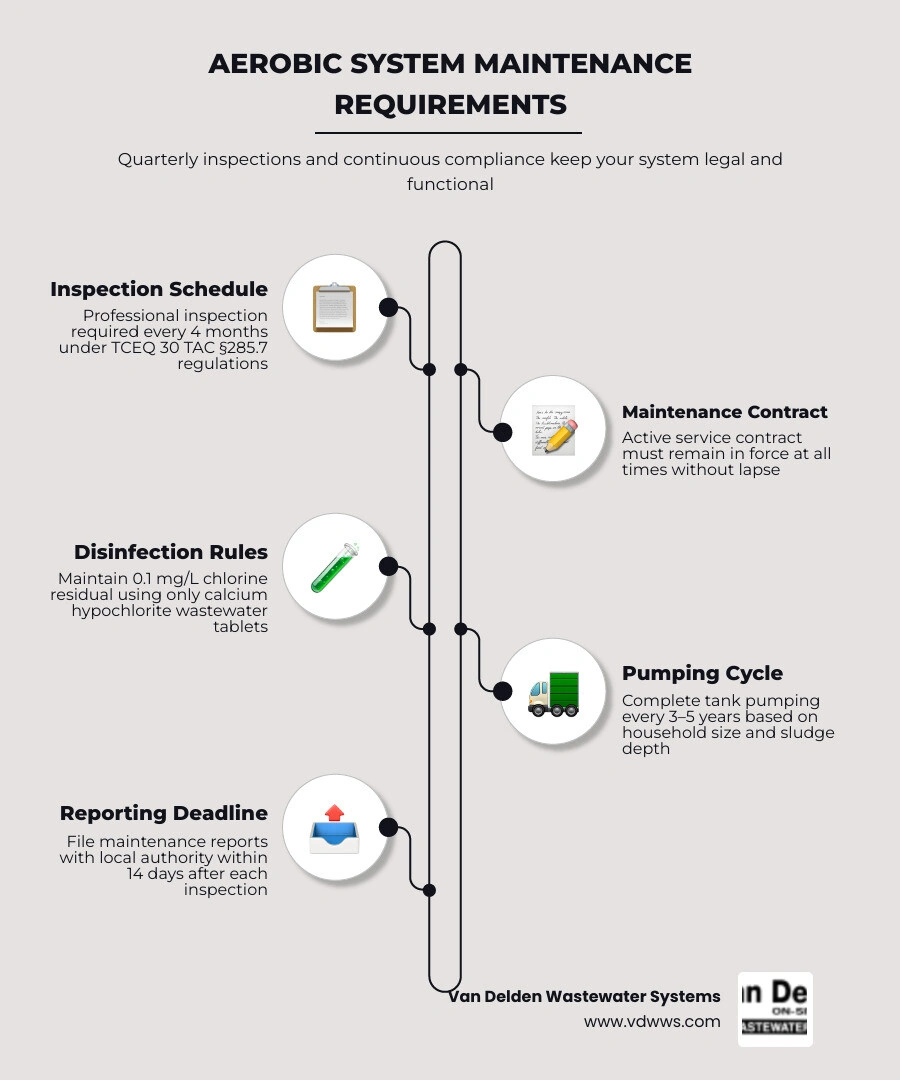
Aerobic system maintenance requirements explained simply: if you own an aerobic septic system, you are legally required to keep it under a professional service contract, have it inspected every four months, and maintain proper disinfection at all times — or face fines and potential system shutdown.
Here is a quick breakdown of the core requirements:
• Inspection frequency: Every 4 months (3 times per year) under Texas TCEQ regulations (30 TAC §285.7)
• Maintenance contract: Required at all times — cannot be skipped or left to lapse
• Disinfection: Chlorine residual must stay at or above 0.1 mg/L continuously
• Chlorine type: Calcium hypochlorite tablets rated for wastewater only — not pool tablets
• Pumping schedule: Every 3 to 5 years depending on household size and sludge levels
• Reporting: Maintenance reports must be filed within 14 days of each inspection
• Self-maintenance: Only allowed in some counties, and only after two years, with proper certification
Most homeowners find out about these rules the hard way — after receiving a notice about a lapsed contract or a failing inspection report. Unlike a conventional septic system, which mostly operates on its own, an aerobic treatment unit has pumps, aerators, alarms, and a disinfection system that all need active attention. If any one of those components fails and goes unnoticed, your system can fall out of compliance fast.
This guide covers every part of your aerobic system's maintenance requirements — from what the law says, to what happens at each quarterly visit, to what you can and cannot handle yourself.
In the state of Texas, on-site sewage facilities (OSSFs) are highly regulated to protect public health and local water sources, such as the sensitive Edwards Aquifer recharge zone. The Texas Commission on Environmental Quality (TCEQ) sets the baseline standards under 30 TAC Chapter 285, but local permitting authorities (such as Bexar, Kendall, or Comal counties) often enforce even stricter rules.
Understanding these regulations is the first step in protecting your property and avoiding legal headaches. For an exhaustive breakdown of how these systems operate under state law, you can read our Aerobic System Maintenance Complete Guide.
The most important legal rule is the four-month rule. Because aerobic systems use an active mechanical process to treat wastewater to a high level, they are prone to mechanical failures if neglected. Therefore, state law mandates that these systems must be inspected at least once every four months (three times per year) by a licensed provider.
To help you understand why these regulations exist, it helps to see how aerobic systems differ from traditional gravity-fed septic setups:
• Treatment Mechanism — Aerobic Septic System: Forced oxygen-loving bacteria (active) — Conventional Septic System: Soil filtration & anaerobic bacteria (passive)
• Treatment Efficiency — Aerobic Septic System: 85% to 98% BOD removal — Conventional Septic System: 30% to 50% BOD removal
• Power Requirement — Aerobic Septic System: 24/7 electricity for aerators & pumps — Conventional Septic System: None (purely gravity-driven)
• Average Lifespan — Aerobic Septic System: 15 to 20 years — Conventional Septic System: 25 to 30 years
• Minimum Lot Size — Aerobic Septic System: 0.25 acres — Conventional Septic System: 0.50+ acres
• Soil Suitability — Aerobic Septic System: Works in heavy clay, rock, or poor drainage — Conventional Septic System: Requires deep, sandy, or medium-textured soil
• Mandatory Inspections — Aerobic Septic System: Every 4 months by law — Conventional Septic System: None (homeowner-monitored)
Your local permitting authority — whether it is the county environmental health department or a local river authority — is responsible for tracking compliance. When a licensed technician performs your quarterly inspection, they must submit a formal maintenance report to both you and the permitting authority within 14 days of the test.
If you let your maintenance contract lapse, or if your provider submits a report showing unresolved compliance violations, the county will issue notices. Ignoring these warnings can lead to statutory fines, court appearances, and even a court-ordered system shutdown. For property owners in Bexar County, our Aerobic System Maintenance San Antonio Guide provides localized guidance on navigating these specific county filing systems and avoiding penalties.
When you purchase a home with a newly installed aerobic system, Texas law requires the installer to provide a mandatory, two-year manufacturer service contract. This initial contract covers your quarterly inspections and gives you time to understand how the system operates.
Once those first two years are up, you must renew your contract with a registered maintenance provider. While some rural Texas counties permit homeowners to perform their own maintenance after completing an approved TCEQ training course, many urbanized counties (including Bexar and parts of the surrounding Hill Country) do not allow self-maintenance. In these jurisdictions, you must keep a valid contract with a certified provider at all times.
To find out who is authorized to service your system in our local area, check out our guide on Aerobic System Maintenance Providers 2025.
An aerobic system is essentially a miniature, highly advanced municipal wastewater treatment plant buried in your yard. It relies on a delicate balance of biology, electricity, and mechanics.
To understand why things go wrong, we have to look at the four main chambers:
1. The Trash Tank: This is the first stop for wastewater. It collects non-biodegradable solids, grease, and oils, acting much like a conventional septic tank.
2. The Aeration Chamber: The heart of the system. Here, an air compressor (aerator) pumps oxygen into the water, bubbling it constantly. This oxygen fuels a thriving colony of aerobic bacteria that rapidly devour organic waste.
3. The Clarifier: A quiet settling chamber where remaining fine solids sink to the bottom, leaving clear water at the top.
4. The Pump Tank: The final chamber holds the treated water, treats it with a disinfection system (usually chlorine), and pumps it out through spray heads or drip lines.
The aerator is the single most critical mechanical part of your system. It must run 24/7 to keep the aerobic bacteria alive. If the aerator stops running, the oxygen levels in the aeration chamber drop to zero within hours. The helpful aerobic bacteria will die off, and anaerobic bacteria will take over, creating foul odors and cloudy, untreated effluent.
Because the aerator runs continuously, it is often the first component to wear out. Typically, aerator pumps last between 2 to 5 years, though some high-quality models can last longer with regular care.
During our quarterly visits, we perform essential air filter cleaning to prevent the pump from overheating. Over time, the air diffusers at the bottom of the aeration tank can also clog with sludge, requiring replacement every one to two years to maintain even bubbling.
Another common cause of aerator failure in Texas is ant infestation. Fire ants are highly attracted to the electrical currents in the compressor housing. They can swarm the electrical contacts, short-circuiting the system and causing instant pump failure. Keeping the area around your risers clear of vegetation and treated for ants is a simple way to prevent this. For a deeper look at aerator care and what to do when yours fails, refer to our Aerobic System Maintenance Replacement Guide San Antonio.
Because the treated water from an aerobic system is often dispersed above ground through spray irrigation, proper disinfection is non-negotiable. In Texas, these spray heads are legally required to have purple tops to warn anyone nearby that the water is reclaimed effluent and not potable.
If your spray heads are clogged by dirt, mowed over, or broken by heavy vehicles, the pump tank can quickly fill up and trigger a high-water alarm. We frequently help homeowners clear clogged spray heads or replace damaged ones to keep the dispersal field operating safely. You can learn more about local spray field maintenance in our guide on Aerobic System Maintenance Service in China Grove TX.
When a licensed technician from Van Delden Wastewater Systems arrives for your quarterly service visit, we do not just glance at the tanks. We perform a comprehensive diagnostic check of the entire system to ensure it meets the strict 85% to 98% BOD (Biochemical Oxygen Demand) removal standard.
During a typical visit, our technicians:
• Measure sludge depth in both the trash tank and the clarifier.
• Check the aerator's operating pressure and clean its intake filter.
• Test the submersible irrigation pump's electrical draw and operation.
• Verify that all control panel alarms (audible and visual) function correctly.
• Test the chlorine residual level to ensure it meets the legal minimum.
• Inspect and clean the spray heads or drip irrigation lines.
• File a detailed, photo-documented service report with the local county.
For residents in Kendall County, we have compiled localized tips and best practices in our Aerobic System Maintenance Boerne TX Guide.
While professional quarterly inspections are legally mandated, what you do between those visits determines the overall lifespan of your system. We recommend a quick, 5-minute monthly walk-through to catch minor issues before they turn into costly repairs.
• Check the control panel: Ensure the power light is green and no red alarm lights are active.
• Listen for the aerator: Walk past the compressor housing to confirm you hear a steady, quiet hum.
• Inspect the spray area: Look for broken spray heads or areas of pooling, soggy soil.
• Monitor the chlorine: Peek inside your chlorinator to see if you need to add tablets.
• Practice water conservation: Aerobic systems are designed to process a specific daily volume of water. If you run multiple loads of laundry, run the dishwasher, and take long baths all in a single afternoon, you risk hydraulically overloading the system. This pushes untreated solids out of the clarifier and directly into your pump tank, which can clog your spray heads. Staggering your laundry loads over several days is one of the easiest ways to protect your system.
For more practical, everyday tips on keeping your system running smoothly, check out our Aerobic System Maintenance Boerne TX Tips.
To remain in compliance with state law, your aerobic system must maintain a minimum chlorine residual of 0.1 mg/L at all times. This ensures that any pathogens or bacteria remaining in the treated wastewater are completely destroyed before the water is sprayed onto your lawn.
The type of chlorine you use is incredibly important. You must only use calcium hypochlorite tablets rated for wastewater disinfection.
Never use swimming pool chlorine tablets (trichlor) in your aerobic septic system. Swimming pool tablets are designed to dissolve very slowly in large volumes of water, and they contain cyanuric acid stabilizers. When used in a septic system, they do not dissolve properly, fail to disinfect the water, and release highly concentrated chlorine gas.
This gas is not only highly corrosive to your system's electrical components, but it also creates a severe explosion hazard if it comes into contact with organic waste residues or petroleum products stored nearby. In fact, using pool tablets in a septic system is a violation of federal law and can result in local environmental fines.
If your disinfection system needs a repair or a conversion, you can read about our professional repair services in our Aerobic System Maintenance Repair in Elmendorf TX.
Even though aerobic systems treat wastewater much more aggressively than conventional systems, they do not vaporize solids. Heavy waste, toilet paper, and inert materials still settle at the bottom of the trash tank and clarifier over time. Eventually, this sludge must be pumped out to prevent it from escaping into the pump chamber and clogging your spray field.
For homeowners in Fair Oaks Ranch, we have a specialized guide detailing local soil challenges and pumping requirements: Aerobic System Maintenance Fair Oaks Ranch TX.
Most residential aerobic systems need to be completely pumped every 3 to 5 years. However, this is not a guessing game. During your quarterly inspections, our technicians measure the sludge accumulation in your tanks.
We recommend pumping your system when the sludge level in the aerobic unit reaches approximately 50% capacity, or when the trash tank sludge builds up to within 40% of its total liquid capacity.
When it is time to pump, ensure you hire a provider who performs a complete pumpout. Some discount pumpers will only empty the trash tank, leaving the aeration and pump chambers full of accumulated fine solids. This partial cleaning leads to rapid sludge buildup and can cause premature water pump failure or clogged spray heads.
For a comprehensive guide on planning and preparing for this service, read our Best Aerobic System Maintenance Guide San Antonio.
Because aerobic systems rely on active mechanical parts, you should plan for periodic component replacements over the system's 15 to 20-year lifespan:
• Air compressor (aerator): Typically lasts 2 to 10 years, depending on brand and filter maintenance.
• Submersible irrigation pump: Generally lasts 3 to 7 years.
• Control panel and floats: Usually last 10 to 15 years.
• Concrete or fiberglass tanks: Can last 20 to 30+ years if protected from vehicle traffic and heavy roots.
Your control panel alarm is designed to alert you to two main issues: air pressure loss or high water levels.
If the alarm sounds, look at your control panel to see which light is illuminated. If it is the compressor/aerator light, your air pump has likely failed or lost power. If it is the high-water light, your pump tank is full, which could mean a failed submersible pump, a stuck float switch, or clogged spray heads.
When the alarm goes off, silence it using the button on the panel, drastically reduce your household water use, and call us for service.
On average, aerobic systems must be pumped every 3 to 5 years. The exact timing depends on your household size, water usage habits, and whether you use a garbage disposal (which we highly discourage, as it introduces massive amounts of undigested solids into the trash tank). Our technicians will monitor your sludge levels during your quarterly visits and let you know exactly when a pumpout is needed.
No. Swimming pool tablets (trichlor) are highly dangerous when mixed with wastewater. They dissolve at a different rate, do not provide proper disinfection, release corrosive gas that destroys your system's components, and present a legitimate explosion hazard. Always use EPA-certified calcium hypochlorite tablets designed specifically for wastewater disinfection.
Understanding aerobic system maintenance requirements explained does not have to be overwhelming. While the legal mandates, quarterly inspections, and mechanical components might seem complex, keeping your system in perfect compliance is simple when you partner with the right professionals.
At Van Delden Wastewater Systems, we have been providing honest, high-quality septic solutions to homeowners across the San Antonio area since 1937. As a family-owned business, we believe in doing things right. Our background-checked, non-commissioned technicians focus on educating you about your system, ensuring you never pay for repairs you do not need. Every service visit is backed by detailed service forms and clear photo documentation, giving you complete peace of mind.
Whether you live in Boerne, Bulverde, Fair Oaks Ranch, Garden Ridge, Helotes, Timberwood Park, Hollywood Park, Shavano Park, or Spring Branch, we are here to handle all your compliance and maintenance needs.
Ready to keep your septic system safe, efficient, and fully compliant? Schedule your professional aerobic system maintenance in San Antonio today with the trusted experts at Van Delden Wastewater Systems.

Peter was personable, professional and thorough. Highly recommend Van Delden. You might be able to find a cheaper company but not better!
On time. 100% professional, knowledgeable, and courteous. Very helpful and straightforward. That is the bar all businesses should strive for.
It has been a pleasure working with your company. Not only did y’all communicate very well but your workers were always polite! Thank you!
“I thank Van Delden for such prompt service. Honest people are hard to come by these days. I will certainly recommend Van Delden to anyone! Jesse is an upstanding young man and very nice to talk to. I thank everyone at Van Delden for taking such good care of me.”
This is just a note to thank you for explaining the problem with my system. You didn’t have to be so kind and I appreciate your good business ethics and time spent. In the future you will have mine in return!