Why Choosing the Right Septic System for Your Property Is One of the Most Important Decisions You'll Make
Choosing the right septic system for your property starts with understanding your soil, your site, and your household needs — not your personal preference or budget alone.
Here is a quick overview of the main factors that determine which system fits your property:
• Soil type and percolation rate — What It Determines: Whether a conventional or alternative system is needed
• Water table depth — What It Determines: If a mound or elevated drainfield is required
• Lot size and slope — What It Determines: Available space for tank and drainfield placement
• Household size and bedrooms — What It Determines: Tank capacity and daily flow requirements
• Proximity to water bodies — What It Determines: Required setbacks and treatment level
• Local regulations — What It Determines: Approved system types and permitting requirements
Over 21 million homes across the United States rely on private septic systems instead of municipal sewer infrastructure. That is roughly one in five households — and in states like Washington, the number climbs to nearly one in three. Yet most homeowners give very little thought to which type of system they actually have, or whether it was the right fit for their land in the first place.
The EPA recognizes 10 distinct septic system types, and the gap between them is significant. A conventional gravity-fed system installed on the wrong soil type can fail within years. An aerobic treatment unit on a property that never needed one adds unnecessary maintenance costs for decades. The land itself — its soil composition, groundwater depth, and slope — is the real decision-maker here.
This guide walks you through every major system type, the site conditions that call for each one, and the professional steps required before a single shovel hits the ground.
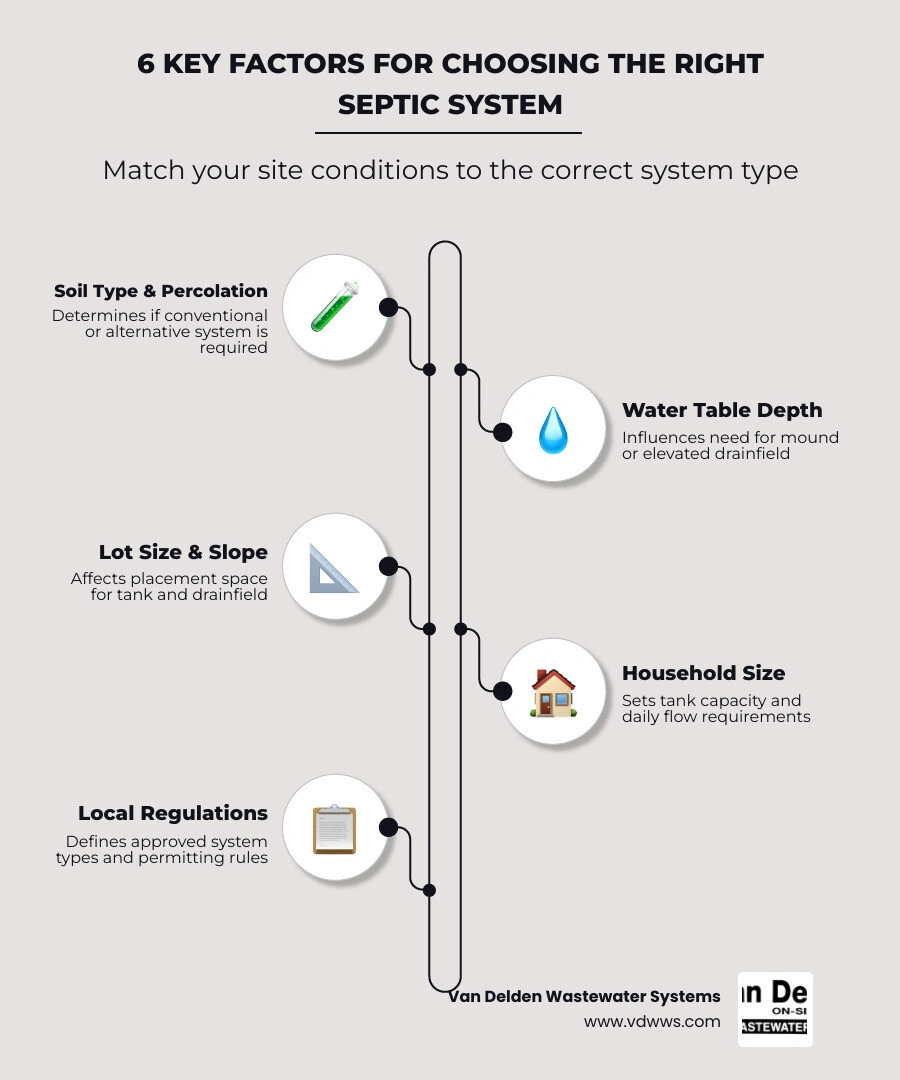
Key Factors in Choosing the Right Septic System for Your Property
When you look out over your yard in San Antonio, Boerne, or Spring Branch, you might just see Texas Hill Country beauty. But beneath that surface lies a complex puzzle of soil layers, limestone, and water tables. Choosing a system is not as simple as picking a model out of a catalog. To ensure your system operates safely and effectively for decades, we must evaluate several critical property characteristics.
The first step in any successful installation is a comprehensive site evaluation. This is where we analyze the unique physical traits of your land. The design and size of a septic system vary widely due to household size, soil type, site slope, lot size, proximity to sensitive water bodies, weather conditions, and local regulations.

A professional site evaluation typically includes:
• Soil Texture and Structure Analysis: We look at the layers of soil to see how well they can naturally filter wastewater.
• Soil Percolation (Perc) Testing: This test measures how quickly water drains through your soil. If it drains too fast (like through coarse sand or fractured rock) or too slow (like through dense clay), standard systems will not work.
• Water Table Identification: We must determine the highest seasonal level of the groundwater to prevent untreated sewage from contaminating drinking water.
• Property Slope and Layout: Steep slopes can cause wastewater to run off rather than seep in, requiring specialized pressure distribution or terracing.
• Setback Requirements: Local codes dictate exactly how far your tank and drainfield must be from your home, property lines, water wells, and nearby creeks or rivers.
For a deeper look into how these elements come together to form a plan, explore our guide on the Best Septic System Designs for Properties.
Comparing Conventional vs. Alternative Septic Systems
To make an informed decision, it helps to understand the two broad categories of onsite wastewater systems: conventional and alternative.
Conventional systems have been the industry standard for decades. They are relatively simple, rely primarily on gravity, and have no moving mechanical parts. Alternative systems, on the other hand, are engineered solutions designed to overcome difficult site conditions using advanced technology, pumps, and oxygen injection.
Here is a quick comparison to show how they stack up:
• Primary Treatment Method — Conventional Systems: Anaerobic bacteria (without oxygen) — Alternative Systems (e.g., Aerobic, Drip): Aerobic bacteria (with oxygen injection)
• Power Requirement — Conventional Systems: None (gravity-fed) — Alternative Systems (e.g., Aerobic, Drip): Continuous electrical power for pumps and aerators
• Drainfield Footprint — Conventional Systems: Large; requires deep, permeable soil — Alternative Systems (e.g., Aerobic, Drip): Small to medium; highly flexible placement
• Soil Requirements — Conventional Systems: Deep, well-draining soil (no shallow rock or clay) — Alternative Systems (e.g., Aerobic, Drip): Can work in clay, shallow soil, or high water tables
• Maintenance Burden — Conventional Systems: Low (pumping every 3–5 years) — Alternative Systems (e.g., Aerobic, Drip): High (regular inspections and service contracts)
• Lifespan — Conventional Systems: 25–40+ years for concrete tanks — Alternative Systems (e.g., Aerobic, Drip): 15–25 years for mechanical components
To help visualize these differences, you can watch our What Kind of Septic System Do I Need? (Video).
The core difference in treatment quality lies in the biology. Conventional systems rely on anaerobic bacteria inside the tank to break down solids. The liquid effluent that leaves the tank is still highly contaminated and requires a large, deep zone of natural soil to finish the purification process.
Alternative systems, such as Aerobic Treatment Units (ATUs), inject oxygen into the treatment chamber. This stimulates aerobic bacteria, which are far more aggressive and efficient at digesting organic waste. The effluent leaving an ATU is up to 98% cleaner than that of a conventional tank, meaning it requires a much smaller soil footprint to safely return to the environment.
Before assuming you need one over the other, read our breakdown on What’s Better: Conventional Septic or Aerobic? to see which philosophy matches your land.
How Soil and Site Conditions Impact Choosing the Right Septic System for Your Property
If you live in Central Texas—whether in the rocky hills of Helotes, the clay-rich soils of Bulverde, or the protected Edwards Aquifer recharge zone in San Antonio—your soil is the ultimate deciding factor.
• Clay Soil: Clay particles are incredibly small and tightly packed. When wet, clay swells and blocks the flow of water. If you try to install a conventional gravity drainfield in heavy clay, the wastewater cannot percolate. It will back up into your home or pool on the surface of your yard. Properties with heavy clay typically require alternative systems, such as ATUs or drip distribution, which apply treated water slowly over a wider surface area.
• Sandy Soil: While sandy soil drains exceptionally well, it can sometimes drain too fast. If wastewater rushes through sand without enough contact time, harmful pathogens can reach the groundwater untreated.
• High Groundwater and Shallow Bedrock: In areas near local rivers or low-lying zones in Shavano Park and Hollywood Park, the water table can sit just a few feet below the surface. Similarly, much of the Hill Country features solid limestone bedrock just inches beneath the topsoil. Conventional systems require at least two to four feet of unsaturated, natural soil beneath the drainfield. If you have shallow bedrock or high groundwater, you must use a mound system to build an artificial soil barrier, or an ATU to treat the water before discharging it.
• Property Setbacks: Smaller lots in tight subdivisions like Timberwood Park or Fair Oaks Ranch often struggle to meet the strict setback distances required for large conventional drainfields. Alternative systems with smaller footprints are often the only way to comply with local health department codes.
How Household Size and Water Usage Affect Choosing the Right Septic System for Your Property
While your soil dictates what kind of system you can install, your household size dictates how large that system must be.
Septic systems are sized based on potential maximum water flow, which is determined by the number of bedrooms in a home rather than the current number of occupants. This ensures the system remains functional if a larger family moves in later.
• An average person generates about 50 to 70 gallons of wastewater per day.
• A 3-bedroom home typically requires a minimum 1,000-gallon septic tank.
• A 4-bedroom home generally requires a 1,500-gallon septic tank, which can support a drainfield footprint of 800 to 2,500 square feet depending on soil absorption rates.
When planning your system, it is wise to design for future expansion. If you plan to add a guest house, a pool cabana, or extra bedrooms down the road, sizing your tank and drainfield larger now will save you from a highly complex and expensive system replacement later.
Additionally, modern water conservation practices—such as installing low-flow toilets, using high-efficiency washing machines, and avoiding garbage disposals—can dramatically extend the life of your drainfield by reducing the daily hydraulic load.
Deep Dive: How Advanced Systems Work
When standard gravity-fed designs cannot meet local environmental codes or handle poor soil, advanced engineered systems step in. Let us look at how three of the most common advanced systems operate.
Aerobic Treatment Units (ATUs)
ATUs act like miniature municipal wastewater treatment plants right in your backyard. They typically consist of three compartments: a trash tank for primary settling, an aeration chamber where an electric air pump bubbles oxygen through the liquid, and a clarifier where remaining solids settle out.
Because the aerobic bacteria thrive in this oxygen-rich environment, they clean the water to a high standard. This highly treated effluent can then be dispersed through shallow drip lines or even spray-sprinkler heads (where permitted by local regulations).
• Advantages: Excellent for poor clay soils, small lots, and strict environmental zones.
• Disadvantages: Requires constant electricity, mechanical parts can wear out, and they demand strict ongoing maintenance.
To clear up common misconceptions about when these are required, read our guide Debunking Myths: All New Septic Systems Must Be Aerobic.
Mound Systems
If your property sits on solid limestone bedrock or has a very high water table, a mound system is often the ideal solution. We place a sand fill layer above the natural ground surface, install a pressurized distribution network of pipes within the sand, and cover the entire structure with topsoil and grass.
A pump chamber doses the effluent into the mound in controlled cycles, allowing the sand to filter the wastewater completely before it ever touches the shallow natural soil or bedrock below.
• Advantages: Overcomes severe depth limitations; highly reliable treatment.
• Disadvantages: Highly visible in the yard; requires careful landscaping to prevent erosion.
Drip Distribution Systems
Drip distribution is an advanced alternative to traditional gravel trenches. It uses a network of flexible, narrow tubes buried just 6 to 12 inches below the surface. A pump forces treated wastewater through these tubes, where specialized emitters slowly release tiny doses of water directly into the root zone of your lawn.
• Advantages: Can be installed on steep slopes, around mature trees, and in very shallow soils. Extremely efficient water dispersal.
• Disadvantages: Requires advanced pretreatment (like an ATU or sand filter) to prevent the tiny emitters from clogging.
Understanding these technical differences is key to managing your property. Learn more by reading Septic System Jargon Defined: Standard vs. Aerobic Systems.
Maintenance and Long-Term Care Requirements
A septic system is a major investment in your property's infrastructure. While a well-maintained system can last up to 50 years, nearly half of all septic owners fail to follow recommended maintenance guidelines, leading to premature failure and costly repairs.
Different systems require different levels of care. You can review the complete list of options in our resource on Common Septic System Types.
Septic Maintenance Best Practices
To keep your system running smoothly, follow this essential checklist:
• Pump Regularly: Have a licensed professional pump your tank every 3 to 5 years to remove accumulated solids and prevent them from escaping into your drainfield.
• Protect the Drainfield: Keep heavy vehicles, machinery, and livestock off your tank and drainfield area. Soil compaction can crush pipes and ruin soil permeability.
• Manage Vegetation: Only grow grass or shallow-rooted plants over your septic components. Deep roots from trees and large shrubs can easily penetrate and destroy pipes.
• Divert Stormwater: Ensure rainwater runoff from gutters and driveways is directed away from your drainfield to prevent waterlogging.
• Watch What You Flush: Never flush wet wipes (even "flushable" ones), feminine products, grease, paper towels, chemicals, or medications.
• Maintain Effluent Filters: If your tank has an effluent filter on the outlet pipe, have it cleaned and inspected during routine service visits to keep solids out of the drainfield.
Frequently Asked Questions About Onsite Wastewater Systems
What is the difference between plastic and concrete septic tanks?
The choice between plastic (polyethylene) and concrete tanks comes down to durability, installation conditions, and site access.
Concrete tanks are exceptionally strong, heavy, and highly durable. They are not easily damaged during excavation and are heavy enough that they will not float or shift if the local water table rises. However, their immense weight requires heavy machinery for installation, which can be challenging on properties with tight access or mature trees.
Plastic tanks are lightweight, easier to transport, and highly resistant to chemical corrosion from sewer gases. However, because they are light, they must be installed with extreme care to prevent them from being crushed by soil pressure or shifting due to groundwater.
A cluster (or community) system is a decentralized wastewater option where multiple nearby homes pipe their wastewater to a shared, larger treatment facility and drainfield.
These are common in modern rural subdivisions where individual lots may be too small or rocky to support individual systems. They offer the environmental benefits of professional, centralized management while keeping installation and land footprint lower for individual homeowners. However, they require strict legal maintenance agreements and shared utility dues to ensure the system is managed properly over time.
What are the most common mistakes to avoid during septic installation?
The single biggest mistake a property owner can make is skipping a professional site evaluation or trying to force a cheaper, conventional system onto a lot with poor clay soil or shallow bedrock.
Other critical errors include:
• Failing to check local health department and environmental protection codes before excavation.
• Allowing heavy construction equipment to drive over the designated drainfield area during home construction, which permanently destroys the soil's ability to absorb water.
• Planting deep-rooted trees near the system lines, which will inevitably lead to root intrusion and system failure.
Conclusion
Choosing and installing the right septic system is a highly technical process that requires local expertise, precise engineering, and a deep understanding of Central Texas geology.
Since 1937, Van Delden Wastewater Systems has been a trusted, family-owned provider of comprehensive septic solutions across San Antonio, Boerne, Bulverde, Spring Branch, Helotes, and surrounding areas. Our honest, background-checked, and non-commissioned technicians are dedicated to educating our customers, delivering top-tier workmanship, and providing complete peace of mind through detailed service forms and photo documentation.
Ready to take the first step toward a reliable, code-compliant wastewater system for your property? Schedule a professional septic installation consultation with Van Delden Wastewater Systems today.