Why the Aerobic vs Conventional Septic System Comparison Matters for Homeowners on Acreage
Aerobic vs conventional septic system comparison is one of the most important decisions you'll make when building or buying a home on rural land — and the wrong choice can mean years of costly repairs, failed inspections, or a system that simply won't work on your property.
Here's a quick side-by-side to help you decide:
| Feature | Conventional (Anaerobic) | Aerobic (ATU) |
|---|
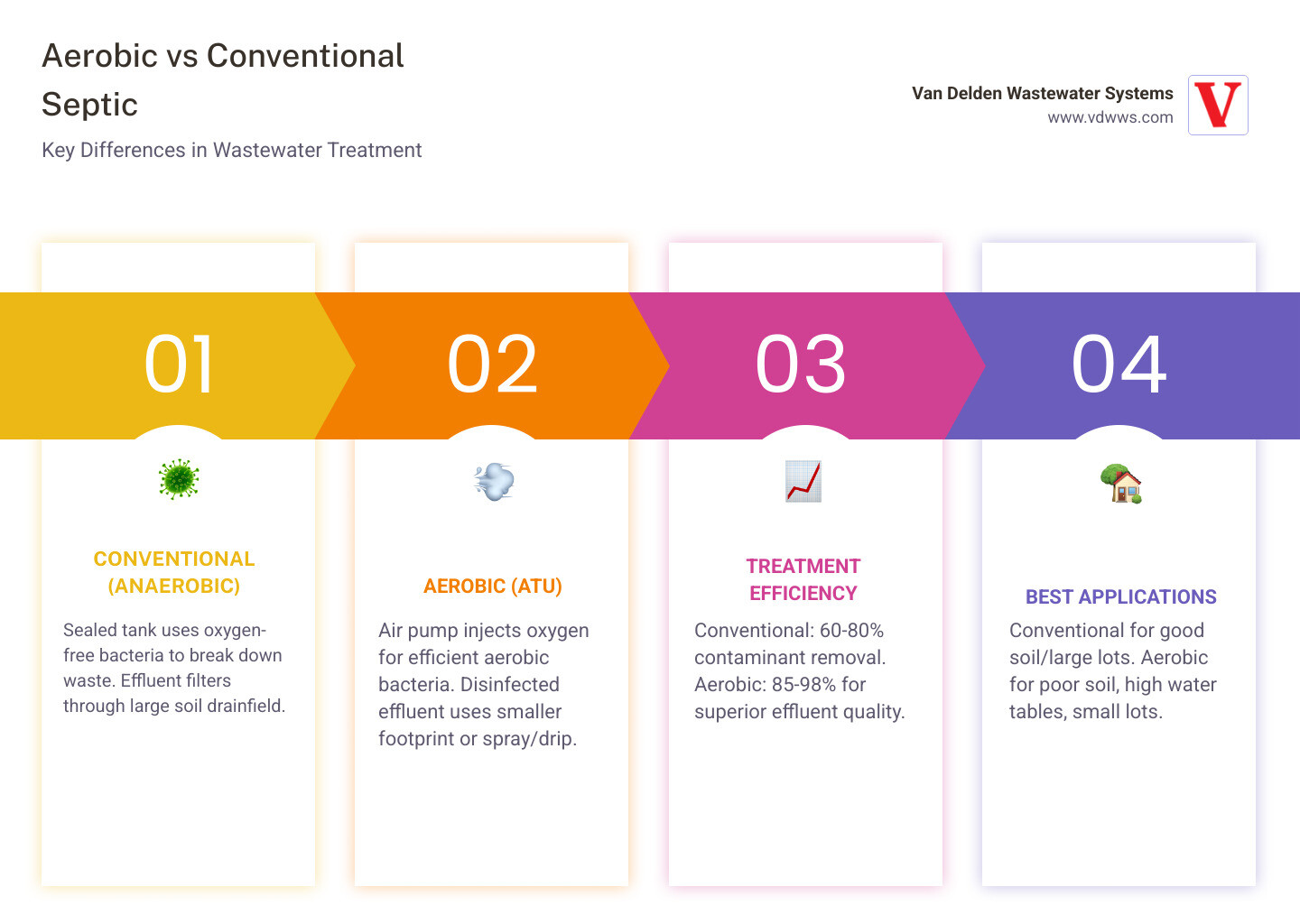
| How it works | Anaerobic bacteria break down waste in a sealed tank; effluent drains to a soil drainfield | Oxygen is injected to power aerobic bacteria; effluent is disinfected before dispersal |
| Treatment efficiency | Removes 60-80% of contaminants | Removes 85-98% of contaminants |
| Electricity needed | No | Yes — continuous power for aerator |
| Drainfield size | Larger footprint required | Smaller footprint; surface spray or drip options |
| Best for | Properties with good soil drainage and sufficient space | Poor soil, high water tables, small lots, or sensitive water zones |
| Maintenance | Pump every 3-5 years | Quarterly inspections + mandatory service contract |
| Typical lifespan | Tank: 20-40 years; Drainfield: 15-25 years | Tank: 20-30 years; Components: 2-15 years |
More than one in five American homes rely on a septic system rather than a public sewer connection. For homeowners on acreage — especially across Texas — that means understanding exactly what's under your yard and why it was installed there.
The short version: if your soil drains well and your lot has room, a conventional system is simpler and more affordable. If your soil is heavy clay, your water table is high, or your lot is small, an aerobic system may not just be better — it may be required by law.
But the details matter a lot, and that's what this guide is here to walk you through.
Understanding the Basics: Aerobic vs Conventional Septic System Comparison
When we look at the aerobic vs conventional septic system comparison, we are essentially looking at a battle between two different types of microscopic workers: anaerobic and aerobic bacteria.
A conventional system is "anaerobic," meaning it functions without oxygen. Inside the dark, sealed environment of a standard septic tank, anaerobic bacteria work slowly to decompose organic matter. Because these bacteria are less efficient than their oxygen-loving cousins, the effluent (liquid waste) that leaves the tank still contains a significant amount of contaminants. This is why a conventional system requires a large area of healthy soil to finish the purification process.
An aerobic system, or Aerobic Treatment Unit (ATU), is essentially a miniature municipal sewage plant in your backyard. By using an aerator to inject oxygen into the wastewater, it supports aerobic bacteria. These "super-charged" microbes break down waste 20 to 30 times faster than anaerobic bacteria. The result is a much higher effluent quality, removing up to 98% of contaminants before the water even touches the ground.
Understanding these differences is the first step in navigating Septic System Jargon Defined Standard Vs Aerobic Systems and ultimately deciding Whats Better Conventional Septic Or Aerobic for your specific needs in April 2026.
How Conventional Anaerobic Systems Process Wastewater
For many homeowners in areas like Boerne or Spring Branch, the Conventional Septic System has been the gold standard for decades. It is a masterpiece of passive engineering that relies almost entirely on gravity.
The process begins when wastewater leaves your home and enters a watertight septic tank. Once inside, the waste naturally separates into three distinct layers:
- The Scum Layer: Lighter materials like fats, oils, and grease float to the top.
- The Sludge Layer: Heavy solids sink to the bottom where anaerobic bacteria begin their slow work.
- The Effluent: The relatively clear liquid in the middle.
As new water enters the tank, an equal amount of effluent is pushed out through a distribution box into the drainfield. This area consists of perforated pipes buried in gravel trenches. The real magic happens in the soil. As the effluent seeps out, the soil acts as a natural filter, removing remaining bacteria and viruses. This is why Common Septic Systems Standard Septic Systems are so dependent on having the right type of soil to function safely.
The Mechanics of Aerobic Treatment Units (ATUs)
If a conventional system is a slow-cooker, an aerobic system is a microwave. How Aerobic Septic Systems Work involves a more complex, multi-stage process designed to produce incredibly clean water.
A typical Common Septic Systems Aerobic System consists of three main compartments:
- Trash Tank: This acts like a primary septic tank, allowing large solids to settle.
- Aeration Chamber: This is the heart of the system. An electric air pump (aerator) forces bubbles through the water, creating an oxygen-rich environment where aerobic bacteria thrive and gobble up organic matter at high speeds.
- Pump Tank/Disinfection: The treated water moves here to be disinfected, usually with chlorine tablets or UV light.
Because the water is so clean by the end of this process, it can be dispersed in ways a conventional system cannot. One of the 4 Advantages Of Aerobic Septic Systems is the ability to use spray irrigation (sprinklers) or drip irrigation to distribute the treated water over the surface of your lawn.
Choosing the Right Fit for Your Property
Selecting between these systems isn't just about personal preference; it’s about what your land can handle. When we perform a site evaluation, we look at several critical factors to determine which Common Septic System Types are viable.
The decision-making process usually involves:
- A Percolation (Perc) Test: Measuring how quickly water moves through your soil.
- Lot Size: Ensuring there is enough room for the required drainfield or spray area.
- Local Regulations: Adhering to Texas Commission on Environmental Quality (TCEQ) mandates.
- Environmental Sensitivity: Checking proximity to the Edwards Aquifer or other protected water bodies.
There are times When And Why To Replace A Standard System With An Aerobic System, such as when a traditional drainfield fails due to soil compaction or age.
Soil Suitability and the Aerobic vs Conventional Septic System Comparison
In the Texas Hill Country and the Blackland Prairie regions, soil is often our biggest hurdle. A perc test is the ultimate decider. If your soil is heavy clay (common in San Antonio and surrounding areas) or sits on shallow limestone, it won't absorb water fast enough for a conventional system.
If a perc test shows a rate slower than 60 minutes per inch, a conventional system is usually out of the question. In these cases, we might look at an aerobic system or a Faqs/Low Pressure Dosing System, which uses a pump to distribute effluent more evenly across a drainfield, helping "difficult" soil keep up.
Land Requirements and the Aerobic vs Conventional Septic System Comparison
Space is the next big factor. A conventional drainfield requires a significant footprint—often over 1,000 square feet—and must be kept clear of structures, driveways, and heavy livestock.
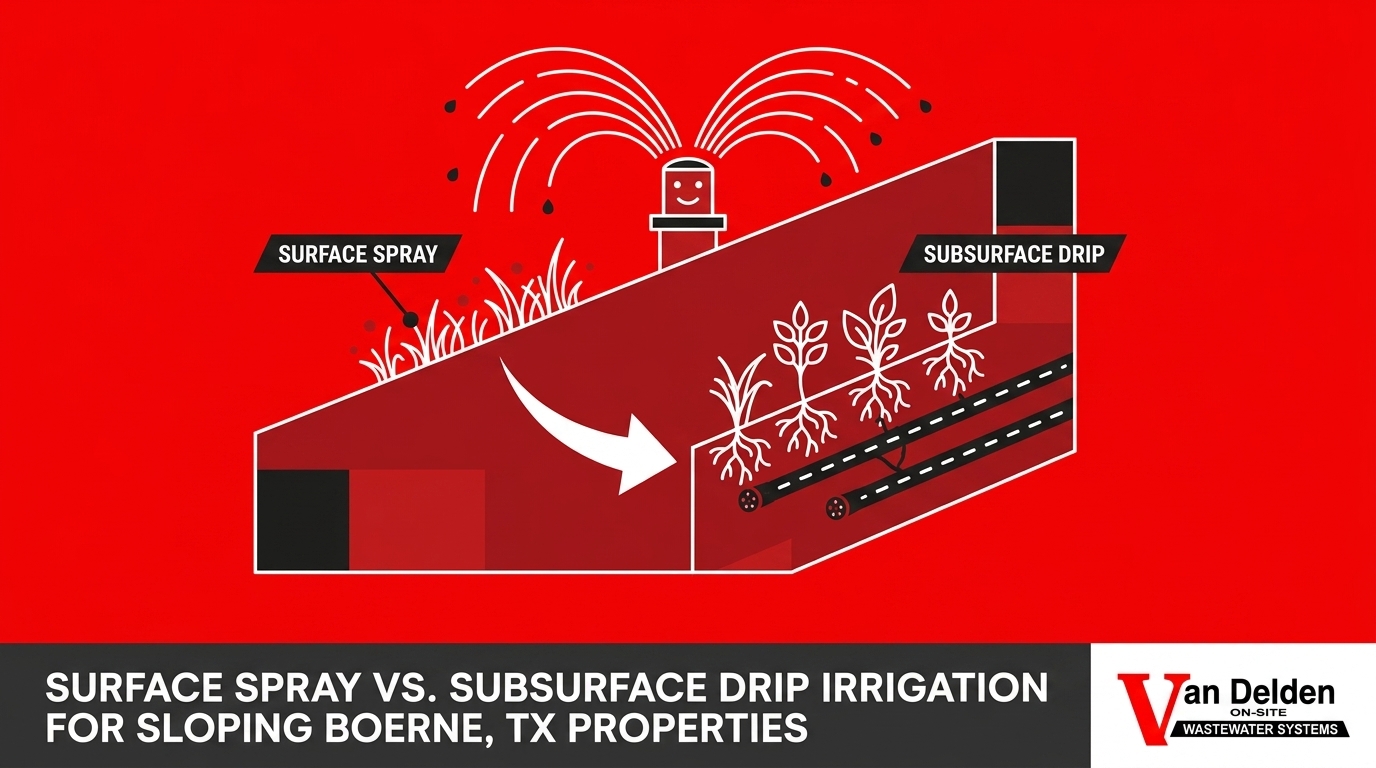
Aerobic systems offer more flexibility. Because the effluent is disinfected, an Aerobic System With Spray Irrigation can utilize your existing lawn to disperse water. If you have a smaller lot or want to keep your backyard open for a pool or workshop, an Aerobic System With Drip Irrigation can be installed just below the surface, requiring much less dedicated space than a traditional gravel trench.
Maintenance, Electricity, and System Lifespan
The "set it and forget it" mentality doesn't apply to either system, but the levels of commitment vary wildly in this aerobic vs conventional septic system comparison.
| Maintenance Task | Conventional System | Aerobic System |
|---|
| Pumping Frequency | Every 3-5 years | Every 3-5 years |
| Inspection Frequency | Visual check during pumping | Quarterly (Every 4 months) |
| Mandatory Contract | Generally no | Yes (TCEQ requirement) |
| Electricity Usage | $0 | $50 - $150 per year |
| Component Lifespan | 20-40 years | 10-15 years (Mechanicals) |
A conventional system is low-maintenance but not "no-maintenance." You still need to pump the tank to prevent solids from flowing into and clogging your drainfield. However, an aerobic system is a different beast. It has moving parts—an air pump, a discharge pump, and often a Low Pressure Dosing System component—that require constant power.
In Texas, aerobic owners are required by law to maintain a service contract with a licensed provider. We perform these inspections to ensure the aerator is humming (if it's silent, that's a problem!), the alarms are functional, and the chlorine levels are sufficient for disinfection.
Frequently Asked Questions about Septic Systems
What happens to an aerobic system during a power outage?
Since aerobic systems rely on an electric aerator to keep the bacteria alive, a power outage is a serious concern. Most systems have about 24 hours of "buffer" capacity. After that, the oxygen in the water is depleted, and the aerobic bacteria begin to die off. If you experience an extended outage in areas like Timberwood Park or Fair Oaks Ranch, it is crucial to minimize water usage to prevent the tank from overflowing and to protect the biological health of the system.
Which system is better for the environment?
From a pure treatment efficiency standpoint, the aerobic system wins. By removing nearly all organic matter and pathogens before dispersal, it poses a much lower risk to groundwater. This is especially important for homes located over the Edwards Aquifer recharge zone, where protecting our water source is a community-wide responsibility.
Are aerobic systems required by local Texas regulations?
In many cases, yes. The TCEQ and local county health departments (like those in Bexar or Comal County) mandate aerobic systems for lots that are too small for a conventional drainfield, properties with "unsuitable" soil (like heavy clay or rock), or homes located in sensitive watersheds. Always check with a professional before assuming a conventional system is an option for your new build.
Conclusion
Choosing between an aerobic vs conventional septic system comparison doesn't have to be a headache. Whether you are in Boerne, Bulverde, or San Antonio, the right system is the one that fits your soil, your lot, and your lifestyle.
At Van Delden Wastewater Systems, we’ve been helping homeowners navigate these waters since 1937. As a family-owned business, we pride ourselves on educating our customers. Our non-commissioned, background-checked technicians aren't there to sell you the most expensive option—they are there to provide an honest, professional site evaluation and ensure your system is installed and maintained to the highest standards.
From detailed service forms to photo documentation of every visit, we make sure you know exactly what is happening in your backyard. If you’re ready to ensure the long-term health of your property, contact us today for expert guidance on Septic System Maintenance and installation.