What Size Septic System Do I Need for My Property?
Figuring out what size septic system you need for your property comes down to a few key factors: the number of bedrooms in your home, your daily wastewater flow, your soil type, and your local code requirements. Here's a quick reference to get you started:
• 1-2 — Minimum Tank Size: 750-1,000 gallons — Daily Flow Estimate: 150-300 gallons/day
• 3 — Minimum Tank Size: 1,000 gallons — Daily Flow Estimate: 450 gallons/day
• 4 — Minimum Tank Size: 1,200-1,500 gallons — Daily Flow Estimate: 600 gallons/day
• 5+ — Minimum Tank Size: 1,500-2,500 gallons — Daily Flow Estimate: 750+ gallons/day
• 10 occupants — Minimum Tank Size: 2,000-2,250 gallons — Daily Flow Estimate: 600-750 gallons/day
These figures are based on the EPA's standard of 150 gallons per bedroom per day and a two-day retention requirement. However, local codes, soil conditions, and high-water-use appliances can all push your required size higher.
Over 21 million households across the United States rely on a private septic system rather than a municipal sewer connection. Choosing the wrong size is one of the most expensive mistakes a homeowner can make. An undersized tank can back up drains, generate foul odors, and push untreated solids into your drain field — potentially destroying it. An oversized tank, on the other hand, can stall the bacterial activity needed to break down waste properly.
The good news is that sizing a septic system follows a clear, logical process. When you understand how bedroom count, soil percolation, and local regulations work together, the right system size becomes much easier to identify.
This guide walks you through every factor that determines the correct septic system size for your property, so you can make a confident, informed decision from the start.
Sizing Factors: What Size Septic System Do I Need for My Property?
When you ask yourself, "what size septic system do i need for my property", it is easy to assume the square footage of your house is the deciding factor. In reality, your septic system doesn't care if your living room is 200 or 2,000 square feet. It only cares about the volume of water running down your drains and the physical capacity of your soil to absorb that water.
A residential septic system is divided into two primary parts: the septic tank itself and the soil absorption system, commonly known as the drain field or leach field. Both must be sized correctly to work in harmony.
The septic tank's primary job is to act as a quiet settling basin. When raw wastewater enters the tank, the flow slows down significantly. This "quiet time," known as retention time, allows heavy solids to sink to the bottom to form a layer of sludge, while lighter greases and oils float to the top to form a scum layer. The liquid in the middle — known as clarified effluent — is what exits the tank and travels to your drain field.
If your tank is too small, water rushes through it too quickly. Instead of settling peacefully, solid waste is swept directly out of the tank and into the drain field, where it clogs the soil pores and causes premature system failure. To understand how your existing setup stacks up, you can read our guide on How Do I Know What Size My Septic Tank Is.
Calculating Daily Wastewater Flow: What Size Septic System Do I Need for My Property?
To determine the ideal tank volume, we start by calculating your home's potential daily wastewater flow. Regulatory bodies and environmental agencies do not base this calculation on your current family size. Instead, they use the number of bedrooms in the home.
Why size by bedrooms instead of actual occupants? Because a family of two living in a five-bedroom house today might sell that house to a family of eight tomorrow. Sizing to the structural capacity of the house ensures the septic system remains safe and functional for the lifetime of the property, regardless of who moves in.
The standard calculation relies on two fundamental metrics:
1. The EPA 150-Gallon Rule: Sizing standards typically assume an occupancy of 1.5 to 2 people per bedroom, with each person generating roughly 75 gallons of wastewater per day. This rounds out to a projected flow of 150 gallons per day (GPD) per bedroom.
2. The Two-Day Retention Standard: To give solids enough time to settle properly, a septic tank must be large enough to hold at least two full days of your projected daily wastewater flow.
For example, a standard 3-bedroom home has a projected daily flow of 450 gallons (3 bedrooms × 150 GPD). To meet the two-day retention standard, the tank must hold at least 900 gallons (450 GPD × 2). Because septic tanks are manufactured in standard sizes, this number is rounded up to the nearest common tank size, which is 1,000 gallons.
Soil and Site Factors: What Size Septic System Do I Need for My Property?
While bedroom count determines the size of your septic tank, your property's soil determines the size and type of your drain field. The drain field is where the real wastewater treatment happens, as beneficial soil bacteria filter out harmful pathogens before the water returns to the local water table.
Before any system can be designed or installed, a professional must perform a soil evaluation or a percolation ("perc") test. This test measures how quickly water drains through your soil, expressed in minutes per inch (MPI).
• Coarse, Sandy Soil: Water drains quickly. While this is great for absorbing high volumes of water, sand offers less treatment time, meaning the drain field design must ensure pathogens are filtered before reaching groundwater.
• Heavy Clay or Rock: Clay particles are tightly packed, meaning water drains incredibly slowly. If your soil has a perc rate slower than 60 MPI, a conventional gravity-fed system won't work because the water will pool on the surface. These conditions require alternative system designs.
The relationship between your soil's absorption rate and your daily wastewater flow determines your hydraulic loading rate. This rate tells us exactly how many gallons of effluent a single square foot of your soil can safely absorb in a day. If you have tight clay soil, your hydraulic loading rate will be low, meaning you will need a much larger drain field footprint to spread out the water compared to someone with ideal sandy loam soil. To learn more about preparing your property for these assessments, read our resource on Septic System Planning What to Know When Building a New Home.
How System Types and Regulations Impact Sizing
Local building codes and environmental regulations are the ultimate authorities when deciding what size septic system do i need for my property. In Texas, the Texas Commission on Environmental Quality (TCEQ) sets the baseline standards for On-Site Sewage Facilities (OSSF), but local counties and cities (such as Bexar, Kendall, or Comal counties) often enforce stricter rules.
These regulations dictate everything from the minimum tank size allowed to the strict setback distances your system must maintain (e.g., keeping the tank at least 10 feet from your home and the drain field at least 150 feet from any private water wells). For a detailed look at how these local rules apply to properties in areas like San Antonio, Boerne, or Bulverde, see our guide on Septic System Regulations A Guide for New Constructions in South Texas.
Conventional vs. Alternative Septic Systems
The type of septic system you install has a massive impact on your required space and tank configuration. Here is how the most common options compare:
• Conventional Gravity Systems: These are the traditional systems where effluent flows from the tank to the drain field using only gravity. They require deep, well-draining soil and a low water table. While simple, they require a relatively large, flat area for the drain field trenches.
• Aerobic Treatment Units (ATUs): Think of an ATU as a small-scale municipal wastewater treatment plant for your yard. These systems inject oxygen into a multi-compartment tank to support aerobic bacteria, which break down waste much faster and more thoroughly than anaerobic bacteria. Because the treated effluent is highly clarified (often achieving 85% to 95% purification), ATUs can be installed in areas with poor, rocky soil or high water tables, and they often use surface spray or drip irrigation for disposal.
• Mound Systems: Used in areas with shallow soil depth or high water tables, a mound system is an above-ground drain field constructed of clean sand and gravel. Effluent is pumped from a dosing tank up into the mound to be treated as it trickles down.
• Drip Distribution Systems: These systems use flexible, narrow tubing inserted into the top 6 to 12 inches of soil. They dose tiny amounts of effluent across a wide area, making them perfect for wooded lots, steep slopes, or properties with irregular layouts.
For a deeper dive into which configuration is right for your property’s layout and geology, explore our overview of the Best Septic System Designs for Properties and watch our What Kind of Septic System Do I Need Video.
Sizing Guidelines by Bedroom Count
While local regulations always take precedence, the table below outlines the typical sizing requirements across South Texas counties for standard residential properties:
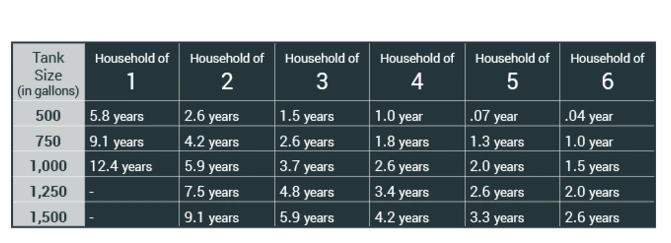
• 1 to 2 — Expected Daily Flow: 150 - 300 Gallons — Minimum Septic Tank Size: 750 - 1,000 Gallons — Typical Drain Field Footprint (Conventional): 400 - 600 Sq. Ft.
• 3 — Expected Daily Flow: 450 Gallons — Minimum Septic Tank Size: 1,000 Gallons — Typical Drain Field Footprint (Conventional): 600 - 900 Sq. Ft.
• 4 — Expected Daily Flow: 600 Gallons — Minimum Septic Tank Size: 1,200 - 1,500 Gallons — Typical Drain Field Footprint (Conventional): 800 - 1,200 Sq. Ft.
• 5+ — Expected Daily Flow: 750+ Gallons — Minimum Septic Tank Size: 1,500 - 2,500 Gallons — Typical Drain Field Footprint (Conventional): 1,000+ Sq. Ft. (Requires Custom Engineering)
When to Choose a Larger Septic Tank
While building codes establish the legal minimum size for your septic tank, the minimum is not always the best choice for how your household actually lives. In many cases, upgrading to a larger tank is one of the smartest, highest-return decisions you can make during installation.
If you are on the boundary between sizes, opting for the larger tank provides a crucial buffer that can prevent system failure. For more details on designing a system built to last, read our guide on how to Maximize Longevity Septic System Design.
Several factors should prompt you to choose a larger tank than the minimum code requires:
• Garbage Disposals: A garbage disposal is a septic system’s worst enemy. It introduces massive amounts of finely ground organic waste and grease into your tank, increasing the solid waste load by 30% to 50%. If you plan to use a garbage disposal, you should increase your tank size by at least 250 gallons or 50% to prevent the tank from filling with solids too quickly.
• High-Water-Use Appliances: Water softeners (which discharge salty brine during regeneration cycles), deep garden tubs, multi-head luxury showers, and high-capacity washing machines can easily overwhelm a standard tank, pushing water through before solids have a chance to settle.
• Frequent Entertaining: If you regularly host large gatherings, weekend guests, or family reunions, your water usage will spike dramatically. A larger tank acts as a shock absorber for these high-flow events.
• Future Additions: If you plan to add a bedroom, an in-law suite, or convert an attic space in the future, sizing your septic system for that future configuration now will save you from a incredibly expensive system upgrade later.
Risks of Undersized vs. Oversized Systems
What actually happens when the math is off? The consequences of an incorrect tank size can affect your property for years:
• The Undersized System: When a tank is too small, the retention time drops below the critical 24-hour mark. Solid waste, grease, and hair do not have time to settle out. Instead, they flow directly into your drain field, clogging the soil and causing system backups, slow drains, and lush, swampy patches of grass in your yard. To fix a ruined drain field, you could face massive excavation work. Additionally, an undersized tank will require pumping every 1 to 2 years instead of the standard 3 to 5 years.
• The Oversized System: Can a septic tank be too big? Physically, no — a larger tank simply means cleaner effluent and a longer-lasting drain field. However, if a tank is vastly oversized for the household (e.g., a 2,500-gallon tank for a single occupant), the extreme dilution of incoming organic waste can occasionally slow down the natural bacterial activity needed to digest the sludge, though this is rare compared to the catastrophic failures of undersized systems. The primary drawback of an oversized system is simply the unnecessary upfront installation and excavation costs.
Steps to Take Before Selecting Your Septic System
Installing a septic system is a major construction project that requires careful planning, permitting, and execution. You cannot simply buy a tank and bury it in your backyard. To ensure a smooth process, you should follow a structured sequence of steps:
1. Perform a Professional Site Evaluation: A licensed professional must assess your property's topography, identify any slopes, rock formations, or mature trees, and map out legal setback distances from property lines, wells, and water bodies.
2. Conduct Soil Testing: A registered sanitarian or professional engineer must perform a soil profile analysis and percolation test to determine your soil class and absorption capabilities.
3. Design the System: Based on the bedroom count, water usage habits, and soil characteristics, a custom system design must be engineered to meet both your needs and state regulations.
4. Secure the Permits: The design must be submitted to your local regulatory authority (such as the county environmental health department) to secure an Authorization to Construct.
5. Excavation and Installation: Once permitted, professional installers excavate the site, set the tanks, lay the drain field lines, and connect the plumbing.
6. Final Inspection and Approval: Before the system is backfilled with soil, a local health inspector and the designer must inspect the installation to ensure it matches the approved plans exactly.
To guide you through this journey step-by-step, we have put together a comprehensive breakdown of the Septic System Design and Installation Process and a localized Septic System Installation Guide Waring TX for our neighbors in and around Kendall County.
Working with a Professional Designer
Because of the geological diversity in South Texas — where you can find deep clay in one yard and solid limestone just inches below the surface in the next — working with a dedicated septic designer is highly recommended.
A professional designer understands how to navigate local regulations and can engineer a system that maximizes the lifespan of your drain field while keeping installation practical. Trying to cut corners on the design phase almost always leads to permitting delays and system failures down the road. Learn why keeping these roles distinct is so beneficial in our article on hiring a Separate Septic System Designer.
Frequently Asked Questions about Septic Sizing
What is the minimum septic tank size for a 3-bedroom home?
In almost all jurisdictions across South Texas, the absolute minimum septic tank capacity allowed for a 3-bedroom home is 1,000 gallons. This minimum is designed to safely handle a daily flow of 450 gallons while maintaining the necessary two-day retention time for proper solids settling.
How does a garbage disposal affect my septic tank size?
A garbage disposal dramatically increases the volume of solid waste entering your tank. Because these finely ground food particles do not break down as easily as human waste, they lead to a rapid buildup of sludge. If you install a garbage disposal, you should increase your tank size by 50% (or add a dedicated 250-gallon trash tank before your main septic tank) to protect your drain field from clogging.
How often should a correctly sized septic tank be pumped?
A correctly sized septic tank for a typical family of four should be pumped every 3 to 5 years. Regular pumping is the most critical preventative maintenance step you can take; it removes the accumulated sludge and scum layers before they can escape into your drain field and cause a system failure.
Conclusion
Determining the right septic system size for your property is not a guessing game — it is a precise science that balances your home’s potential wastewater volume with the unique absorption capabilities of your local soil. Investing in the correct system size and design today is the single best way to protect your property, your family’s health, and your wallet for decades to come.
Since 1937, Van Delden Wastewater Systems has provided professional, reliable, and honest septic solutions across South Texas, including Boerne, Bulverde, Fair Oaks Ranch, Garden Ridge, Helotes, Timberwood Park, Hollywood Park, San Antonio, Shavano Park, and Spring Branch. As a family-owned business, our non-commissioned, background-checked technicians are dedicated to educating our customers and ensuring quality work through detailed documentation and photos.
Whether you are building a new home or replacing an aging system, we can help you navigate the soil testing, design, and installation process from start to finish. Schedule a Professional Septic Consultation with our team today, and let’s build a system that is perfectly sized for your property’s long-term performance.