Why Resetting Your Septic Alarm Won't Fix a Failing Effluent Pump
Muting a buzzing septic alarm stops the noise, but it doesn't pause the wastewater filling your tank. Understand what this critical warning means before a total sewage backup occurs.
How regular maintenance keeps you in compliance with Texas septic regulations is simpler than most homeowners expect — but the consequences of skipping it are not.
Here is a quick overview of how maintenance protects your compliance status:
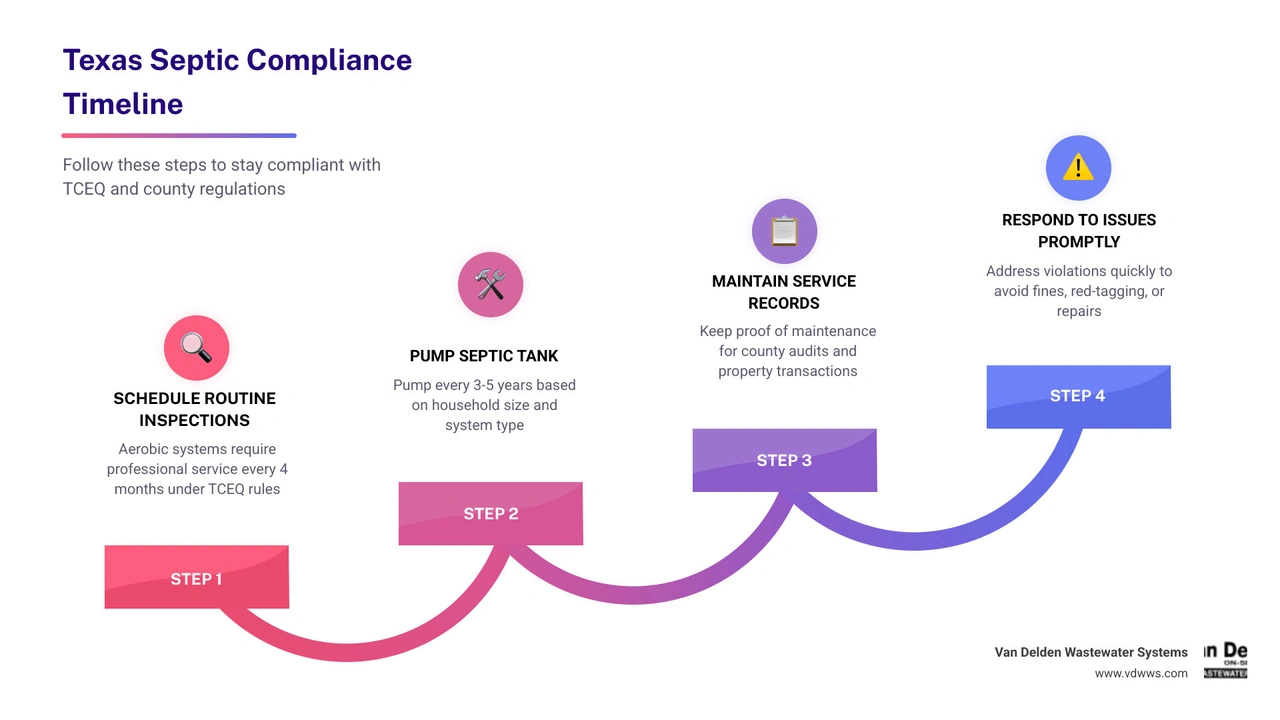
1. Schedule routine inspections — aerobic systems in Texas require professional service every four months under TCEQ rules
2. Pump your septic tank on time — typically every 3 to 5 years, depending on household size and system type
3. Keep service records — counties can request proof of maintenance during audits or property transactions
4. Respond to violations promptly — unresolved issues can lead to fines, red-tagging, or mandatory system repairs
5. Work with a licensed provider — Texas requires certified technicians to service aerobic systems and submit maintenance reports
If your property runs on a septic system, staying compliant is not just about avoiding fines. It protects your groundwater, your neighbors, and your investment. In Texas, the TCEQ and local county health departments set clear rules — and when those rules go unmet, homeowners face real legal and financial consequences.
The good news is that a consistent maintenance routine handles most of the compliance work for you automatically.
In the Texas Hill Country—from the rocky hills of Boerne and Spring Branch to the growing neighborhoods of San Antonio, Bulverde, and Fair Oaks Ranch—homeowners rely heavily on On-Site Sewage Facilities (OSSFs). Because our local geology features thin soils and sensitive limestone formations like the Edwards Aquifer, the Texas Commission on Environmental Quality (TCEQ) maintains some of the strictest septic standards in the country.
Understanding Texas Septic Regulations Homeowners Should Know is the first step toward protecting both your property value and our shared environment. When you operate an OSSF, you are essentially running a miniature utility plant in your backyard. Just like municipal wastewater plants, your home system requires structured oversight to ensure it discharges clean, safe effluent.
Neglecting your septic system does not just result in a smelly yard—it can lead to serious legal and environmental headaches. When a system is ignored, solids build up in the tank and eventually escape into the drainfield or spray area. This leads to soil clogging, surface pooling of untreated sewage, and severe groundwater contamination.
Because untreated wastewater contains dangerous bacteria, viruses, and parasites, local health departments in Bexar, Kendall, and Comal counties do not take failures lightly. If an inspector finds raw sewage pooling on your lawn, or if your system is found to be discharging non-compliant effluent, you can face:
• Heavy County Fines: Fines can quickly accumulate for active environmental hazards.
• Property Red-Tagging: In extreme cases, the county can declare a home uninhabitable if it lacks a functioning, compliant wastewater system.
• Expensive Emergency Repairs: Failing to pump your tank can lead to complete drainfield failure. Learning How Regular Pumping Prevents System Failure can save you from a massive, unexpected replacement bill.
Statistically, implementing a scheduled maintenance program reduces the likelihood of experiencing these compliance violations by 25% to 30%. Taking care of your system is not just an chore—it is a critical shield against legal and financial liability.
For homeowners with aerobic septic systems, local health departments require a continuous maintenance contract with a licensed provider. In areas like Helotes, Garden Ridge, Shavano Park, and Timberwood Park, counties perform regular audits of these contracts to ensure properties are not operating unmonitored systems.
When you maintain an active service agreement, your licensed provider conducts inspections every four months. These visits are highly structured. The technician tests the water quality, checks the mechanical components, ensures proper chlorine residual levels, and submits an official inspection report directly to the county registrar.
Keeping up with Routine Maintenance for Aerobic Septic Systems keeps your property in "good standing" during county audits. In fact, properties with regular, documented maintenance schedules report 35% higher compliance audit pass rates. When the county auditor pulls your address, they see an unbroken chain of clean inspection reports, keeping you clear of warning letters and administrative penalties.
To stay fully compliant, you cannot rely on guesswork. Different septic systems have different mechanical needs, but the core objective remains the same: keep solids inside the tanks and ensure only highly treated liquid leaves the system.
A compliant maintenance strategy focuses on several key areas:
1. Measuring Sludge and Scum Accumulation: Technicians use specialized tools to measure the solid layers inside your tanks. Once these layers occupy too much space, the tank must be pumped.
2. Chlorine Residual Testing: For aerobic systems utilizing spray distribution, maintaining the correct chlorine level is a strict legal requirement to ensure pathogens are destroyed before the water is sprayed.
3. Aerator and Pump Inspections: The aerator is the heart of an aerobic system, pumping oxygen into the treatment tank to keep beneficial bacteria alive. If it fails, the system quickly goes out of compliance.
4. Cleaning Filters and Spray Heads: Clogged filters restrict water flow, while damaged spray heads can cause uneven wastewater distribution or pooling.
For a complete breakdown of how to care for every component of your system, check out our Ultimate Septic System Maintenance Guide.
To help you understand how maintenance requirements differ between system types, here is a comparison:
• Inspection Frequency — Conventional Gravity / LPD Systems: Recommended annually — Aerobic Spray / Drip Systems: Mandatory every 4 months (in most Texas counties)
• Pumping Interval — Conventional Gravity / LPD Systems: Every 3 to 5 years (depending on usage) — Aerobic Spray / Drip Systems: Every 3 to 5 years (must monitor trash tank)
• Disinfection — Conventional Gravity / LPD Systems: None required — Aerobic Spray / Drip Systems: Required (liquid bleach or chlorine tablets)
• Mechanical Parts — Conventional Gravity / LPD Systems: Minimal (sometimes a single pump) — Aerobic Spray / Drip Systems: Air compressor, water pump, control panel, float switches
• Distribution Area — Conventional Gravity / LPD Systems: Underground drainfield trenches — Aerobic Spray / Drip Systems: Surface spray nozzles or subsurface drip tubing
• Reporting Requirements — Conventional Gravity / LPD Systems: Usually none, unless selling property — Aerobic Spray / Drip Systems: Mandatory reports submitted to county every 4 months
Setting up a structured, scheduled maintenance program is the single best way to extend your system’s lifespan by 20% to 40%. It transitions your household from reactive maintenance (waiting for a backup to occur) to proactive preservation.
Your schedule should be built around several milestones:
• Daily Habits: Practice smart water conservation. Spread out heavy laundry loads, fix leaky faucets immediately, and avoid flushing non-biodegradable items or harsh chemicals down the drain.
• Monthly Checks: For aerobic systems, check your chlorine tablet chlorinator or liquid bleach reservoir to ensure it is filled with approved disinfecting agents.
• Every Four Months: Ensure your licensed maintenance provider completes their periodic inspection and submits the required paperwork to the county.
• Every 3 to 5 Years: Schedule a professional pump-out of your septic tanks to remove accumulated solids.
Following the guidelines in our Septic System Care Guide 2025 will help you establish these habits easily, keeping your system running smoothly and in total compliance year after year.
In regulatory compliance, there is a golden rule: if it isn't documented, it never happened.
When a county inspector or environmental health officer audits your property, they will not take your word for it that you pumped your tank last year. They want to see clean, verifiable records. If you are planning to modify your system or build an addition on your property, you will need to verify your current OSSF status. You might ask yourself, Do I Need a Septic Permit? In almost all cases in Texas, any installation, major repair, or modification requires a formal permit and a clean record of compliance.
To protect yourself during an audit, you should maintain a dedicated "Septic Compliance File" containing:
• The Original OSSF Permit and Design Map: This shows exactly where your tanks, lines, and spray fields are located.
• Your Active Maintenance Contract: For aerobic systems, this proves you have a licensed professional overseeing your system.
• Service Manifest Copies: Whenever your tank is pumped, the licensed waste transporter must provide a manifest showing how many gallons were pumped and where the waste was legally disposed of.
• Detailed Inspection Reports: These should include technician notes, measured sludge levels, chlorine test results, and any replaced parts.
While paper records are fine, digital tracking with photo proof is the modern gold standard for audit protection. When you work with a professional team that utilizes detailed digital service forms, you build an ironclad defense against compliance disputes.
Professional records protect you because they feature:
• Technician Signatures and License Numbers: This proves the work was performed by an individual certified by the TCEQ.
• Timestamped Photo Documentation: Photos of clean spray heads, functional aerators, and measured sludge levels leave no room for interpretation.
• Unbroken Chains of Custody: For repairs and installations, these records prove that all work was completed under the proper permits. Permits Are Required for Septic System Installation and major modifications; having professional documentation links your permits directly to the finished work, satisfying both state and local inspectors.
For aerobic septic systems in Texas, maintenance reports must be submitted every four months (three times a year). If you have a valid maintenance contract with a licensed provider, your service provider is responsible for performing the inspection, filling out the required TCEQ-approved forms, and submitting them directly to your local county environmental health department (such as Bexar, Comal, or Kendall County). Homeowners should always receive a copy of these reports for their personal files.
If a licensed technician identifies a non-compliant component (such as a broken aerator, failed pump, or lack of chlorine disinfection), they will document the issue on your inspection report. You will receive a copy detailing the repairs needed to bring the system back into compliance.
If the issue is an environmental hazard (like surfacing sewage), you must address it immediately. If left unresolved, the county may issue a formal Notice of Violation (NOV), giving you a strict timeline (typically 10 to 30 days) to complete the repairs before facing legal fines or system red-tagging.
In some Texas counties, homeowners are allowed to maintain their own aerobic systems, but only if they meet strict requirements. You must typically take an accredited homeowner maintenance course approved by the TCEQ, pass an exam, register as a maintenance provider with your county, and pay a registration fee.
However, many counties—including several in our local service areas—do not allow homeowner maintenance or place heavy restrictions on it. Additionally, you must still purchase your own testing equipment, source approved replacement parts, and submit the formal reports on time every four months. For most homeowners in Boerne, Spring Branch, and San Antonio, keeping a professional maintenance contract is the safest, easiest, and most reliable way to guarantee compliance.
At the end of the day, understanding how regular maintenance keeps you in compliance is about protecting your home, your family, and your peace of mind. A septic system is a major investment, and keeping it in compliance with Texas law does not have to be stressful. By partnering with a dedicated, professional team, you can automate your inspections, secure your documentation, and keep your system running perfectly for decades.
Since 1937, Van Delden Wastewater Systems has provided comprehensive septic solutions across the Texas Hill Country. As a family-owned business, we believe in doing things the right way. Our honest, background-checked, and non-commissioned technicians are dedicated to educating our customers, ensuring quality work with detailed service forms and extensive photo documentation.
Whether you need a routine inspection in Bulverde, a pump-out in Fair Oaks Ranch, or expert compliance advice in San Antonio, we are here to help.
Ready to take the stress out of septic compliance? Explore our professional services and schedule your next inspection by visiting our Van Delden Septic Systems Services Page today!

Peter was personable, professional and thorough. Highly recommend Van Delden. You might be able to find a cheaper company but not better!
On time. 100% professional, knowledgeable, and courteous. Very helpful and straightforward. That is the bar all businesses should strive for.
It has been a pleasure working with your company. Not only did y’all communicate very well but your workers were always polite! Thank you!
“I thank Van Delden for such prompt service. Honest people are hard to come by these days. I will certainly recommend Van Delden to anyone! Jesse is an upstanding young man and very nice to talk to. I thank everyone at Van Delden for taking such good care of me.”
This is just a note to thank you for explaining the problem with my system. You didn’t have to be so kind and I appreciate your good business ethics and time spent. In the future you will have mine in return!