Translating a Septic Inspection Report for Kendall County Homebuyers
Don't let technical septic jargon derail your late-summer closing. We break down which inspection findings are routine maintenance items and which are true dealbreakers.
Septic pumping frequency for different household sizes is one of the most practical questions any homeowner on a septic system can ask — and the answer changes significantly depending on how many people live in your home and how large your tank is.
Here's a quick-reference guide based on EPA guidelines and industry standards:
| Household Size | Tank Size | Recommended Pumping Frequency |
|---|---|---|
| 1-2 people | 1,000 gal | Every 5 years |
| 1-2 people | 1,500 gal | Every 7-9 years |
| 3-4 people | 1,000 gal | Every 2.5 years |
| 3-4 people | 1,500 gal | Every 4 years |
| 5-6 people | 2,000 gal | Every 3 years |
| 7+ people | 2,500+ gal | Every 2 years |
The EPA recommends pumping most residential septic tanks every 3 to 5 years — but that range is wide enough to be almost misleading. A retired couple with a large tank lives in a very different reality than a family of six sharing a standard 1,000-gallon system. Add a garbage disposal, a leaky toilet, or a teenager who takes 20-minute showers, and your timeline shifts again.
Think of it like this: asking "how often should I pump my septic tank?" without knowing your household size is like asking "how often should I change my oil?" without knowing how many miles you drive. The answer always depends.
The good news is that once you know your tank size and occupancy count, you can pin down a reliable pumping schedule — and stop guessing.
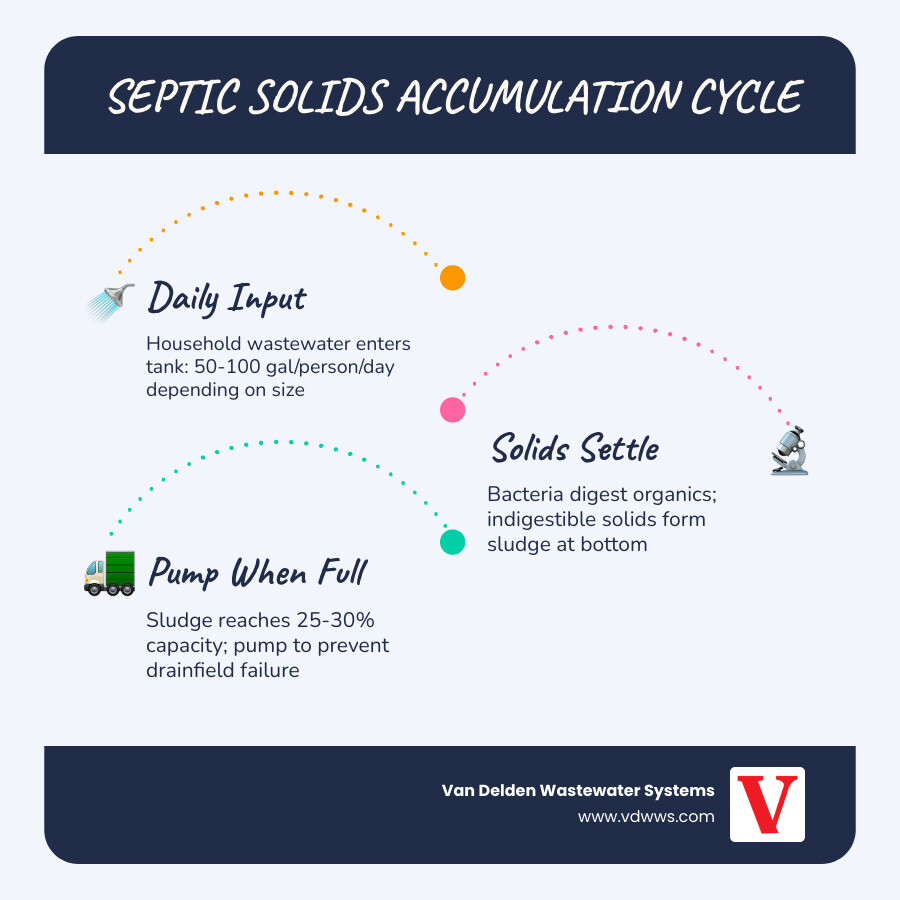
As we move through April 2026, the standards for wastewater management have become more precise than ever. We often tell our neighbors in San Antonio and Boerne that a septic tank isn't just a "waste bin" in the backyard; it is a living biological filter. Several core factors dictate how quickly that filter fills up.
First is the tank volume. A larger tank provides more surface area for solids to settle and more room for the clarified liquid (effluent) to separate from the sludge. Second is the wastewater flow. This is the total volume of water entering the system from showers, toilets, and laundry. Finally, there is the solids accumulation rate, which is the speed at which indigestible materials build up at the bottom. Understanding when is it time for septic tank pumping requires looking at these variables as a whole.
In Texas, we generally use the "Bedroom Rule" to estimate tank size. A house with three or fewer bedrooms typically has a 1,000-gallon tank, while a home with four or more bedrooms usually steps up to a 1,500 or 2,000-gallon system. However, the number of bedrooms doesn't always match the occupancy rate.
If you have a 1,000-gallon tank (our local baseline) but you have five people living in a three-bedroom house, your system is working overtime. Each person contributes roughly 50 to 70 gallons of wastewater per day. For a family of four, that is nearly 300 gallons hitting the tank every 24 hours. To stay ahead of potential clogs, following a septic tank pump out guide tailored to your specific resident count is essential.
The "Roommate Rule" is simple: the more people using the drains, the faster the solids accumulate. While a tank is always "full" of liquid, it is the buildup of the sludge layer (at the bottom) and the scum layer (at the top) that determines when you need a service.
| Number of Residents | 1,000 Gallon Tank | 1,250 Gallon Tank | 1,500 Gallon Tank |
|---|---|---|---|
| 1 | 12 Years | 16 Years | 19 Years |
| 2 | 5.9 Years | 7.5 Years | 9.1 Years |
| 3 | 3.7 Years | 4.8 Years | 5.9 Years |
| 4 | 2.6 Years | 3.4 Years | 4.2 Years |
| 5 | 2.0 Years | 2.6 Years | 3.3 Years |
| 6 | 1.5 Years | 2.0 Years | 2.6 Years |
For 1-2 residents, the system is under very light stress. A couple in a home with a 1,500-gallon tank can often go much longer than the standard "3-year rule" suggests. Conversely, a family of four or a household with several roommates will find that how often should my septic tank be cleaned becomes a question they need to answer every two to three years.
Geography matters. For our customers in Helotes, Bulverde, and Spring Branch, the regional soil often consists of heavy clay or rocky terrain. These soil types don't always absorb effluent as quickly as sandy soils might. When the ground is saturated or the soil is naturally dense, it places even more importance on keeping solids out of the drain field.
Local regulations and the specific type of system you have (conventional vs. aerobic) can also influence your schedule. We recommend professional inspections every 1 to 3 years to measure the actual sludge levels. This is the only way to truly customize the how often to pump septic tank in Helotes schedule for your specific property.
Occupancy isn't the only thing that dictates septic pumping frequency for different household sizes. Your daily habits play a massive role. Water conservation is the best friend of a healthy septic system. High-efficiency fixtures, such as low-flow toilets and front-loading washing machines, significantly reduce the "hydraulic load" on your tank.
Laundry habits are another major factor. If you do six loads of laundry on a Saturday, you risk "flushing" the tank—sending unsettled solids straight into the drain field because the water is moving through the system too fast. Spreading laundry throughout the week helps the system keep up. Understanding why should I pump my septic tank involves realizing that pumping isn't just about emptying the tank; it's about protecting your expensive drain field from these surges of waste.
The garbage disposal is perhaps the most controversial appliance in a septic-reliant home. While convenient, it sends finely ground organic waste into the tank. These food particles don't break down as easily as human waste and they increase the sludge layer by 30% to 50% faster.
If you have a family of four and use a garbage disposal regularly, your pumping interval could drop from 2.5 years down to 1.5 years. We often suggest that households with disposals pump 50% more frequently or, better yet, start a compost pile. This is one of the 3 frequently asked septic pumping questions we hear most often because homeowners are surprised by how much "invisible" waste they are adding to their systems.
Waiting for a backup to occur before calling us is a recipe for a headache. Your system will usually try to tell you it’s full before it fails completely. One of the most common signs your septic tank should be pumped is actually quite beautiful: a patch of lush, vibrant green grass over the drain field. While it looks nice, it often means the soil is being over-fertilized by wastewater that isn't being properly filtered.
Other warning signs include:
For a standard family of four with a 1,000-gallon tank, the sweet spot is every 2.5 years. This assumes average water usage (about 280 gallons per day total). If that family uses a garbage disposal or has teenagers who take long showers, that interval should be shortened. Staying on top of when to schedule septic tank pumping prevents the sludge from reaching the outlet pipe, which is where the real damage starts.
Yes, in many cases, a household of two with a 1,500-gallon tank can easily go five years. If they use low-flow fixtures and are mindful of what they flush, they might even go longer. However, the only way to know for sure is to check the sludge levels. You don't want to guess and be wrong. Learning how can I tell if my septic tank is full involves more than just looking at the calendar; it involves physical measurement.
We use a tool called a "Sludge Judge"—a clear hollow tube that we lower into the tank to take a core sample of the layers. This allows us to see exactly how many inches of scum and sludge have accumulated. The industry standard is to pump when the solids occupy 20-25% of the tank's total capacity. If the sludge is within 12 inches of the outlet or the scum is within 6 inches, it is definitely time. This measurement is the one sign its time to pump your septic system that never lies.
At Van Delden Wastewater Systems, we believe that an educated homeowner is a septic system’s best defense. Since 1937, our family has been helping residents in San Antonio, Boerne, Shavano Park, and the surrounding areas maintain their systems with honesty and transparency. We don't just pump and leave; our non-commissioned technicians take the time to document your system's health with photos and detailed service forms, ensuring you understand exactly what is happening under your lawn.
Preventive maintenance is the key to system longevity. By understanding the septic pumping frequency for different household sizes, you can avoid the stress of emergency repairs and keep your home running smoothly for decades. For more info about septic tank services or to schedule your next inspection, reach out to our team. We’re here to help you master the "Roommate Rule" and keep your septic system in peak condition.

Peter was personable, professional and thorough. Highly recommend Van Delden. You might be able to find a cheaper company but not better!
On time. 100% professional, knowledgeable, and courteous. Very helpful and straightforward. That is the bar all businesses should strive for.
It has been a pleasure working with your company. Not only did y’all communicate very well but your workers were always polite! Thank you!
“I thank Van Delden for such prompt service. Honest people are hard to come by these days. I will certainly recommend Van Delden to anyone! Jesse is an upstanding young man and very nice to talk to. I thank everyone at Van Delden for taking such good care of me.”
This is just a note to thank you for explaining the problem with my system. You didn’t have to be so kind and I appreciate your good business ethics and time spent. In the future you will have mine in return!